OpelBook.ru
Cars AvtoVAZ Cars Mitsubishi Cars BMW Cars Mercedes Cars Nissan Cars Toyota Cars Chevrolet
English Русский
Български
Беларускі
Український
Српски
Hrvatski
Română
Polski
Slovenský
Magyar
 |  Sitemap  |  Contacts  |    


Main Astra Corsa Insignia Kadett Omega Vectra Zafira Others Articles
Astra F (1991-1998, petrol) Astra G (1998-2004, petrol) Astra G (1998-2004) Astra H (2004-2009) Astra J (2009-2015, petrol)
  • Main
  • Astra
  • Astra H
  • General information
  • Maintenance
  • Checking the condition and replacing the windshield wipers

Checking the condition and replacing the windshield wipers (Opel Astra H)

            0

Contents: Checking the condition of the brushes ⬇ Replacing windshield wiper blades ⬇ Replacing the rear window wiper blade ⬇
Note: Metal reinforcing strips are installed inside the frameless flexible rubber brushes.


Checking the condition of the brushes


1. Good visibility is an important component of driving safety. The condition of the windshield wiper assemblies should be checked regularly in accordance with the vehicle's routine maintenance schedule (see Section 1). Over time, road film accumulates on the windshield wipers, reducing their efficiency, so the wipers should be washed regularly in a mild cleaning solution. It is recommended to replace the windshield wipers at least once a year.

2. Windscreen wiper assemblies with blades should be inspected regularly; if hardening or cracks are found on the rubber of the blades, replace them.

Note: Before inspecting the windshield wipers, the wiper arms must be moved to the service position (see below).


If nothing unusual is found during inspection, wet the windshield/rear window, turn on the wiper, let it run for a while, then turn it off. Uneven marks from the wiper on the glass or streaks on clean glass indicate that the blade should be replaced.

3. If the brush does not clean the glass well enough, it is possible that wax or other material particles have gotten onto the glass or the wiper blade. In this case, it is necessary to wipe the outer surface of the glass using a soft cleaning solution. You can check the cleanliness of the glass by rinsing it with clean water. Drops of water should not form on clean glass.


Note: Using a liquid with wax-dissolving properties to clean glass can significantly improve the performance of windshield wipers.


Then wipe the brush with a soft cloth soaked in the cleaning solution and rinse it with water. If the brush still does not clean the glass well enough, replace the brush (see below)

4. During operation of the windscreen wiper mechanism, the mounting nuts may become loose, so they should be checked and, if necessary, tightened each time the brushes are checked.

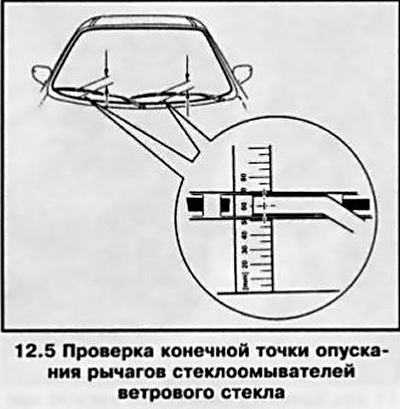
5. Check the correct position of the brushes on the glass in the parking position of the windshield wipers. To do this, measure the distance from the edge of the windshield to the middle of the wiper blade (see accompanying illustration).

5. Check the correct position of the brushes on the glass in the parking position of the windshield…


Note: The brush should not touch the glass when measuring. If necessary, adjust (see Chapter 12, Section 9).


Replacing windshield wiper blades


6. Turn off the ignition, without removing the key from the lock, press the right steering column switch (see Chapter "Controls and operating techniques", Section 17) down and hold it in this position for about 4 seconds - the windshield wiper arms will move to the vertical position. Remove the key from the ignition switch.


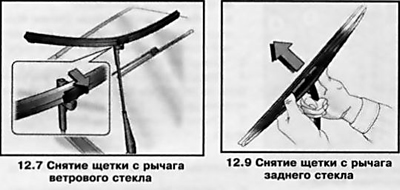
7. Turn the brush 90° and remove it from the lever (see accompanying illustration).

7. Turn the brush 90° and remove it from the lever (see accompanying illustration).


8. Installation is carried out in reverse order.

Replacing the rear window wiper blade


9. Move the wiper arm away from the glass surface, turn the blade 90° and remove it (see accompanying illustration).

10. Place the new blade on the wiper arm and snap it into the retainer clips. Check that it is securely fastened.


This article is available at russian, bulgarian, belarusian, ukrainian, serbian, croatian, romanian, polish, slovak, hungarian
Checking the article: Simonov Timofey

Share information:

Previous articles
Opel Astra H: Maintenance
Next articles

Maintenance and charging of the battery
Battery — General Information
Checking the condition of the cooling system components
Checking the condition and replacing the hoses located in the engine compartment
Draining sediment, removing air from the filter (diesel models)
Checking the condition and replacing the multi-rib drive belt of the units
Inspection of suspension and steering components, checking the condition of the drive shaft protective covers
Checking the brake system
Checking electrical equipment
Monitoring the condition of the anti-corrosion coating of the car body and underbody
Lubrication of locks, hinges and stops
Replacing the air cleaner filter element


See similar ones from other Opel car manuals:
▶ Checking the condition and replacing the windshield wipers Opel Corsa C (2000-2006)
▶ Checking the condition and replacing the windshield wipers Opel Vectra C (2002-2008)
▶ Checking the condition and replacing the windshield wipers Opel Frontera A (1991-1998, petrol)
▶ Accessory Drive Belt — Checking Condition and Replacing Opel Zafira A (1999-2005, petrol)
▶ Replacing windshield wiper blades Opel Insignia A (2008-2017)
Link to this page in different formats

Visitor comments


No comments yet


How much will 24 + 42 =


Astra J (2009-2015, petrol) 
  • General information
  • Vehicle device
  • User manual
  • Faults en route
  • Maintenance
  • Power unit
  • Engine repair
  • Cooling and lubrication system
  • Engine power system
  • Exhaust system
  • Transmission
  • Clutch
  • Car gearbox
  • Drive shafts
  • Chassis
  • Front suspension
  • Rear suspension
  • Steering
  • Brake system
  • Wheels and tires
  • Body
  • Exterior
  • Interior
  • Doors and windows
  • Body Care
  • Heating and air conditioning
  • Security systems
  • Electrical equipment
  • Equipment and devices
  • Lighting and signaling
  • Power devices
  • Electrical circuits
Astra H (2004-2009) 
  • General information
  • Introduction to the guide
  • Troubleshooting
  • User manual
  • Maintenance
  • Power unit
  • Engine repair
  • Cooling and heating
  • Power and exhaust system
  • Ignition system
  • Launch and charge system
  • Transmission
  • Mechanical gearbox
  • Automatic gearbox
  • Drive shafts
  • Chassis
  • Brake system
  • Car suspension
  • Steering
  • Body
  • Interior
  • Exterior
  • Electrical equipment
  • Equipment and devices
  • Electrical circuits
Astra G (1998-2004) 
  • General information
  • Introduction to manual
  • User manual
  • Maintenance
  • Power unit
  • SOHC gasoline engines
  • DOHC gasoline engines
  • Diesel engines 1.7 and 2.0
  • Engine repair
  • Cooling system
  • Supply system
  • Injection system (gasoline)
  • Injection system (diesel)
  • Exhaust system
  • Charge and launch system
  • Ignition system (gasoline)
  • Preheat system (diesel)
  • Transmission
  • Manual gearbox
  • Automatic gearbox
  • Clutch
  • Drive shafts
  • Chassis
  • Brake system
  • Wheel suspension
  • Steering
  • Body
  • Exterior
  • Interior
  • Doors and windows
  • Ventilation and heating
  • Electrical equipment
  • Equipment and devices
  • Electrical circuits
Astra G (1998-2004, petrol) 
  • General information
  • User manual
  • Car care
  • Maintenance
  • Power unit
  • Single shaft engines
  • Twin shaft engines
  • Engine repair
  • Cooling and heating
  • Fuel and exhaust systems
  • Starting and charging system
  • Ignition system
  • Transmission
  • Clutch
  • Mechanical gearbox
  • Automatic gearbox
  • Drive shafts
  • Chassis
  • Brake system
  • Car suspension
  • Steering
  • Body
  • Interior
  • Exterior
  • Electrical equipment
  • Equipment and devices
  • Wiring diagrams Opel Astra
  • Wiring diagrams Opel Zafira
Astra F (1991-1998, petrol) 
  • General information
  • Maintenance
  • Power unit
  • Engine in car
  • Engine removed
  • Cooling system
  • Heating and ventilation
  • Fuel supply (carburetor)
  • Fuel supply (injector)
  • Emission control
  • Ignition system
  • Transmission
  • Clutch
  • Mechanical gearbox
  • Automatic gearbox
  • Drive shafts
  • Chassis
  • Brake system
  • Car suspension
  • Steering
  • Body
  • Exterior
  • Interior
  • Electrical equipment
  • Equipment and devices
  • Electrical circuits
OpelBook.ru © 2017–2026 · Mobile version · · Sitemap: EN BG BY UA RS HR RO PL SK HU · Feedback · Site search
Astra F, petrol · Astra G, petrol · Astra G · Astra H · Astra J, petrol · Corsa B · Corsa C, petrol · Corsa C · Insignia A · Kadett D · Kadett E · Omega A · Omega B · Omega B2 · Vectra A, petrol · Vectra A · Vectra B, petrol · Vectra B · Vectra C · Zafira A, petrol · Frontera A, petrol · Frontera B · Ascona C · Vivaro A ·
We want your visit to be comfortable 🤝! We use cookies 🍪 to make that happen.