


General information
1. The exhaust system of all models under consideration consists of three sections: intake, middle (intermediate) and rear. The main elements of the system are: the inlet pipe, the catalytic converter, the mufflers (central and additional), connecting tubular sections, mounting clamps, as well as support brackets and rubber loops by means of which the exhaust assembly is suspended from the underbody of the vehicle (see accompanying illustrations). The system sections are connected to each other by means of two clamp connections. The joint of the middle and rear sections of the system is spring-loaded, which allows for compensation of the play that occurs during the movement of the car; in order to reduce the vibration level, a flexible insert is usually included in the receiving section of the system. Incorrect installation of the components and sections of the system leads to an increase in the level of noise and vibration transmitted to the car body.

21.1a Components of the exhaust system of Z16XE/Z18XE engines: 1. Flexible section of the inlet pipe; 2. Lambda probe; 3. Intake pipe; 4, 6. Exhaust tract connection points; 5. Central muffler; 7. Additional muffler; 8. Exhaust pipe
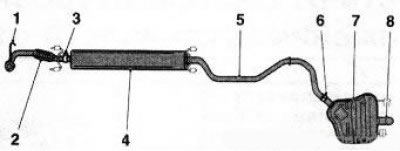
21.1b Z22SE engine exhaust system components: 1. Lambda probe; 2. Flexible section of the inlet pipe; 3, 6. Exhaust tract connection points; 4. Central muffler; 5. Middle section of the exhaust tract; 7. Additional muffler; 8. Exhaust pipe
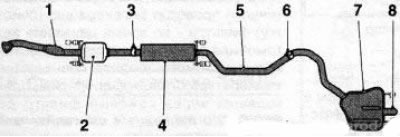
21.1c Components of the exhaust system of Y20DTH/Y22DTR engines: 1. Flexible section of the inlet pipe; 2. Pre-muffler; 3, 6. Exhaust tract connection points; 4. Central muffler; 5. Middle section of the exhaust tract; 7. Additional muffler; 8. Exhaust pipe
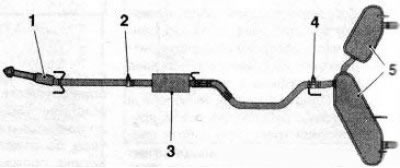
21.1d Components of the Z22YH engine exhaust system: 1. Flexible section of the inlet pipe; 2, 4. Exhaust tract connection points; 3. Central muffler; 5. Additional muffler (consists of two parts)
2. Regularly inspect the entire system for signs of corrosion, deformation and mechanical damage. Check the reliability of fastener tightening. A breach of the tightness of the components and their joints is fraught with the ingress of exhaust gases into the car interior, and also leads to difficulty starting the engine and uneven operation at idle speed and during acceleration.
3. To check the exhaust system for leaks, start the engine and plug the exhaust pipe with a rag. Identify the damaged areas, for which you can use a special spray. Apply the composition evenly to the exhaust system components - the composition will start to bubble in areas where the leaks are broken. Defective components and sections must be replaced.
4. When working with the exhaust system, the following instructions must be followed:
- a) Pre-lubricate the fasteners to be released with penetrating oil or other rust-dissolving substance.
Note: If the system is severely damaged by corrosion, a gas cutter may be required to undock its sections (alternatively, you can use a metal hacksaw or a pneumatic chisel - do not forget to wear protective glasses and gloves;
- b) Prepare the necessary replacement gaskets, hanging loops, clamps and fasteners in advance; when removing, all seals and fastening elements must be replaced;
- c) The sealing surfaces of the parts to be re-installed should be cleaned with a wire brush or sandpaper. Before installation, lubricate the threaded part of the fastener with anti-seize sealant;
- d) When installing components, ensure that there is sufficient clearance between the system sections and adjacent suspension/body components. Pay particular attention to the correct installation and secure fastening of heat shields (with appropriate equipment).
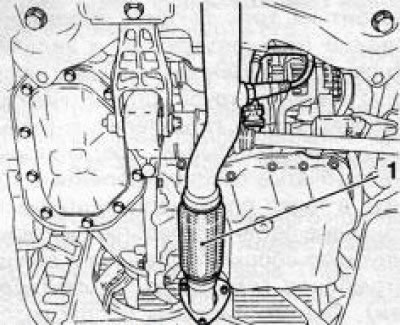
21.5 Flexible section of the outlet pipe
5. When removing or disconnecting the intake pipe, do not allow it to hang on the flexible section of the pipe (see accompanying illustration). Bending the flexible section at an angle of 5-10° and twisting at an angle of ±0.5° can lead to its damage and failure. For this reason, when performing corresponding work, the intake pipe should be secured with wire to rigid elements of the bottom; if necessary, use the help of an assistant.
Visitor comments