


Start the engine, warm it up to an oil temperature of 70°C and turn it off.
Turn off all energy consumers, such as the radio, lighting, etc.
Make sure that the octane number set by the coding connector matches the octane number of the fuel poured into the tank.
Check the condition of the air filter element.
Check the accelerator cable adjustment.
Connect the tachometer and gas analyzer.
Disconnect the crankcase ventilation hose from the camshaft housing.
Start the engine.
Check the intake tract for leaks. To do this, apply a brush soaked in gasoline to all joints. If the engine speed temporarily increases, this means that the engine is sucking in air in this area. Eliminate leaks.
Warning! Gasoline vapors are toxic! Ensure good ventilation of the workplace.
Warning! Do not allow open flames or sparks near the work area. There is a risk of fire!
Check the idle speed. It should be within 770-780 rpm.
If the number of revolutions is outside the specified limits, look for the fault according to the fault table.
Check the CO content. It should be no more than 0.2%.
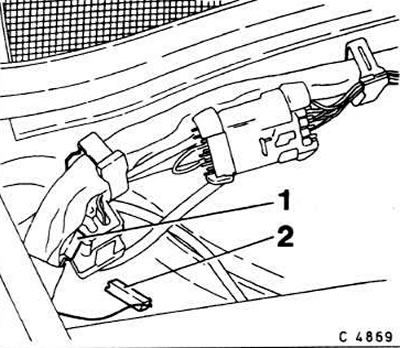
Attention! If it is technically impossible to measure the specified CO content, connect connectors 1 and 2 behind the right shock absorber strut (see fig.). Connector 1 is connected to a black and white wire (terminal 10), and connector 2 to a brown wire ("ground"). As a result of this connection, the throttle and air valves take a position in which the CO content increases to 1.0-2.0%. The idle speed is 700-1100 rpm.
If you detect a deviation of the CO content from the specified value, remove the seal of the CO content adjustment screw. To do this, drill a hole in the seal and screw a screw into it and pull out the seal. If necessary, remove the air filter and then reinstall it.
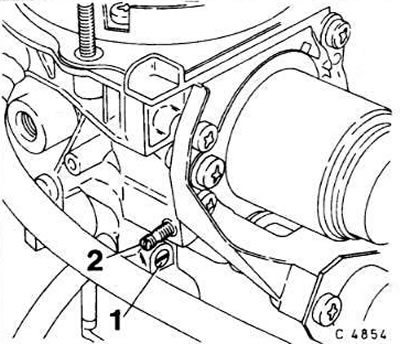
Adjust the CO content by turning the adjusting screw. It should be 0.1-0.3% without the above-described connection of the connectors, and 1.0-2.0% with the connection.
Install a new seal on the adjustment screw.
Disconnect the tachometer and gas analyzer.
Disconnect the connected connectors.
Connect the crankcase ventilation hose.
Visitor comments