


Contents: Transportation of infants and small…⬇ Transporting big children ⬇ Three-point seat belts ⬇
If you are wearing a seat belt that is properly adjusted and are positioned correctly and securely in the seat with your back firmly against the seatback, the risk of injury and/or serious injury is greatly reduced.
If your vehicle is equipped with the Supplemental Restraint System (SRS), the front seats are equipped with seat belts with a pre-tensioning mechanism. The use of these belts is similar to the use of regular seat belts.
The rules require the mandatory use of seat belts in all seats while the vehicle is moving.
Warnings:
- The maximum protective effect of seat belts and airbags is achieved only if the seats are adjusted correctly. Adjust the seat back to the position closest to vertical and sit up straight with your back pressed firmly against the seat back. Every passenger riding in a vehicle must wear a seat belt at all times. Children must be seated in the rear seat and, if necessary, in an additional child seat.
- Never use one belt to secure two people (including children). It is especially dangerous to fasten a child when he or she is sitting on your lap.
- Never carry more people in a vehicle than there are seat belts. The seat belt must be properly adjusted. Failure to do so reduces the effectiveness of the overall safety system and increases the risk of serious injury in the event of an accident.
- The waistband of the belt should always fit snugly across the hips, not across the stomach. A belt that is positioned too high increases the risk of internal organ damage in the event of an accident.
- The diagonal portion of the seat belt webbing should pass approximately through the middle of the shoulder and should never go around the neck. The belt should fit snugly against the chest.
Transportation of infants and small children
Opel recommends that infants and small children be transported in child seats that meet safety requirements. It is important to select a child seat that can be installed in your vehicle and always follow the manufacturer's instructions for installation and use.
Transporting big children
Children who are too big for child seats should be secured with the vehicle's equipped seat belts.
If the shoulder belt is too close to the face and neck, you will need to use a booster seat cushion that will allow the child to sit higher, causing the shoulder belt to pass through the middle of the shoulder and the lap belt to be positioned across the hips. The booster seat must be suitable for the vehicle and meet safety requirements. Once your child has grown, you can remove the extra seat cushion.
Three-point seat belts
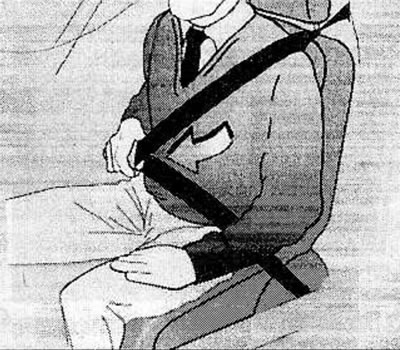
This type of belt does not require length adjustment. Once such a belt is put on, it automatically follows the movements of your body, but in the event of a sudden or strong jerk, the belt automatically locks to hold the person fastened with it.
In the event of sudden braking or an accident, the seat belt instantly locks. The ability of the belt to lock cannot be tested by quickly moving the upper body forward.
Visitor comments