


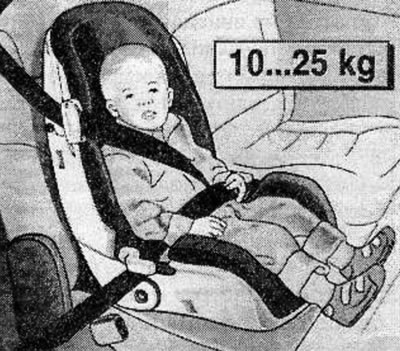
Experience shows that the safest way to transport children is in the back seat in an additionally installed child seat.
For effective protection in the event of a crash or sudden stop, the child must be properly restrained with a seat belt or child seat, depending on the age and size of the child. Carrying a child in your arms is not an adequate substitute for a child seat. Infants and small children should not be carried on the lap or in the arms, as even a strong person will not be able to resist the inertial forces that arise during an accident or sudden braking of the car. In this case, the child may be trapped between an adult passenger and the interior elements of the vehicle.
Warnings: When installing a child seat, follow the seat manufacturer's recommendations. Securely fasten the child seat in the rear seat of the vehicle using the seat belt or anchor.
A child seat that is not installed properly could cause serious injury in the event of an accident.
If the vehicle is equipped with a front passenger airbag, never place a child safety seat on the front passenger's seat where the child is positioned with his or her back facing the vehicle.
Warning: If necessary, properly install a forward-facing child seat in the front passenger seat by moving the front seat as far back as possible. Otherwise, in the event of an accident, the airbag deploying with great force could injure the child.
Visitor comments