


Contents: Drive Mode Selector Lever Position…⬇ Sports mode switch ⬇ Winter mode switch ⬇ Switch for the "kickdown" function ⬇ Electromagnetic unit of the drive…⬇ Ignition Key Release Switch ⬇ Electronic Control Unit (ECU) ⬇ Transmission Output Shaft Speed…⬇ Transmission electromagnetic valves ⬇
Drive Mode Selector Lever Position Sensor
1. The sensor is a multi-function switch that functions as a reversing light switch and starter interlock switch, and also controls the illumination of the mode selector lever panel. If the mode selector panel illumination or reversing lights do not work properly, or the engine starts in positions other than P and N, the sensor is probably faulty. If the malfunction cannot be corrected by adjustment, replace the sensor assembly.
Removal
2. Place the drive mode selector lever in position N. Apply the handbrake, then jack up the rear of the vehicle and support it on axle stands.
3. Loosen and remove the bolts securing the front section of the exhaust pipe/catalytic converter to the intermediate section of the system (see the relevant section), and separate the flange connection; on 6-cylinder models, disconnect both the left and right connections. Unclip the insulation from the underbody to gain access to the driveshaft center bearing.
4. Loosen and remove the two bolts securing the propeller shaft center bearing bracket to the vehicle body (see Section 8). Remove the washers (where is available), located between the body and the bracket.
5. Trace the wiring from the sensor and disconnect it from the connector. Unfasten the connector from the wall of the transmission case so that it can be removed together with the sensor. If the connector mounting bracket breaks during removal, purchase a new one.
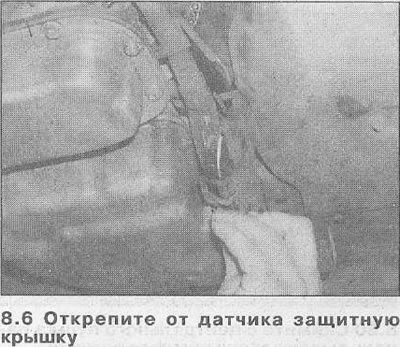
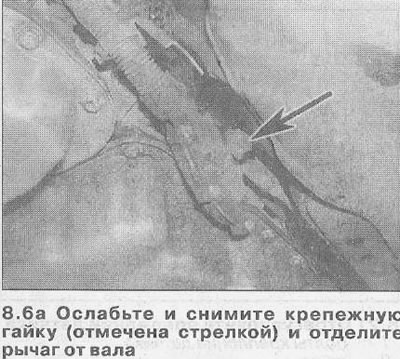
6. Remove the protective cover from the sensor, then unscrew the mounting nut and separate the operating lever from the transmission shaft (see illustrations).
7. Support the transmission with a jack using a piece of wood between the jacks and raise the jack to support the weight of the transmission.
8. Loosen and remove the bolts securing the transmission unit rear suspension crossmember to the vehicle body.
9. Lower the transmission slightly to gain access to the sensor mounting bolts. Be careful not to put too much stress on the driveshaft or engine components, and have an assistant check to see if anything is pinched between the rear of the engine and the bulkhead.
Attention! On 4-cylinder engines with a single overhead camshaft (SOHC), the ignition control module assembly may need to be removed to obtain the required clearance (see the relevant section).
10. Loosen and remove the mounting bolts and remove the sensor from the drive shaft. Inspect the drive shaft seal for leaks and replace it if necessary (see Chapter 6).
(Source is on the website opelbook.ru)
Installation
11. Before installing, make sure that the drive shaft is still in the neutral position (N). If there is any doubt about this, connect the operating lever to the shaft and move the lever back as far as it will go (position P), and then move it forward two notches.
12. If a new sensor is being installed, place it on the roller, then insert the mounting bolts and tighten them to the torque specified in the Specifications. Note that the sensor position has already been adjusted by the sensor manufacturer. The sensor is held in position by a seal that will be destroyed by the first movement of the lever.
13. If the old sensor is being installed, place it on the roller, then install the mounting bolts. Adjust the sensor position as described in step 21, then tighten the mounting bolts to the specified tightening torque Specifications.
14. Connect the transmission operating lever to the drive shaft, then install the mounting nut. Tighten the nut to the specified tightening torque Specifications, then attach the protective cover with staples.
15. Connect the wiring connector, then secure it to the transmission unit with staples and lift the unit into position.
16. Remove all traces of blocking compound from the threads of the bolts securing the rear transmission suspension crossmember to the body. Apply a few drops of blocking compound (Opel recommends using composition 1510181) on the threads of each bolt, then install the bolts and tighten them to the specified tightening torque Specifications.
17. Align the bracket of the central bearing of the cardan shaft with the place of its attachment on the body, placing all the necessary washers under it (where are there). Install the bracket mounting bolts and tighten them to the specified tightening torque Specifications.
18. Install thermal insulation and restore the flange connection of the exhaust system (see the relevant section), then lower the car to the ground.
Adjustment
Caution! Before adjusting the position of the sensor, check the adjustment of the mode switching rod (see Chapter 3). You will need a short metal rod with a diameter of 2.0-2.3 mm.
19. Place the drive mode selector lever in position N. Apply the handbrake, then jack up the rear of the vehicle and support it on axle stands.
20. Remove the protective cover from the sensor, then unscrew the mounting nut and separate the lever from the transmission shaft.
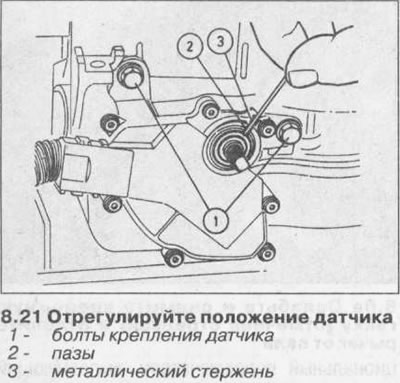
21. When the transmission is in neutral, the groove on the sensor should be aligned with the groove on its inner ring. Check this by inserting a metal rod (see illustration). If adjustment is necessary, loosen the sensor mounting bolts and turn it in the desired direction, then retighten the bolts.
22. Connect the operating lever to the shaft and tighten the fastening nut with the specified tightening force Specifications.
23. Attach the sensor protective cover with staples, then lower the vehicle to the ground.
Sports mode switch
Attention! You will need a soldering iron and solder.
Removal
24. Remove the protective cover of the drive mode selection lever from the central console.
25. Push the switch out of the upper end of the lever by inserting a suitable metal rod into its hole.
26. Apply identification marks to the switch terminals and wires, then carefully unsolder the wires and remove the switch.
Installation
27. Solder the wires to the switch terminals using the marks made before removal.
28. Push the switch into the working position, then attach the lever protective cover with staples.
Winter mode switch
Removal
29. Remove the protective cover of the drive mode selection lever from the central console.
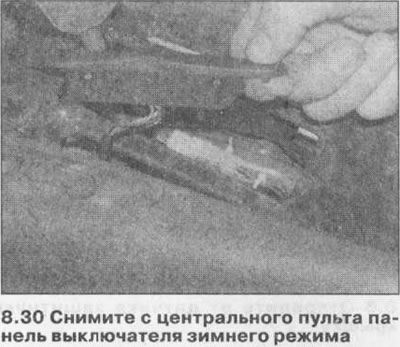
30. Push the switch panel located behind the central console out of the operating position. Disconnect the wiring connector once it is accessible (see illustration). Separate the switch and the panel.
Installation
31. Perform installation in reverse order.
Switch for the "kickdown" function
32. The kickdown switch is built into the gas pedal cable and cannot be removed or replaced separately. Removal and installation of the cable are described in Section 4A. Drive mode selector lever latch switch
Caution: Use new switch mounting brackets when installing.
Removal
33. Remove the central console (see the relevant section), then move the drive mode selector lever to position P.
34. Loosen and remove the mounting nuts and bolt, then remove the front and rear brackets of the rear heating/ventilation duct. Unclip the duct and move it away from the drive mode selector lever.
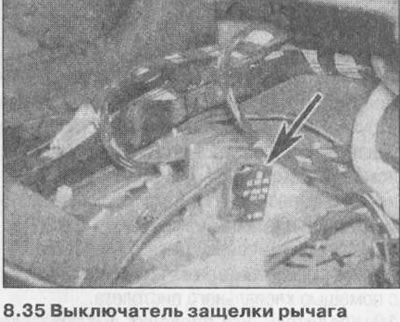
35. Disconnect the wiring connectors, then press the retaining clips and remove the switch from the lever mounting plate (see illustration).
Installation
36. Reinstall in reverse order using new brackets.
Electromagnetic unit of the drive mode selection lever latch
Removal
37. Remove the drive mode selector lever as described in Chapter 5 (see illustration).
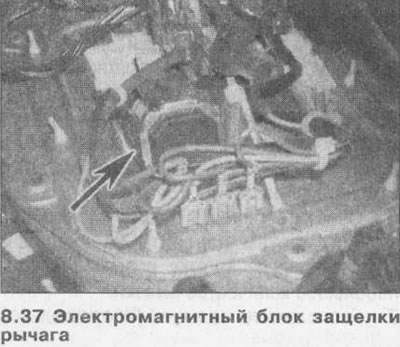
38. Disconnect the solenoid unit ground strap from the lever mounting plate and carefully separate the unit wiring from the main connector.
39. Loosen the mounting screws and remove the unit from the mounting plate.
Installation
40. Install in reverse order. Make sure the electromagnetic unit is properly engaged with the latch.
Ignition Key Release Switch
Caution: Use new switch mounting brackets when installing.
Removal
41. Perform the actions described in points 33 and 34.
42. Disconnect the main connector of the drive mode selector lever wiring, then carefully separate the ignition key release switch wiring from the rear of the lever. Disconnect the switch ground strap from the lever mounting plate.
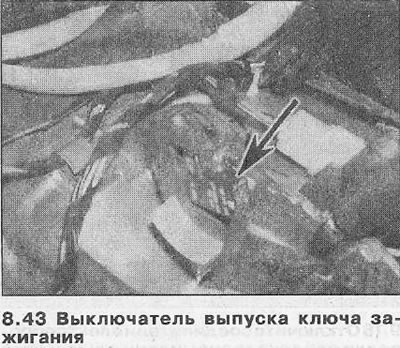
43. Release the retaining clips and remove the switch from the vehicle (see illustration).
Installation
44. Reinstall in reverse order using new mounting brackets.
Electronic Control Unit (ECU)
Removal
45. Disconnect the negative cable from the battery.
46. The ECU is located behind the dashboard on the right.
47. Remove the glove compartment (see the relevant section).
48. Remove the nuts securing the ECU to the strut, then carefully lower the ECU from its operating position. Release the retaining clip and disconnect the wiring connector, then remove the ECU from the vehicle.
Installation
49. Install in reverse order. If a new ECU needs to be installed, have your Opel dealer code the unit to match your vehicle's engine type.
Transmission Output Shaft Speed Sensor
Removal
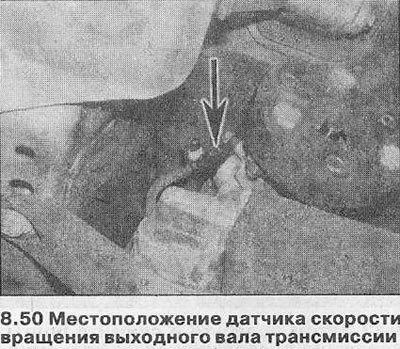
50. The output shaft speed sensor is installed at the rear of the transmission, above and to the left of the propeller shaft flange (see illustration).
51. To access the sensor, apply the handbrake, then jack up the front of the vehicle and support it on axle stands.
52. Disconnect the wiring connector and wipe the area around the sensor.
53. Unscrew the mounting bolt and remove the sensor from the transmission. Remove the sensor O-ring - it is subject to replacement.
Installation
54. Install a new O-ring into the sensor groove and lubricate it with transmission fluid.
55. Place the sensor in the working position, then install the mounting bolt and tighten it to the tightening torque specified in the Specifications. Connect the wiring connector, then lower the vehicle to the ground.
Transmission electromagnetic valves
56. Removal and installation of valves must be entrusted to an Opel dealer.
Visitor comments