


Contents: Separate service for anti-corrosion…⬇ Checking and topping up liquids ⬇ Motor oil ⬇ Engine oil level, engine oil…⬇ Checking the engine oil level,…⬇ Oil and oil filter change ⬇ Diesel fuel filter ⬇ Coolant ⬇ Frost protection and anti-corrosion…⬇ Coolant level ⬇ Coolant temperature ⬇ Brake fluid ⬇ Windscreen wipers ⬇ Replacing the windshield wiper blade ⬇ Replacing the rear window wiper blade ⬇ Glass washing device, headlight…⬇ Battery ⬇
For safe operation of the vehicle and road traffic, as well as maintaining the good condition of the vehicle, it is important to carry out maintenance work at the intervals specified by Opel.
The frequency of oil changes and maintenance is set flexibly based on many parameters and operating conditions. For this purpose, various engine characteristics are constantly determined and the remaining vehicle mileage until the next maintenance is calculated.
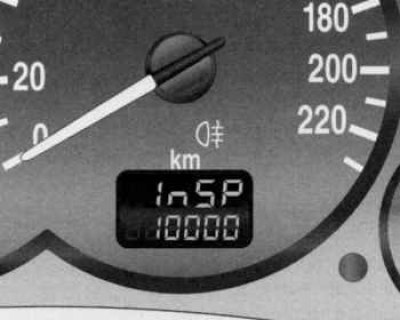
The remaining mileage of the car can be viewed on the speedometer indicator with the ignition off and the mileage indicator off. Press and hold the mileage counter setting button for about 2 seconds, and the inscription "InsP" and the remaining mileage of the car will be displayed.
When the remaining mileage is less than 1,500 km, after turning the ignition on and off, the display will show "InsP" with a remaining mileage of 1,000 km. When the remaining mileage is less than 500 km, the "InsP" message will appear for a few seconds: scheduled maintenance work should be performed within one week or 500 km. To avoid losing the warranty, contact a service station.
Periods of inactivity during which the vehicle battery terminals are disconnected are taken into account by the service interval indication.
Further information on maintenance and the inspection system can be found in the service booklet, which is located in the front glove compartment.
Maintenance work, as well as repair work on the body and units, must be carried out only by qualified personnel.
Separate service for anti-corrosion protection
Should be performed annually, as part of the annual technical inspection or separately, see service booklet, to avoid the possibility of losing the anti-corrosion protection warranty.
Note: To avoid injury from live ignition cables and rotating parts, all inspections in the engine compartment (for example, checking the level of brake fluid or engine oil) should only be performed with the ignition off.
Since the cooling fan is controlled by a thermostat, it may turn on even when the ignition is off, which may result in injury.
Electronic ignition systems operate with very high discharge power.
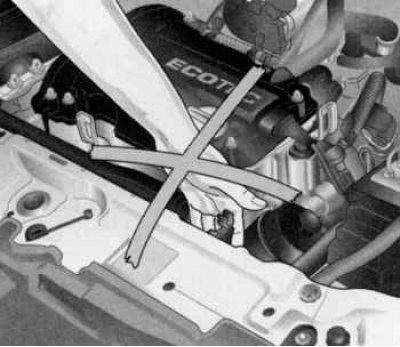
It is not recommended to carry out any repair, adjustment or maintenance work on the vehicle yourself. This especially applies to work on the engine and chassis, as well as on safety system components. Due to ignorance, you can violate legal requirements and, through incompetent actions, bring danger to yourself and others.
Checking and topping up liquids
To make it easier to find, the filler caps for engine oil, coolant, washing liquid, as well as the oil dipstick handle are painted yellow.
Motor oil
Information on engine oils is provided in the service booklet.
Engine oil level, engine oil consumption
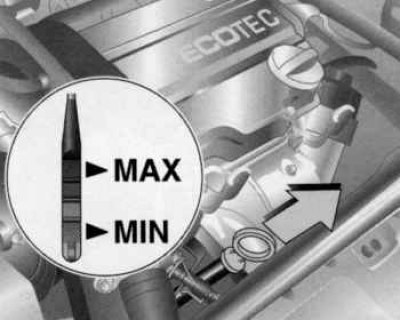
For technical reasons, each engine consumes oil. Oil consumption can only be estimated after a sufficiently large mileage, and in the initial period (at the running-in stage) the consumption level may exceed the value specified in the documentation. Frequent driving at high engine speeds leads to increased oil consumption.
On vehicles with an engine oil level monitoring system, the oil level is monitored automatically. It is recommended to check the oil level before a long trip.
Checking the engine oil level, topping up engine oil
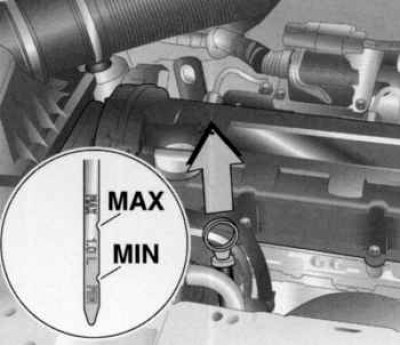
The figures show how to check and top up oil for various carburetor and diesel engines.
Check only when the car is parked horizontally and the engine is turned off and warmed up. Before checking, wait at least 5 minutes for the oil in the manifold to drain into the oil bath.
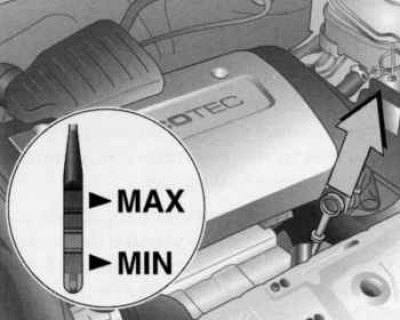
To check the oil level, insert the wiped oil dipstick to the stop surface on the handle. Top up if the oil level has dropped to the "MIN" refill mark.
The oil level should not exceed the upper mark "MAX" of the oil level gauge. Excessive oil must be drained or pumped out. If the oil level exceeds the mark "MAX", there is a risk of damage to the engine or catalytic converter.
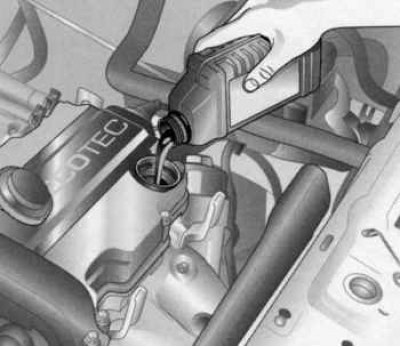
You should top up with oil of the same brand that was used during the previous oil change, following the instructions given in the service booklet.
Oil and oil filter change
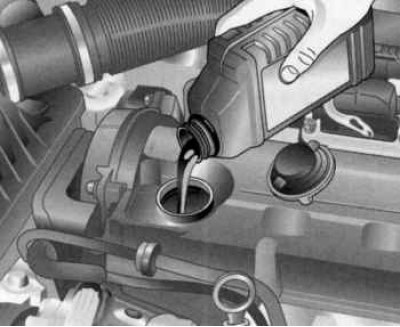
Change the oil according to the service interval indication.
It is recommended to use the original Opel oil filter.
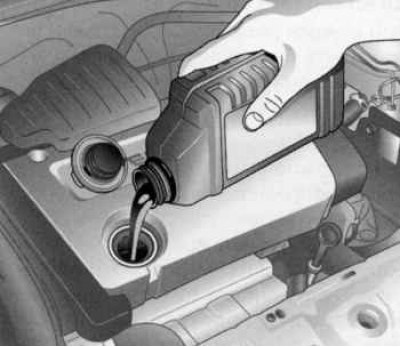
Do not dispose of used oil filters and empty oil cans in household waste. It is recommended to have the oil and oil filter changed by an Opel partner.
Diesel fuel filter
Every time you change your engine oil, check the fuel filter for possible water residue.
Under difficult operating conditions, for example, in high humidity (mainly on the coast), very high or low outside temperatures, or when there are large temperature differences between day and night, the filter should be checked at shorter intervals.
Coolant
During operation, the system is under increased pressure. Therefore, the temperature may briefly rise above 100°C.
Glycol-based coolant provides excellent corrosion protection for cooling and heating systems, as well as freeze protection down to -28°C. It remains in the cooling system all year round and does not require replacement.
There are antifreezes, the use of which can lead to engine damage. Therefore, it is recommended to use antifreeze approved by Opel when necessary.
Warning! Antifreeze is harmful to health, so store it only in its original packaging and keep it away from children.
Frost protection and anti-corrosion protection
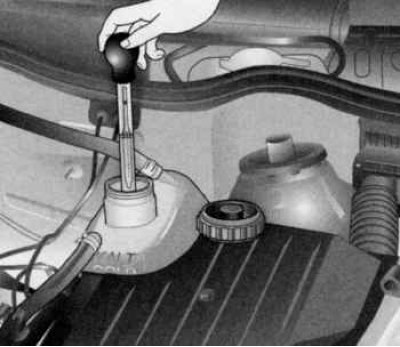
Before the winter period begins, check the concentration of the coolant. The antifreeze content in the radiator should provide protection against freezing down to approximately -28°C. Too low a concentration of antifreeze worsens the protection against freezing and corrosion. Add antifreeze if necessary.
If coolant is lost, top up with water, check the antifreeze concentration and add antifreeze if necessary.
Coolant level
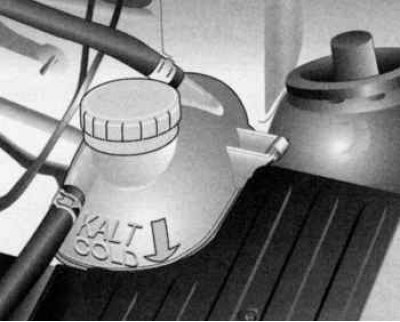
With a closed cooling system, losses are virtually non-existent. Therefore, topping up the coolant is rarely necessary.
The coolant level in the expansion tank when the cooling system is cold should be slightly above the "KALT/COLD" mark. When the engine is warmed up to operating temperature, the level rises, and when it cools down, it decreases again. If it falls below the mark, you should add coolant slightly above it.
Allow the engine to cool before opening the cap. Open the cap carefully to allow excess pressure to slowly drop, otherwise there is a risk of burns.
Add antifreeze. If there is no antifreeze, add clean drinking water or distilled water as a substitute.
After filling with drinking or distilled water, check the concentration of antifreeze and add antifreeze if necessary. Eliminate the cause of the loss of coolant.
When closing, screw the cap all the way in.
Coolant temperature
For physical reasons, the coolant temperature indication is only performed when the coolant level is sufficient.
During operation, the system is under increased pressure. Therefore, the temperature can rise above 100°C.
If the temperature indicator is in the red zone, check the coolant level immediately.
If the coolant level is too low: Add coolant.
If the coolant level is normal: eliminate the cause of the temperature increase. Contact a service station for assistance.
Brake fluid
Brake fluid is hygroscopic, i.e. it absorbs moisture. Due to strong heating during braking, for example, on a long descent, steam bubbles may form, which can significantly (depending on water content) reduce braking performance.
Therefore, the replacement intervals specified in the service booklet must be observed.
Windscreen wipers
Check the efficiency of your windshield wipers and headlight washer regularly. It is recommended to replace your windshield wipers at least once a year.
If the glass is dirty, use the windshield washer before turning on the windshield wipers or the automatic windshield wiper control with rain sensor to prevent wear on the windshield wiper blades.
Do not operate the windshield wipers or the automatic windshield wiper control with a rain sensor when the glass is icy, as this may damage the wipers or the control system.
It is recommended to separate frozen windshield wipers using a de-icing spray.
Dirty brushes can be cleaned with a soft cloth using detergent and antifreeze.
Windscreen wipers with hardened, cracked or silicone-coated blades should be replaced. This may be necessary after damage due to ice, salt, heat or improper use of care products.
Windscreen wipers or automatic windscreen wiper control with rain sensor in car washes must be switched off.
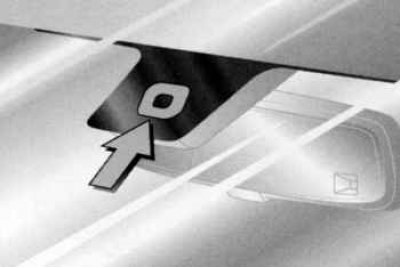
To ensure trouble-free operation of the rain sensor, the sensor window must be free of dust, dirt and ice, which is done by periodically turning on the glass washer or removing ice from the sensor window. Cars with a rain sensor are distinguished by the sensor window on top of the windshield.
Replacing the windshield wiper blade
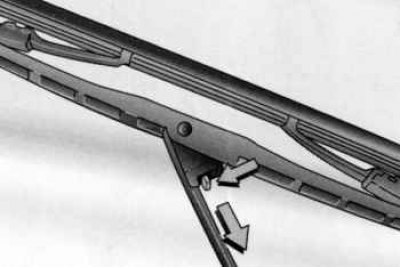
Lift the wiper arm. Lock the lever and separate the wiper blade.
Replacing the rear window wiper blade
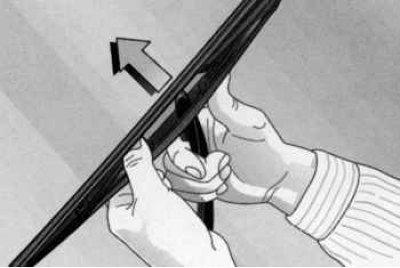
Lift the wiper arm. Secure and remove the wiper as shown in the figure.
Glass washing device, headlight washing device
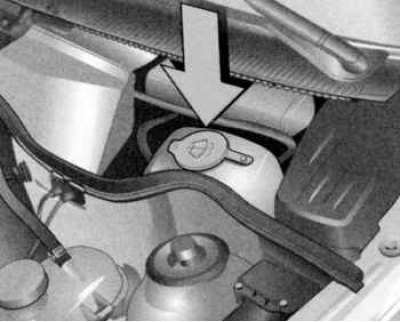
The reservoir for the windshield washer and rear window washer is located in the engine compartment on the driver's side.
On vehicles with a headlight washer system, the filler neck is located in the engine compartment behind the right headlight.
Fill only with clean water to avoid clogging the nozzles. To increase cleaning efficiency, it is recommended to add a small amount of detergent and antifreeze.
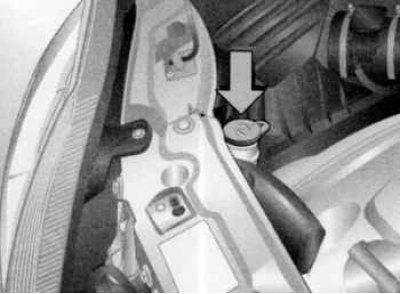
When closing the tank, press firmly around the edges of the lid.
Battery
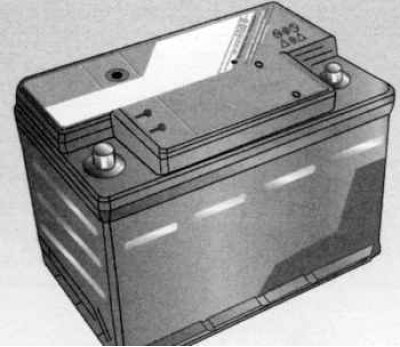
The battery does not require maintenance.
The installation of additional electrical and electronic equipment may increase the load on the battery, which will discharge faster. It is recommended to consult with your Opel partner regarding technical possibilities, such as installing a battery with a higher capacity.
Visitor comments