


Contents: Voltage ⬇ Frequency ⬇
Note: The material below is descriptive only and is not tied to any specific make or model of car. The rules for using the oscilloscope are described in detail in the operating instructions.
1. Digital multimeters are great for testing static electrical circuits and for recording slow changes in monitored parameters. When performing dynamic tests on a running engine and when identifying the causes of sporadic failures, an oscilloscope becomes an absolutely indispensable tool.
2. Modern oscilloscopes are usually equipped with only two signal wires, along with a set of various probes, allowing you to connect the device to almost any device.
3. Some oscilloscopes allow you to save oscillograms in a built-in memory module with subsequent printing of the results or transferring them to a personal computer drive in stationary conditions.
4. The oscilloscope allows you to observe periodic signals and measure voltage, frequency, width (duration) rectangular pulses, as well as slowly changing voltage levels. The oscilloscope can be used to perform the following procedures:
- a) Detection of unstable failures;
- b) Checking the results of the corrections made;
- c) Monitoring the activity of the lambda probe of the engine control system equipped with a catalytic converter;
- d) Analysis of signals generated by the lambda probe, the deviation of parameters of which from the norm is an unconditional evidence of a malfunction of the control system as a whole. On the other hand, the correctness of the form of pulses generated by the sensor can serve as a reliable guarantee of the absence of malfunctions in the control system.
5. Reliability and ease of use of modern oscilloscopes do not require any special knowledge or experience from the operator. As a rule, the characteristics of a faulty device differ greatly from the reference ones, which allows the operator to easily and quickly identify the failed component when analyzing the corresponding oscillogram. Interpretation of the information obtained can be done by an elementary visual comparison of the oscillograms taken during the test with the time dependencies typical for various sensors and actuators of automobile control systems.
6. The shape of the signal output by the oscilloscope depends on many different factors and can change significantly. Therefore, before replacing the suspected component in case of a discrepancy between the shape of the removed diagnostic signal and the reference oscillogram, you should carefully analyze the result obtained.
7. Below is a description of some signal parameters and their brief characteristics.
8. Each signal recorded by an oscilloscope can be described using the following basic parameters: (see accompanying illustration):
- a) Amplitude: The difference between the maximum and minimum voltages (V) of the signal within the period;
- b) Period: Duration of signal cycle (ms);
- c) Frequency: Number of cycles per second (Hz);
- d) Width: Duration of the rectangular pulse (ms, μs);
- e) Duty cycle: The ratio of the repetition period to the width (In foreign terminology, the inverse of the duty cycle is used, called the working cycle, expressed in %);
- f) Signal shape: Rectangular pulse train, spike, sine wave, sawtooth pulse, etc.
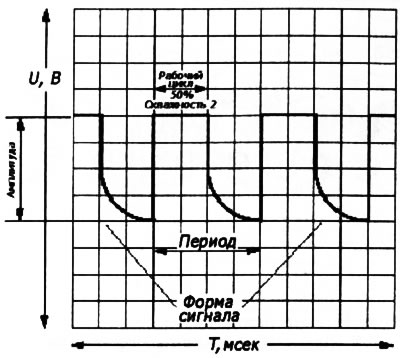
4.8. Characteristics of an arbitrary periodic signal
Voltage
9. The zero level of the reference signal cannot be considered as an absolute reference value - the "zero" of the real signal, depending on the specific parameters of the circuit being tested, may be shifted relative to the reference [1] (see accompanying illustration) within a certain acceptable range.
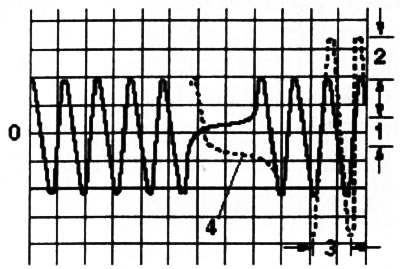
4.9 Digital signal
10. The full amplitude of the signal depends on the supply voltage of the circuit being tested and can also vary within certain limits relative to the reference value ([3] - see Illustration 4.9 and [2] - see Illustration 4.18).
11. In DC circuits, the signal voltage limits correspond to the supply voltage. An example is the Idle Speed Control (IAC) circuit, the signal voltage of which does not change at all with changes in engine speed.
12. In alternating current circuits, the signal amplitude already clearly depends on the frequency of the signal source, so the amplitude of the signal generated by the crankshaft position sensor (CSP) will increase with increasing engine speed.
Material was taken from a resource: www.OpelBook.ru
13. In view of the above, if the amplitude of the signal recorded using the oscilloscope is excessively low or high (up to the cutting of the upper levels), it is enough to simply switch the operating range of the device by moving to the corresponding measurement scale.
14. When checking the equipment of electromagnetically controlled circuits (e.g. IAC system) when the power supply is disconnected, voltage surges may be observed ([4] - see Figure 4.9), which can be safely ignored when analyzing the measurement results.
15. You should also not worry if such oscillogram deformations appear as a flattening of the lower part of the leading edge of rectangular pulses ([5] - see illustration 4.9), unless, of course, the very fact of the flattening of the front is a sign of a malfunction of the component being tested.
Frequency
16. The repetition frequency of signal pulses depends on the operating frequency of the signal source.
17. The shape of the signal being recorded can be edited and brought to a form convenient for analysis by switching the image time base scale on the oscilloscope.
18. When observing signals in AC circuits, the time base of the oscilloscope depends on the frequency of the signal source [3] (see accompanying illustration), determined by engine speed.
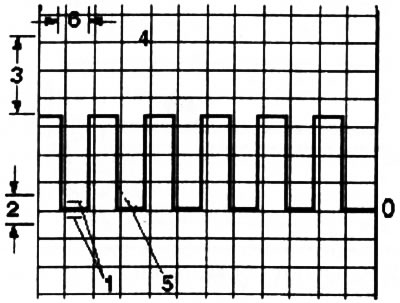
4.18. Analog signal
19. As mentioned above, to make the signal easier to read, it is enough to switch the time base scale of the oscilloscope.
20. In some cases, the signal oscillogram turns out to be mirrored relative to the reference dependence, which is explained by the reversibility of the connection polarity of the corresponding element and, in the absence of a prohibition on changing the connection polarity, can be ignored during analysis.
Visitor comments