


Contents: Keys ⬇ Unlocking and locking doors with a…⬇ Locking doors from the inside ⬇ Additional locking of rear door locks ⬇ Remote control ⬇ Ignition Switch/Steering Column Lock ⬇ Engine immobilization system ⬇ Enabling/disabling the anti-theft…⬇ Unlocking and locking the tailgate ⬇ Hood ⬇ Sliding roof panel and sun visor ⬇ Window lifters ⬇
Keys
The key is a component of the electronic engine immobiliser system. Spare keys ordered from an Opel dealership ensure trouble-free operation of the electronic engine immobiliser system.
Key numbers are indicated in the accompanying documentation for the vehicle
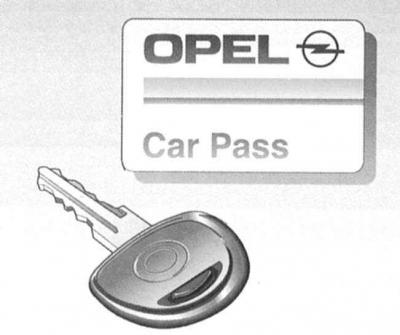
Keep the spare key in a safe place.
The key head has a microchip that automatically switches off the engine immobilization system. If you lose your key, contact your Opel representative.
When using a key equipped with a microchip, some special precautions should be taken:
- When starting the engine, make sure that the key fob ring and other metal objects do not touch the plastic head of the key;
- Do not allow the key to come into contact with other microchip-equipped keys that have a transceiver chip installed while starting the engine (including keys from other cars);
- Do not bend the key head and try not to subject the key to impact loads;
- Do not place the key head in any protective covers that may interfere with the passage of signal pulses;
- Do not expose the key to high temperatures or direct sunlight for long periods of time;
- Keep the key dry and do not allow it to come into contact with water or other liquids;
- Do not leave the key near sources of electromagnetic radiation.
Unlocking and locking doors with a key from outside the car
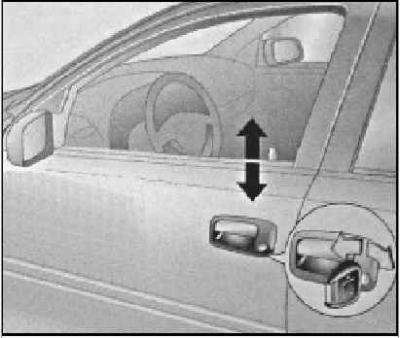
To unlock the car with a key from outside the car, insert the key into the door lock and turn it in the appropriate direction, then pull the handle.
Unlocking and locking doors from outside the vehicle
Material provided by this website (OpelBook)
Locking doors from the inside
Locking of doors from the inside is done by pressing the push-button switches for locking the locks, built into the upper lower edges of the window openings.
Additional locking of rear door locks
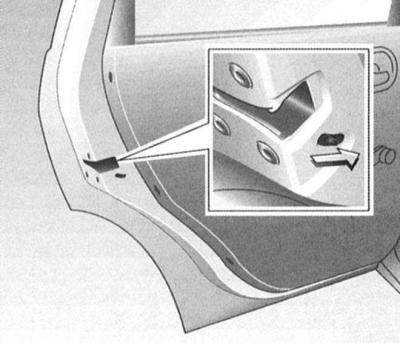
An additional lock is provided to prevent accidental unlocking of the rear doors of the vehicle by children transported in the rear seat.
Open the door and move the lever to the lower position - after slamming the door can only be opened from the outside.
Activating additional locking of the rear door lock
Remote control
The remote control is built into the key head and allows you to control the operation of a single lock (doors and fuel filler flap) and anti-theft alarm.
Control of lock actuators
The range of the remote control emitter is approximately 3 meters and may be reduced by various types of interference.
When unlocking the doors using the remote control built into the key head, point your hand with the key in it towards the car and press the button
 . The functioning of the remote control is confirmed by the glow of the built-in LED. To open the door after the door activators have been triggered, simply pull the handle. The doors are locked by pressing the button .
Avoid getting the remote control wet and try not to expose it to direct sunlight!
Failures of the single lock actuators to operate upon command from the remote control can be explained by several reasons:
- Remote control range exceeded, try again from a shorter distance;
- The internal battery of the remote control is discharged - replace the battery;
- The transmitter and receiver are out of sync due to frequent use of the remote control from an excessively long distance - please re-synchronize;
- Attempting to reactivate the locks after an excessively short period of time - wait at least 30 seconds, then try again;
- There is active interference associated with the operation of a source of powerful radio emission nearby - try again from a shorter distance, if necessary, unlock the door with the key.
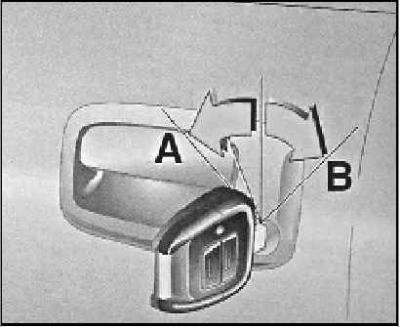
In case of refusal, proceed as follows:
1. When unlocking the door, turn the key in the door lock in direction A, passing the point of resistance, then return it to the vertical position.
2. When locking, turn in direction B until it stops, then return to its original position.
Procedure for actions in case of failure of the single lock actuators to operate on command from the remote control
Replacing the battery
If the operating range of the remote control decreases, the battery should be replaced.
Using a small screwdriver, pry up the remote control latch through the special hole.
Releasing the remote control mounting latch
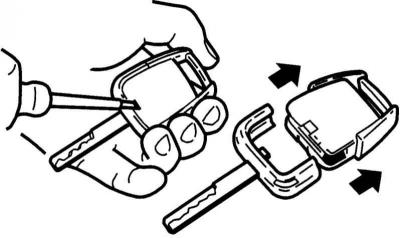
Separate the remote control from the key, open its cover and replace the battery.
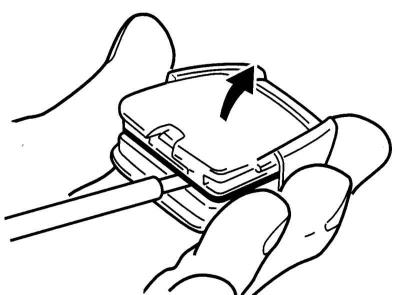
Opening the remote control cover
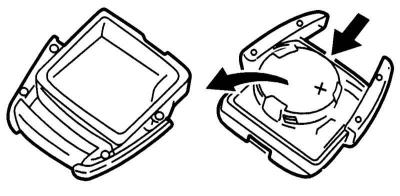
Replacing the battery
As a replacement, use the same type of element as was previously installed in the remote control. Make sure to observe the polarity of the replacement element.
The battery must be replaced within 3 minutes after opening the remote control cover, otherwise you will have to re-synchronize the transmitter and receiver
Synchronization of the transmitter and receiver of the remote control device
In case of malfunction of the remote control device (the key battery replacement lasted more than 3 minutes, or if the transmitter was locked) it should be re-synchronized: turn on the ignition - the system will be in synchronization mode for 30 seconds; briefly press any of the buttons on the remote control built into the key head. Successful completion of the synchronization process is confirmed by a single activation of the door lock actuators.
Ignition Switch/Steering Column Lock
The ignition switch is located on the right side of the steering column. The key can be in one of four positions in the lock
Ignition switch positions
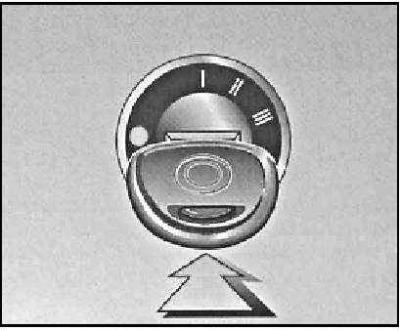
0 — LOCK (blocking)
I — ACC (parking)
II — ON (ignition)
III — START (launch)
Position "0" - lock
the key can be inserted into or removed from the lock only in this position. When the ignition key is turned from position "0" to position "I", the steering column is unlocked. In order to turn the key from position "I" to position "0", it is necessary to first press it slightly, slightly sinking it into the lock. In addition, on models equipped with an automatic transmission, an additional condition for allowing the start is the mandatory transfer of the selector lever to position "P".
The steering column lock is activated automatically when you try to turn the steering wheel after removing the key from the ignition switch.
Steering column lock sometimes makes it impossible to turn the key in the ignition. In this situation, you should slightly turn the steering wheel in one direction or another (in order to relieve the load), while simultaneously turning the key in the lock.
Never remove the key from the ignition while driving! This will inevitably lead to the steering column locking and loss of control. Remove the key from the ignition only after the car has come to a complete stop!
Position "I" - parking
In this position of the ignition key, the operation of auxiliary power consumers is ensured (audio system, cigarette lighter, heater fan, windshield wipers, etc.).
Position "II" - ignition on
The ignition key is kept in this position all the time while the vehicle is moving, as well as when the engine is idling. At the same time, all systems and additional equipment installed on the vehicle are supplied with electricity. When the key is turned from one position to another, some of the control lamps located on the vehicle's instrument panel are briefly switched on, confirming the proper functioning of the corresponding control systems.
If equipped accordingly, turning the key to position "II" automatically turns on the headlights.
Position "III" - start
When the key is turned to this position, the starter is engaged. After the engine has started, the key should be released and it will automatically return to position "II".
If the vehicle is equipped with an immobilization system, the engine will not start if the anti-theft system does not identify the key code.
Engine immobilization system
The standard anti-theft system of some models may include an engine immobilizer device (simply put - immobilizer). The device serves to prevent attempts at unauthorized engine starting and is an effective anti-theft device, protecting the car from thieves.
The key head of models equipped with an engine immobilization system contains a microchip that disables the engine immobilizing anti-theft device.
Damage to the microchip may result in loss of the ability to start the engine! Do not allow the keys to become excessively hot, do not leave them exposed to direct sunlight for a long time; try not to drop your keys or place heavy objects on them; avoid exposure to moisture, if the set gets wet, gently wipe it dry with a soft cloth.
There are no replaceable power elements for the microchip - do not attempt to disassemble the key head on your own under any circumstances!
The engine of a car equipped with an immobilizer can only be started with an ignition key equipped with a built-in microchip. A special code is encrypted in the microchip, and the anti-theft system disables the lock only if it is recognized. An attempt to start the engine with any other key or master key results in the engine starting circuit being disabled.
When the ignition is turned on (the ignition key is turned to position) the Malfunction Indicator Lamp (MIL) comes on for a few seconds and then goes out (see section Instrument panel). Flashing indicator means that the system did not identify the key code. In this case, you need to turn off the ignition (key to position "0") and remove the key from the lock, then try again.
There is a possibility that the system will not recognize the code of the key in the ignition switch if there is another key with a built-in microchip nearby. For reliable code identification, we recommend keeping each key on a separate bunch.
If the system repeatedly refuses to identify the key code, contact the vehicle manufacturer's service station.
Do not attempt to make any changes or additions to the immobilizer design. This may disrupt the normal operation of the vehicle's electronic systems and make it uncontrollable.
If you lose the key and cannot start the engine, contact an Opel service station.
Enabling/disabling the anti-theft alarm
The anti-theft alarm with an autonomous power source allows the siren to operate with the battery disconnected. When performing work that requires disconnecting the battery, turn off the alarm in advance. To do this, turn the ignition on and off and disconnect the battery within no more than 15 seconds.
Turning on
The anti-theft alarm system monitors attempts to unlock the hood and all doors. In addition, the system includes a volume sensor inside the cabin. In addition, attempts to use the ignition switch are blocked separately. It is possible to turn off the cabin volume sensor, which allows you to leave children and pets in a locked car. To turn off the sensor, turn off the ignition and press the push-button switch near the main cabin light - the control LED of the anti-theft alarm should be activated for 10 seconds. Then, within 10 seconds, lock the doors and activate the alarm.
Disabling the cabin volume sensor
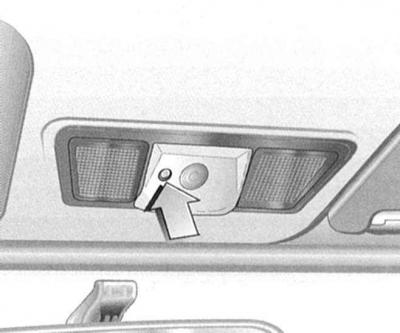
Make sure the hood and trunk lid are also locked until the sensor is turned off. When the alarm is triggered, the siren turns on and the turn signals start flashing.
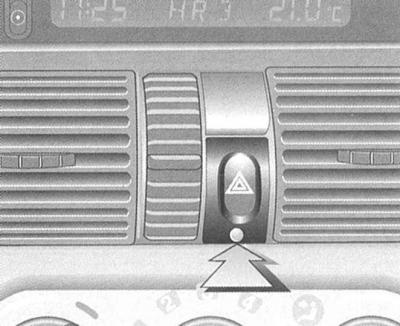
Activation of the anti-theft alarm is accompanied by the activation of the LED built into the instrument panel directly under the hazard warning switch. The LED operating mode allows you to obtain the following information about the state of the controlled elements:
Within the first 10 seconds after the alarm is activated:
- The LED lights continuously: Control, delay on.
- The LED is blinking: Any of the controlled locks is not locked or the system is faulty.
10 seconds after the alarm is activated:
- The LED is blinking: The anti-theft alarm is activated.
- The LED lights continuously for 1 second: The function is disabled.
Anti-theft alarm LED location
If the anti-theft alarm system malfunctions, take the car to an Opel service station.
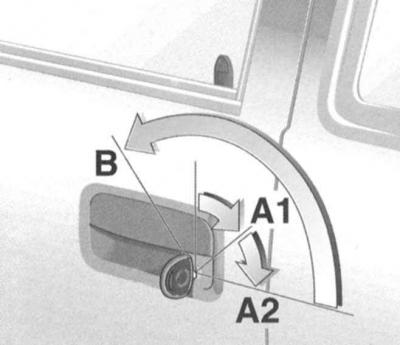
To activate the anti-theft alarm, lock the driver's door by turning the key to position A1, then within 10 seconds return the key to the vertical position and turn it to position A2. When using the remote control, within 10 seconds after locking the locks, press the door unlock button again. If the vehicle is equipped with a mechanical anti-theft system with a single lock, turn the key to position A2 to activate the system.
Activating the anti-theft alarm
Disconnection
The anti-theft alarm is automatically deactivated when the car doors are unlocked using the key or the remote control (please also refer to the accompanying illustration)
Actions with the tailgate lock do not affect the status of the anti-theft alarm.
Unlocking and locking the tailgate
General rules for using the lock
To lock the trunk, turn the key in the trunk lid lock to the vertical position. The horizontal position of the lock cylinder corresponds to the unlocked state of the lid.
Locking the trunk lid
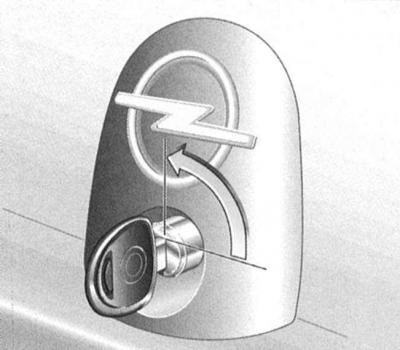
When the cylinder is in a horizontal position, the rear door lock is activated simultaneously with the lock of one of the front doors.
When the lock cylinder is in the vertical position, the trunk remains locked even when the doors are unlocked using the remote control.
To close the trunk, there is a handle or loop on the inside of its lid/door.
Unlocking the tailgate with the doors centrally locked
To unlock the trunk with the doors centrally locked, turn the key in the lock from a vertical or horizontal position to the right until it stops, overcoming resistance.
Unlocking the trunk with centrally locked doors
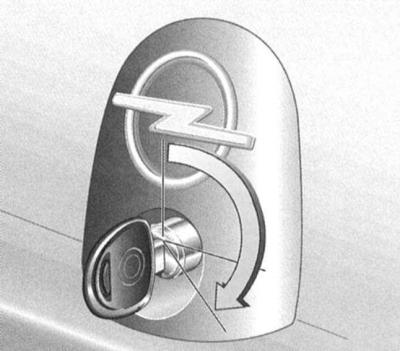
To protect against accidental locking, it is not possible to remove the key from the lock in this position.
Resetting the key to its original state (vertical or horizontal) the position results in the lock being locked.
Tailgate model Combo
First open the right door by pulling up on its outside handle or by pressing the push handle on the inside of the door. Then unlock the left door by lifting the push handle on its inside
Push handle on the inside of the tailgate of the Combo model
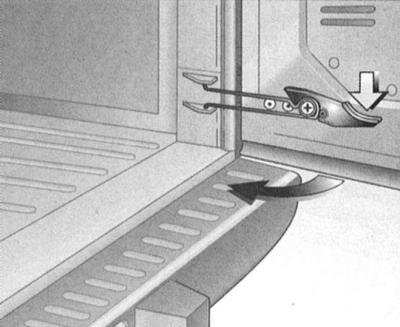
The door opening angle is fixed at 90 degrees. To open the doors at an angle of 180 degrees, press the push handle and, having closed the door far enough, remove the locking springs from the push handle bolts.
Please note that when the Combo model's tailgate is opened 180 degrees, it will cover the taillights, so do not open the doors 180 degrees in the dark.
Hood
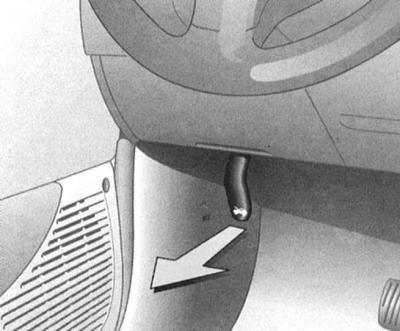
The hood latch release handle is located on the left under the vehicle's instrument panel and has a pictogram on top of it
 . To release the latch when opening the hood, pull the handle towards you.
Location of the hood latch release handle
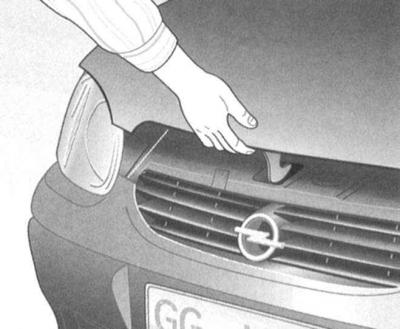
To open the hood, after releasing the hood latch, pull the release loop located approximately a palm's width to the left of the center of the hood on its lower surface.
Removal the bonnet safety lock
To fix the hood in the open position, a special stop rod of the support rod is provided in its holder.
A special stop is provided to fix the hood in the open position
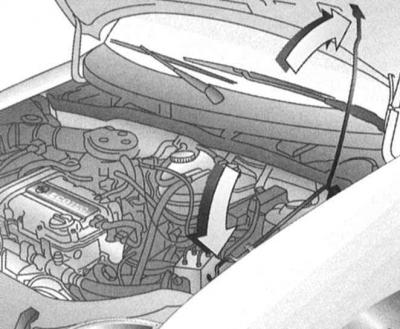
To close, lower the hood to the bottom position, leaving a gap of about 10 centimeters, then release it. To check the reliability of the hood locking in the closed position, pull it up by the front edge.
To avoid damaging the paintwork, do not press the loosely closed hood with your hands; the correct approach is to open it again and try to close it again by releasing it from a small height.
Sliding roof panel and sun visor
Manual drive
To open the panel, release the handle from the groove in the roof, press the release button and turn the handle. This will raise the sun visor. The feeling of resistance when turning the handle indicates that the optimal position of the sliding panel has been reached. To open the sliding panel more completely, press the release button again and turn the handle to the left. Closing is done in the reverse order.
Location of the sliding roof panel control handle
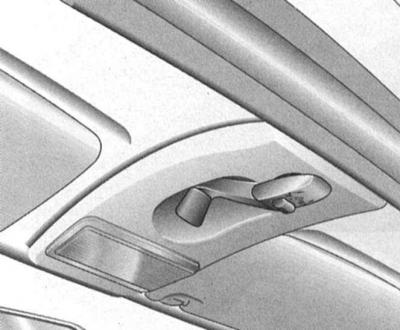
To raise the sliding panel, press the handle release button when the panel is closed and turn the handle to the right. To lower the sliding panel, turn the handle to the left.
The sun visor can be raised or lowered with the sliding roof panel closed and raised.
Electric drive
The location of the sliding roof panel control buttons is shown. When the panel reaches its final position, release the button.
Location of the sliding roof panel control buttons
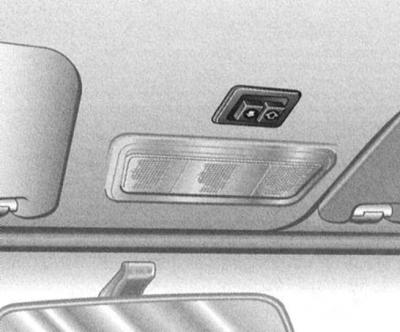
Do not open the sliding panel if there is snow or ice on it. Opening and closing the sliding panel should be done at a vehicle speed of no more than 120 km/h.
When installing the roof rack, open the sliding panel fully to avoid damage.
If the power sliding roof panel fails, check the corresponding fuse. To close the sliding panel manually, remove the cover located at the rear of the overhead console and, using the appropriate key, rotate the actuator until the panel is completely closed.
Manually closing the sliding roof panel (in case of electric drive failure)
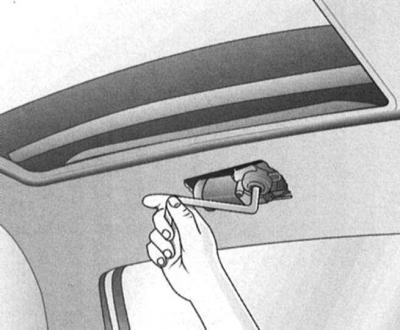
The key must be in the glove compartment.
Window lifters
Manual window lifts
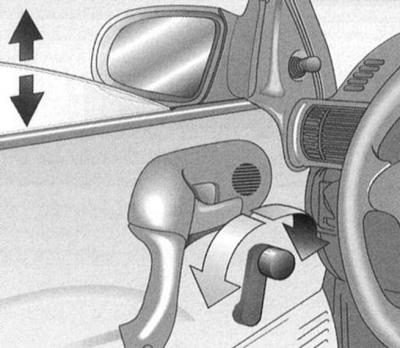
The rotary handles of the drive are located on the inner sides of the corresponding doors.
Location of the manual window lift handle
Electric windows
On appropriately equipped models, the electric window lifts only operate when the ignition is on.
On each of the car doors there is a switch designed to control the operation of the electric drive of the window regulator of that door. Drive (lowering and raising) glass is carried out by pressing the corresponding section of the key. A short press on the key allows for a step-by-step opening or closing of the glass. To automatically move the glass to the extreme (upper or lower) position, the corresponding part of the key should be held down for a longer period of time, pressing the key again will stop the glass. The functional readiness of the switches is confirmed by built-in control lamps.
Location of the switch for controlling the operation of the electric window lifters
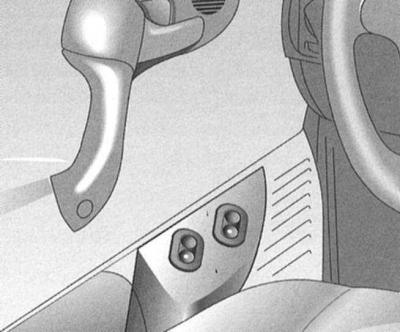
On some models, an additional slide switch is mounted in the switch assembly on the driver's door, allowing the passenger door window drive to be blocked from the individual switches.
If resistance to lifting the glass occurs in the second half of its travel, the operation of the window lifter is immediately suspended, which prevents the driver and passengers from getting injured as a result of pinching their hands or other body parts.
If the glass stops moving due to icing, you should press the corresponding button several times.
To activate the electric window lifter after a power failure or excessive battery voltage drop, close all doors, turn on the ignition, and, with the window closed, hold down the switch keys for each door for at least 5 seconds.
Visitor comments