


Contents: Running in a new car ⬇ Refueling a car ⬇ Opening the hood ⬇ Control operations ⬇ Transportation of goods by car ⬇ Starting the engine ⬇ Five-speed manual transmission ⬇ Automatic transmission ⬇ Car parking ⬇ Brake system ⬇ ABS malfunction indicator light ⬇ Recommendations for driving in…⬇ Review ⬇ Tire grip on the road surface ⬇ Towing a trailer ⬇
Running in a new car
In order to ensure the reliability and durability of the vehicle in operation, the following rules must be followed during the first 1000 km of mileage:
- Don't start off at full throttle, avoid sudden acceleration;
- Do not brake too sharply. Normal running-in of new brake pads occurs over a 200 km run, during which time you should, if possible, brake smoothly and with moderate intensity.
After repairing or replacing the engine, as well as after replacing the brake pads, it is necessary to observe similar restrictions and recommendations.
Refueling a car
Type of fuel used
Cm. Controls and operating techniques.
Filling the fuel tank
Gasoline is highly flammable and explosive. Careless handling of gasoline may result in burns or other serious injuries. When filling the fuel tank, turn off the engine and do not bring hot or sparking objects close to the open filler neck, do not smoke on the territory of the gas station. Perform all maintenance operations on the fuel system only outdoors. If gasoline splashes on exposed areas of skin or on the paintwork of body elements, immediately wipe them with a dry rag.
The fuel filler neck is located on the left side of the car, so you should approach the fuel dispenser at the gas station from the left side.
1. Open the fuel tank filler cap.
2. Slowly turn and remove the cap from the filler neck.
When you open the cap, you may hear a characteristic hissing sound caused by fuel vapors escaping from the tank.
3. Some models are equipped with a special holder, which is located on the inside of the hatch and is designed to temporarily secure the fuel tank cap while refueling the vehicle.
4. Refueling should be stopped immediately after the automatic shutdown of the fuel pump. Do not try to fill the tank above the norm - leave free space for the fuel to expand when heated.
5. Close the fuel tank filler neck with the cap and tighten it securely.
6. Close the hatch and press it to engage the lock catch.
Opening the hood
See Section Access, protection.
Control operations
Checking the engine oil level
A description of how to check the oil level is given in Chapter Vehicle settings and routine maintenance.
Coolant level control
A description of how to check the coolant level is given in Chapter Vehicle settings and routine maintenance.
Transportation of goods by car
The vehicle is equipped with several containers designed to accommodate transported items.
The storage compartments located in the car's interior are designed to accommodate small items. These include the main and additional storage boxes (see section Salon equipment), door pockets, as well as pockets built into the instrument panel.
Large items should be placed in the luggage compartment of the car. The transportation of long items is made possible by the folding design of the rear seat backs.
It is important to remember, however, that improper transportation of cargo may adversely affect the vehicle's handling and stability, and therefore reduce safety. Before transporting any cargo in your vehicle, please read the information below.
Cargo transportation
Maximum load capacity of the vehicle
Exceeding the maximum permissible load capacity of the vehicle or improper placement of cargo may cause an accident and result in injury or even death to the driver or passengers in the vehicle. Do not exceed the maximum permissible gross weight when loading the vehicle, as well as other restrictions mentioned in this Manual.
When transporting cargo in a vehicle, it should be taken into account that the gross vehicle weight must not exceed the maximum permissible value. The gross vehicle weight includes: the unladen weight of the vehicle, the weight of the driver and passengers, the weight of the towing device installed on the vehicle, as well as the weight of the trailer that falls on it. With any vehicle loading options, the axle loads must also not exceed the maximum permissible values. Information on the maximum permissible values of the gross weight and axle loads is provided on the certification label, usually attached to the B-pillar of the vehicle (see section Vehicle Identification Numbers).
Transportation of cargo in the passenger compartment of a vehicle
Securely fasten all objects placed in the vehicle to prevent them from shifting in the event of an accident.
Do not place large objects on the rear shelf of the passenger compartment - they narrow the driver's field of view and can be thrown forward in the event of a collision or sudden braking.
Make sure that objects placed on the floor behind the front seats cannot roll forward and cannot under any circumstances interfere with the driver's free operation of the control pedals, or interfere with the proper adjustment of the front seats or the operation of the SRS system.
Keep the glove compartment closed while driving.
Carrying cargo in the luggage compartment or on a roof rack
Try to distribute the load evenly, placing the luggage as close to the seats as possible. Heavy loads should always be placed below, on the floor of the luggage compartment. Securely fasten the transported items with a strong cord so that they cannot shift while the car is moving. Never place luggage higher than the level of the seat backs.
When transporting large or long items with the rear seats folded down, try to secure them securely with a strong cord to prevent the load from shifting during emergency braking of the vehicle.
A description of the operations for folding the rear seat backs and setting them to their original position is given in Section Salon equipment.
If you need to transport long objects that do not allow you to close the tailgate, remember that engine exhaust gases may enter the vehicle interior - take appropriate precautions (see section Salon equipment).
When placing cargo on a roof rack, make sure that the total weight of the luggage does not exceed the permissible value. Remember that the center of mass of the car shifts when the roof rack is loaded, and the driving characteristics of the car change.
Starting the engine
Petrol models
Standard launch
1. Set the parking brake.
2. When the ambient temperature is low, turn off all auxiliary electrical consumers to reduce the load on the battery.
3. On models equipped with a manual transmission, depress the clutch pedal all the way and engage neutral gear.
4. On models with automatic transmission, make sure the selector lever is in the "P" or "N" position and depress the foot brake pedal.
5. Without pressing the gas pedal, turn the ignition key to position "III" and turn on the starter. If the engine does not start immediately, continue to turn the crankshaft with the starter, remembering that the duration of continuous operation of the starter should not exceed 15 seconds. A second attempt to start should be made after at least ten seconds - a pause is necessary for cooling the starter electric motor.
6. If the engine fails to start after 15 seconds of continuous starter operation, or the engine stalls immediately after starting, try starting it with the accelerator pedal depressed halfway. After the engine starts successfully, release the accelerator pedal to avoid a sharp increase in engine speed.
7. If the engine still fails to start, fully depress the gas pedal and hold it down for the entire time the starter is operating - this will help remove excess fuel that has entered the intake manifold and engine cylinders. The duration of continuous operation of the starter, as in the previous cases, should not exceed 15 seconds. If the engine does not start after purging the cylinders, try to start it again with the gas pedal partially depressed. Release the pedal immediately after starting.
8. The activation of the start immobilization system is indicated by the activation of the corresponding indicator lamp on the vehicle instrument panel (see section Instrument panel), - turn the key to the left and remove it from the lock, then try again.
Features of starting the engine in cold weather at high altitudes (altitude above sea level over 2400 m)
At low ambient temperatures, starting the engine is difficult. In high altitude conditions, where the air is very thin, starting the engine is even more difficult. Below are the instructions that must be followed when starting the engine in these conditions.
1. Turn off all auxiliary electrical consumers to reduce the load on the battery.
2. Press the gas pedal halfway and hold it in this position for the entire time the starter is turning the engine crankshaft. The duration of continuous engagement of the starter should not exceed 15 seconds. After the engine has successfully started, gradually release the gas pedal, preventing a significant increase in speed.
3. If the engine does not start, press the gas pedal all the way down and hold it down for the entire time the starter operates. The duration of continuous starter operation, as in the previous case, should not exceed 15 seconds. If the engine still does not start, repeat the attempt described above.
4. If the ambient temperature is below zero, or if the car has not been used for several days, let the engine warm up for 3-4 minutes before starting to drive.
Diesel models
1. Set the parking brake.
2. Turn off all auxiliary electrical consumers to reduce the load on the battery.
3. On models equipped with a manual transmission, depress the clutch pedal all the way and engage neutral gear.
4. On models with automatic transmission, make sure the selector lever is in the "P" or "N" position and depress the foot brake pedal.
5. Without pressing the gas pedal, turn the key in the ignition switch to position II, wait until the pre-glow indicator lamp goes out (see section Instrument panel), then turn the key to position III and start the engine.
6. Before attempting to start again, the key must be returned to the "•" position and removed from the lock.
Five-speed manual transmission
When driving on a slippery road surface, heavy engine braking or excessive acceleration may result in loss of control of the vehicle and an accident, which may result in serious injury to the occupants. Be especially careful when driving on a road surface that does not provide adequate traction for the vehicle's wheels.
All forward gears are synchronized to ensure smooth, shock-free shifting. After moving the gearshift lever to the next gear, release the clutch pedal smoothly. While driving in the selected gear, remove your foot completely from the clutch pedal to avoid premature wear of the clutch components.
Engage reverse gear only after the vehicle has come to a complete stop. Attempting to engage reverse while driving can cause serious damage to the transmission. Before engaging reverse gear, fully disengage the clutch and wait a short time (in a few seconds) pause.
Instead of a pause, one of the forward gears can be briefly engaged. The described techniques for engaging reverse gear allow preventing the shock engagement of reverse gear due to residual rotation of the gears.
To slow down the car, you can use engine braking by shifting the gearbox to one of the lower gears. Engine braking allows you to control the speed of the car at a safe level and prevents the brakes from overheating when driving on long descents with a significant slope. Shift the gearbox to lower gears sequentially, as the speed decreases, to prevent exceeding the maximum permissible crankshaft speed. The tachometer needle should not go into the red zone of the scale. In all cases, you should focus on the values of the maximum permissible speed of the car in the corresponding gears.
Recommended gear shift points
Try to drive in the highest possible gear, which ensures normal engine operation in specific road conditions during uniform movement and the ability to smoothly accelerate the car. Following this recommendation will ensure high fuel efficiency of the car and efficient operation of the EGR system. When driving in the city, 4th gear should be engaged when reaching a speed of 50 km / h.
Maximum permissible vehicle speeds in different gears
Make sure you change gears in a timely manner - try not to let the tachometer needle enter the range of the measuring scale highlighted in red.
To avoid engine damage, before changing gear, make sure that the tachometer needle does not exceed the maximum permissible speed for the given gear and is not in the red zone of the scale.
Automatic transmission
The cars of the brand in question are equipped with a four-speed hydromechanical automatic transmission with an electronic-hydraulic control system. The transmission control system ensures timely and smooth switching of all forward gears.
Positions of the range selector lever
The AT range selector lever can be in one of seven locking positions. When starting the engine, the lever must be in the "P" or "N" position only. Moving the lever to and from the "P" position, as well as to the "R" position, is possible only with the raised lock located under the lever handle. If the car is stopped when one of the AT ranges is engaged "D", "3", "2", "1", "R", or "N", you should completely release the gas pedal and press the brake pedal to reliably brake the car.
AT selector lever positions
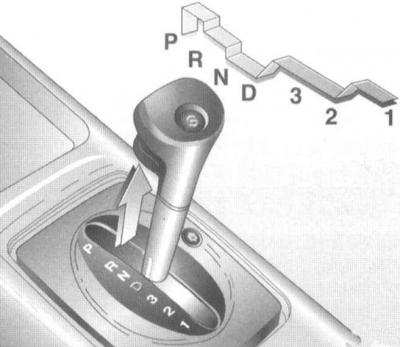
When changing the ranges of the automatic transmission, move the lever along the guide groove. The range shift lever is locked in the "P" position if the ignition key is turned to the "O" or "I" position. In this case, it is impossible to move the lever out of the "P" position even when the brake pedal is depressed.
Position "P". In this position of the AT range selector lever, the secondary shaft of the transmission is mechanically locked. Always move the range selector lever to the "P" position when turning off or starting the engine. In order to move the range selector lever out of the "P" position, it is necessary to depress the brake pedal, having previously released the gas pedal. Pull up the lock and move the lever out of the "P" position. If after performing all the above actions it is still not possible to move the lever out of the "P" position, it is necessary to unlock it following the instructions below.
Position "R". Techniques for controlling the AT range selector lever when moving it to the "R" position (Reverse) from the "P" position are described above. Switch the lever to the "R" position from the "N" position only after the vehicle has come to a complete stop.
ATs are usually equipped with a special safety device that prevents the lever from accidentally moving to the "R" position if the vehicle speed exceeds 10÷12 km/h.
If reverse gear does not engage after the vehicle has come to a complete stop, depress the brake pedal and slowly move the AT range selector lever first to the "N" position, then to the "R" position.
If the safety device is faulty, or if the battery is disconnected from the vehicle electrical system or discharged, it is impossible to engage the reverse range. In this case, it is necessary to remove the reverse range lock, following the instructions below.
Position "N". Use the "N" position when starting a stalled engine while driving and when briefly stopping the car with the engine running. If for any reason it is necessary to leave the car, first move the range selector lever to the "P" position. When moving the lever from the "N" position, depress the brake pedal.
When starting the engine from the "N" position, you should additionally press the foot brake pedal or set the parking brake.
The electronic control system of the automatic transmission, in order to save fuel consumption, provides automatic internal switching of the gearbox to the "N" position when the selector lever is in the position "D", "3", "2" and "1" when the gas pedal is released, the car is stationary and the foot brake pedal is depressed (for example, parking at a traffic light). Releasing the brake and activating the gas pedal causes the car to move off.
Position "D". The range selector lever should be kept in this position at all times when the vehicle is moving under normal road conditions. Range "D" provides automatic forward gear shifting throughout the entire range of gears, depending on the vehicle speed and the degree of pressure on the accelerator pedal. When the vehicle is moving, you may notice that automatic upshifts occur later, i.e. at higher speeds, if the vehicle's engine has not yet warmed up to normal operating temperature. This function ensures faster engine warm-up.
Position "3". If the range selector lever is in position "3", the automatic transmission functions similarly to the case of range "D". The difference is that switching to fourth gear is excluded. Range "3" is recommended for towing a trailer in hilly terrain or for engine braking on a steep descent. Switching on range "3" is also useful for eliminating unnecessary cyclic switching of the automatic transmission between third and fourth gears, for example, when driving in dense traffic with frequent slowdowns and stops of the car.
To accelerate the car sharply when the gearbox is in the "D" or "3" range, press the gas pedal all the way down. In this case, the AT will automatically switch to the adjacent lower gear (kickdown mode). If the vehicle speed is low, the gearbox can shift down two gears at once.
Position "2". When range "2" is engaged, the ability to shift the transmission to gears higher than 2nd stage is blocked.
When the "2" range is engaged while the vehicle is moving, the engagement of the second gear is automatically delayed and occurs only after the vehicle speed has dropped to a safe level at which the engine crankshaft speed does not exceed the maximum permissible value.
Position "1". When range "1" is engaged, the AT will constantly operate in first gear. If range "1" is engaged at a speed of over 50 km/h, the transmission will first switch to second gear. Engaging the intermediate stage allows eliminating abrupt and unexpected engine braking.
Maximum permissible vehicle speeds
When the maximum permissible values of gear shift speeds are exceeded, the tachometer needle enters the red zone of the scale, indicating that the permissible engine speed has been exceeded. At the same time, the ECU begins to limit the crankshaft speed, reducing the fuel supply, which can be felt by changing the engine operating mode. The engine operation returns to normal as soon as the tachometer needle leaves the red zone of the scale.
To avoid engine damage, before changing gears, make sure that the tachometer needle does not go beyond the maximum permissible speed in this gear and is not in the red zone of the scale.
Sports mode of AT operation
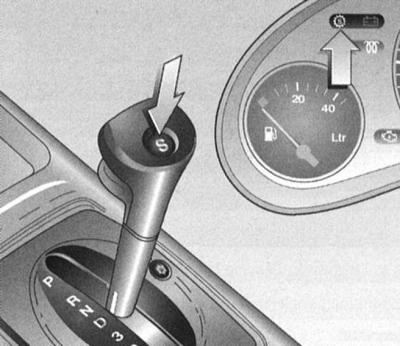
When switching the AT to sport mode, gear shifting occurs at increased engine speeds. The shift is carried out using the push-button switch S, built into the selector lever handle and is accompanied by the activation of a control lamp built into the instrument cluster above the fuel consumption meter. To return to the economical transmission mode, press the button again S.
Button and indicator lamp for activating the AT sport mode
Winter mode of operation of the AT
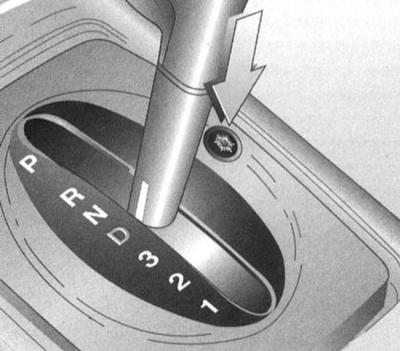
In the winter mode of the automatic transmission, the vehicle starts moving in 3rd gear. The mode is activated by means of a push-button switch with a snowflake-shaped pictogram on top, equipped with a built-in indicator lamp and located to the right of the automatic transmission selector lever. The X14NZ and X14XE engines can be started in the "D" position. The X12XE, C14SEL and C16SEL engines can be started in the positions "P", "R", "N", "D" and "3".
Winter mode on X12XE, C14SEL and C16SEL engines is switched off by pressing the switch button again, moving the selector lever to position "2" or "1", and also when the ignition is switched off. On X14NZ and X14XE engines, winter mode is also switched off at a speed above 80 km/h, by sharply pressing the gas pedal for more than 2 seconds, and also when moving the selector lever to position "P", "3", "2" or "1". In order to protect the transmission from internal damage, the winter mode is automatically switched off also when the ATF overheats.
Activation of winter mode AT
Disabling the selector lever lock
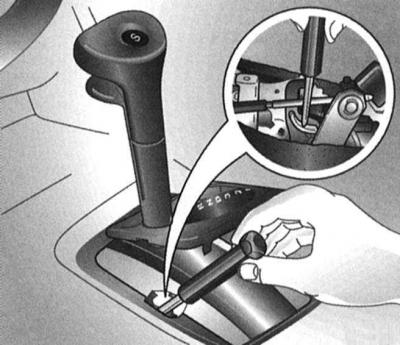
If the power supply is disconnected or the battery is too discharged, it becomes impossible to move the selector lever out of the "P" position. To get out of this situation and release the lever lock, proceed as follows:
- Turn off the ignition and apply the parking brake;
- Release the locks and move the selector lever protective cover 90 degrees to the right;
- Using a small screwdriver or other suitable tool, carefully push the lock forward and move the lever out of the "P" position;
- Lower the protective cover and secure it to the console panel;
Releasing the stopper that locks the selector lever in the "P" position
To prevent the lever from becoming locked in the "P" position again, eliminate the cause of the power interruption.
AT malfunctions
Malfunctions of the AT are indicated by the activation of the corresponding control lamp on the instrument cluster
If the automatic transmission shift fails, further movement can be continued in emergency mode, shifting gears manually using the selector lever. In this case, the inclusion of 2nd gear is completely blocked and shifting occurs 1-3-4. In this case, the following scheme of the relationship of the lever positions takes place:
- 1 - 1st gear
- 2 - 3rd gear
- 3 - 4th gear
- D — 4th gear
- N — Neutral
- R — Reverse
- P - Parking position
To eliminate the causes of AT failures, contact auto service specialists.
When stuck
To free a car stuck in sand, mud, etc., with the gas pedal slightly depressed, move the selector lever between the "D" and "R" positions. The engine speed should be as low as possible. Use this function only in exceptional cases.
Car parking
When leaving the vehicle in a parking lot, always set the parking brake. Remember that the parking brake indicator light mounted in the instrument panel only serves to remind the driver to release the brake before driving off. The lighting of the indicator light does not guarantee that the parking brake is fully set. To avoid the vehicle rolling down a slope, make sure that the parking brake is properly set.
1. First, you should set the parking brake, and then engage first or reverse gear (models with manual transmission)/move the automatic transmission range selector lever to the "P" position. This sequence of actions prevents accidental starting of the vehicle, and on models with automatic transmission, it also eliminates the transfer of significant load to the transmission secondary shaft locking mechanism from the force rolling the vehicle - unloading the transmission secondary shaft locking clutch ensures that the lever can be easily moved out of the "P" position when the vehicle starts moving.
2. When parking your car on a hill, turn the front wheels away from the curb; when parking on a slope - towards the curb.
3. Before driving, make sure that the parking brake is fully released. Driving with the parking brake not fully released may cause overheating and failure of the rear wheel brakes. In addition, this may lead to malfunction of the ABS.
Recommendation for safe parking of a car
1. Make sure the sliding roof panel and all windows are closed.
2. Turn off all lighting devices.
3. Place luggage and valuables in locked compartments, or take them with you.
4. Lock the doors. On models equipped with an anti-theft system, make sure the system indicator on the instrument panel comes on, indicating that the device is activated.
5. Do not leave the vehicle with the engine running on areas covered with dry leaves, tall grass or other flammable materials. Remember that the catalytic converter housing can heat up to very high temperatures, which can cause a fire.
Brake system
General information
General information on the braking system is given in Chapter Brake system.
Parking brake
The parking brake has a drive to the rear wheels of the car. The parking brake lever is located in the rear part of the center console between the front seats of the car. When the parking brake is applied, the corresponding indicator lamp on the instrument cluster comes on (see section Instrument panel), - do not forget to release the parking brake before starting to move, having first pressed the button located on the front end of the parking brake lever.
Safety recommendations for operating models equipped with ABS
ABS does not reduce the braking distance of the car and can only ensure that the car remains under control during braking. In view of the above, it is necessary to constantly maintain a safe distance from the vehicle in front, based on the speed of the car and specific traffic conditions.
ABS does not prevent lateral skidding when the vehicle changes direction abruptly. For example, the vehicle may skid when taking a turn at too high a speed or when the steering wheel is jerked when changing lanes. Always maintain a safe vehicle speed, taking into account the road surface and traffic conditions.
ABS does not prevent the vehicle from losing directional stability. Avoid sharp jerks of the steering wheel during emergency braking.
The braking distance of a car equipped with ABS may be slightly longer than that of a model with a conventional braking system. This is especially noticeable when driving on unstable and uneven road surfaces (gravel, snow). When driving in such road conditions, reduce speed and increase the distance from the vehicle in front.
ABS malfunction indicator light
The anti-lock system includes a self-diagnostic unit. Externally, the self-diagnostic procedure of the system is manifested by small pulsations of the foot brake immediately after starting the engine. ABS failure diagnostics are also performed each time the car is braked.
If the system detects any fault, the corresponding indicator lamp lights up on the instrument panel. When the indicator lamp lights up, it means that the ABS is disabled. The service brake system remains fully functional, except for the automatic brake force regulation function performed by the ABS. If the ABS indicator lamp does not go out after starting the engine or lights up while driving, you should contact your nearest service station as soon as possible.
Combined activation of ABS and brake system failure warning lights (parking brake) also means that the brake force regulation function is disabled, which indicates that there are faults in both the ABS and the brake system. The vehicle's brake system will continue to provide adequate braking, but you should avoid abruptly pressing the foot brake pedal. Contact your nearest service station without delay.
Recommendations for driving in adverse weather conditions
Peculiarities of driving a car in adverse road conditions
Driving in rain, heavy fog or snowfall requires special skills from the driver, due to reduced traction of the wheels with the road surface and poor visibility. Always keep your car in good technical condition. When driving in bad weather, be especially careful.
Reduce speed and drive more slowly than usual in normal weather conditions on dry road surfaces. Remember that the car's response to control will be more sluggish and slow, even if the road surface appears only slightly damp. Try to operate all the car's controls smoothly. On wet and slippery road surfaces, a sharp jerk of the steering wheel or careless pressing of the brake pedal can lead to loss of control. At the beginning of the trip, not yet fully adapted to adverse weather conditions, exercise increased caution. This rule is especially useful when driving during snowfall. It should be remembered that when using a car in the warm season, many useful skills of driving a car on a slippery road surface are forgotten, which requires some time to restore them.
Be especially careful when driving in the rain, as lack of practice during the dry period does not allow you to quickly change your riding style and adapt it to the new conditions.
The first rains after a long dry period make the road surface especially slippery.
Review
For road safety in all weather conditions, it is very important to have a good view in all directions. Your car should always remain clearly visible to drivers of other vehicles - remember that when driving on the highway, turning on the low beam will never hurt, even in daylight. These requirements are more difficult to meet in adverse weather conditions.
Regularly check the condition of the windshield wiper blades and windshield washer nozzles. Always maintain the required level of coolant in its reservoir. Use only recommended brands of liquid to fill the windshield washer system. Monitor the condition of the working elements of the windshield wipers, replace them as soon as the brushes stop cleaning the glass properly. To prevent moisture condensation on the inner surface of the glass, use air blowing on the glass, if necessary, turn on the air conditioner.
Tire grip on the road surface
Check your tire pressure and tire tread wear regularly (depth of pattern). Both of these factors are extremely important in terms of good tire grip on the road surface and preventing aquaplaning, i.e. a sharp decrease in grip when driving into puddles. To ensure better vehicle control and driving safety when the winter season arrives, use studded tires.
While driving, constantly monitor changes in road conditions, which are often very unstable. The presence of wet leaves on the road can be no less dangerous than black ice. Often, a seemingly clean and dry road surface can become icy in individual areas. Particularly dangerous conditions develop at air temperatures around 0 degrees, when puddles can alternate with ice, which makes the car's behavior especially unpredictable.
Be careful when downshifting an automatic transmission. On slippery surfaces, abrupt downshifting can cause the drive wheels to briefly slip and the vehicle to skid
The driver must exercise particular caution and attention when overtaking. Equally, you must be careful when your car is being overtaken by other vehicles. Splashes of water and dirt from under the wheels of the overtaken truck can dramatically impair visibility through the windshield. A gust of crosswind when overtaking a truck or bus is dangerous due to loss of control.
Towing a trailer
Incorrect placement of luggage, as well as transportation of excessively heavy loads on a vehicle or towed trailer, can significantly worsen the controllability and braking properties of the vehicle/road train, which is fraught with the creation of an emergency situation on the roads. Before starting to drive, always carefully check the correct loading of the vehicle and trailer.
The models of cars considered in this Manual are, of course, primarily passenger cars and are intended for the transportation of people and their luggage. However, subject to mandatory compliance with a number of general rules, which are given below, Opel cars can also be successfully used for towing a trailer.
Material provided by this website: Opelbook.ru
The total mass of the trailer, including its own mass and the mass of the cargo placed in it, must not exceed the maximum permissible mass of the towed trailer. The maximum permissible mass of the trailer depends on whether it is equipped with brakes or not.
The maximum vertical load on the towing hitch of a vehicle with a gross trailer weight must not exceed 50 kgf. For trailers with a gross weight of up to 500 kg, the following rule should be followed: the vertical load on the towbar should be approximately 10% of the gross trailer weight. Adjust the load on the towbar of the vehicle by placing the load on the trailer accordingly. To begin with, it is recommended to place the load so that approximately 60% of its weight is in front of the trailer axle and 40% behind. If the gross trailer weight exceeds 500 kg, try to distribute the load more evenly along the length of the trailer. Never load the trailer so that the rear of the trailer outweighs the front - this leads to unloading of the rear wheels of the vehicle, which worsens the grip of the tires on the road surface.
The gross vehicle weights and the towed trailer must not exceed the corresponding maximum permissible values.
The gross vehicle weight includes: the unladen weight of the vehicle, the weight of the driver, passengers and luggage, the weight of the towing hitch and the weight of the trailer on it. Remember that the weight of the additional equipment installed on the vehicle and the weight of the trailer on the towing hitch (when towing a trailer), reduce the payload capacity of the vehicle by the corresponding amounts.
The most reliable way to check the correct loading of the vehicle and trailer is weighing. Load the vehicle and trailer as they are usually used in a road train and weigh them on a truck scale. Determine the values of the total mass of the vehicle and trailer, as well as the masses per axle of the vehicle and trailer. Compare the measurement results with the nominal values.
Towing device
Installation of towing devices that do not correspond in size to the trailer's weight and dimensions, or are incorrectly installed on the vehicle, may cause damage to the vehicle's body elements.
The design of the towing device intended for installation on your vehicle must fully meet all necessary requirements; if necessary, consult an Opel service station.
The towing device must be secured at several specially designated points on the base of the vehicle body so that the loads from the towed trailer are distributed more evenly and fall on the body reinforcement elements. It is prohibited to mount towing devices on the vehicle that rest only on the rear bumper, which is not designed to withstand such loads. The towing device must be installed by qualified personnel at a car service center.
Rear view mirrors
Towing a large trailer (such as a "Caravan") usually requires the installation of additional rear-view mirrors with extended brackets on the vehicle. Check the requirements of local legislation and the Road Traffic Regulations regarding towing trailers by cars. Attach the trailer to the vehicle and assess the degree of deterioration of the rear view through the standard rear-view mirrors. If the view is unsatisfactory, then for safety reasons it is necessary to equip special mirrors that provide the driver with an adequate view of the space behind the vehicle.
Attaching a trailer to a vehicle
If you are going to buy a trailer equipped with brake mechanisms, make sure that they have an electric control drive - the design of the hydraulic drive of the service brake system of your car does not provide for the possibility of connecting any additional circuits to it, in particular, to activate the brake mechanisms of the trailer. Any method of connecting the brake system of the trailer to the brake hydraulic drive of the car, no matter how attractive it may seem, will lead to a deterioration in the efficiency of braking of the car and a decrease in traffic safety.
When connecting a trailer to a vehicle, always use a safety chain. The ends of the safety chain must be securely fastened to the appropriate places on the trailer drawbar and on the vehicle's towing hitch. Make sure that the chain passes under the trailer drawbar - this will prevent the front end of the drawbar from falling onto the road in the event of disconnection of the coupling. The free length of the chain must be sufficient so as not to interfere with the road train's turns with minimal radii, however, the chain should not be allowed to drag on the ground.
Trailer exterior lighting and signaling devices
Since trailers of different brands may use different wiring, the installation of the towbar should be entrusted to specialists of the car service. In some cases, it may be necessary to install an adapter.
Before connecting the trailer's electrical equipment to the vehicle's electrical system, be sure to consult a service station.
Preparing to tow a trailer
1. Before starting to drive, you should carry out a control inspection and check of the vehicle and trailer.
2. Measure the vertical load on the towing hitch - use a standard floor scale.
3. Check the reliability of the trailer drawbar and safety chain fastening.
4. Check the technical condition of the tires and the air pressure in the tires on the car and trailer. Low air pressure in the tires significantly worsens the controllability of the car and the road train. At the same time, check the condition and air pressure in the spare wheel.
5. Once the trailer is fully loaded and connected to the vehicle, make sure that there is no excessive "sag" in the rear of the vehicle - if necessary, load the vehicle/trailer.
6. Check the proper functioning of the external lighting and signaling devices on the vehicle and trailer.
7. Check the current traffic regulations for the maximum speed of a road train consisting of a car and a trailer. If you are planning a trip to several countries, familiarize yourself in advance with the specifics of local requirements and restrictions regarding towing a trailer with a car, as each country may have its own restrictions.
In European countries, the speed limit for a road train consisting of a passenger car and a trailer is set at 100 km/h.
Safety precautions when towing a trailer
It should be taken into account that the braking distance of a vehicle towing a trailer increases. Therefore, when driving with a trailer, you should maintain an increased distance from the vehicle in front. Try to avoid sudden braking and turns. This may lead to the jackknifing of the road train or even the overturning of the trailer.
Remember that the length of a road train is significantly greater than the length of a single car. When turning right, leave a significantly larger distance than usual between the edge of the road and the wheels of the right side of the car to avoid the trailer wheels hitting the curb. Keep in mind that when turning a road train, the trailer moves along an arc of a smaller radius than the car and may run into or collide with an obstacle that the car has easily passed. When overtaking another vehicle, do not rush to return to your lane, as this may lead to a collision between the overtaken car and the trailer.
A road train, compared to a single car, is more sensitive to the effects of crosswind gusts and aerodynamic disturbances from other cars. If you are overtaken at high speed by a heavy truck or road train, try to maintain a straight and uniform movement of your car. To reduce the aerodynamic disturbances acting on the road train from the car in front, reduce speed to get out of the turbulent flow.
When towing a trailer, the load on all the main units and systems of the vehicle increases. Therefore, if the vehicle is frequently used to tow a trailer, it is necessary to carry out periodic maintenance of the vehicle in accordance with the regulations typical for intense operating conditions
The additional load on the vehicle increases even more when operating the road train in hilly terrain. When overcoming long climbs, carefully monitor the engine temperature using the pointer indicator on the dashboard. When the pointer approaches the overheating zone, turn off the air conditioner (if it is equipped and turned on) and continue driving. If the engine coolant temperature does not decrease or continues to increase, pull over to the side of the road and allow the engine to cool.
The air conditioner should also be switched off when accelerating rapidly downhill in hilly or mountainous terrain. If the engine coolant temperature rises steadily while driving in second gear, reduce your speed to below 60 km/h.
When driving in hilly or mountainous terrain, cyclic switching of the third and fourth gears of the automatic transmission may be observed. In this case, you should switch to a lower range "3", which will prevent overheating and excessive wear of the friction elements of the AT. To avoid overheating of the brake mechanisms when driving on long descents, use engine braking. For effective engine braking, engage a lower range or one of the lower stages of the automatic transmission.
When stopping the road train on an incline, do not hold it in place by pressing the gas pedal - this may lead to overheating of the AT. Use the service brake system or the parking brake.
When operating an automatic transmission in manual mode, use third, second and first gears, depending on the vehicle speed and road conditions. When towing a trailer, do not engage fourth gear. The Specifications provide recommended speed ranges for using the various gears of the transmission.
When parking the road train for a long time, especially on a descent or ascent, take all precautions to ensure reliable braking of the car and trailer. Turn the front wheels of the car so that when the road train rolls, they rest against the curb. Fully apply the parking brake and move the range selector lever to the "P" position. On models equipped with a manual transmission, engage first or reverse gear. Additionally, place wheel chocks under both wheels of the trailer.
Driving a road train in reverse presents certain difficulties and requires special skills and training from the driver. Reverse carefully and slowly, do not turn the steering wheel too quickly. When maneuvering in reverse in cramped conditions, it is useful to have someone standing outside to monitor the trailer's movements and direct your actions. Keep in mind that when you turn the steering wheel clockwise (to the right), the trailer moves to the left, and vice versa. When maneuvering a road train in reverse, it is recommended to hold on to the steering wheel rim from below (and not from above, as usual, when moving forward). With this grip, the usual correspondence between the direction of rotation of the steering wheel and the movement of the trailer is maintained: moving the hand to the left causes the trailer to turn to the left and vice versa.
Visitor comments