


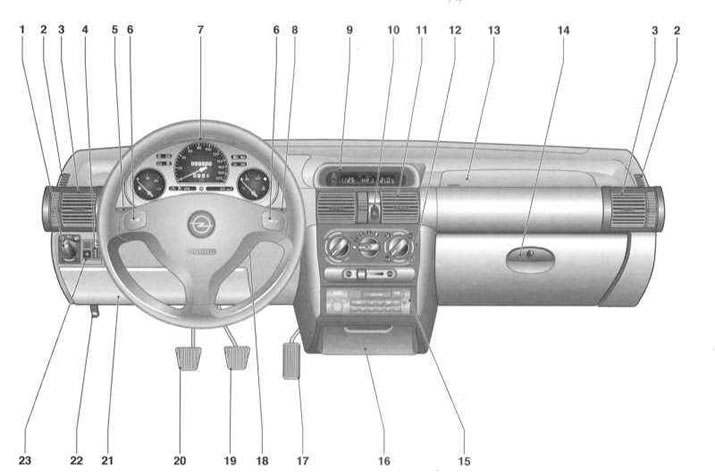
1 — Lighting control switch and instrument lighting intensity regulator
2 — Side window blower deflectors
3 — Side air duct deflectors for the ventilation and heating system
4 — Headlight optical axis tilt regulator (with appropriate equipment)
5 — Left steering column switch for controlling the turn signals, selecting the headlight operating mode, high beam signaling
6 — Horn button pictograms
7 — Instrument cluster
8 — Right steering column switch for controlling the operation of windshield washers and (with appropriate equipment) headlight lenses
9 - Display of date, time, outside air temperature gauge, and radio receiver
10 — Hazard warning switch
11 — Deflectors of the central air ducts of the ventilation and heating system of the passenger compartment
12 — Control panel for the operation of heating, ventilation and air conditioning systems
13 — Passenger airbag module cover
14 - Glove box
15 - Radio receiver (with appropriate equipment)
16 - Ashtray and cigarette lighter
17 — Gas pedal
18 - Ignition switch
19 — Brake pedal
20 — Clutch pedal
21 — Fuse box mounting
22 — Hood lock latch release drive lever
23 - Fog light and rear fog light switches
The appearance and location of individual elements of the instrument panel in cars of different modifications may differ.
Instrument cluster
Instrument panel control lamps and indicator lights
The completeness of the instrument panel with control lamps and indicator lights depends on the vehicle modification.
Control lamp for switching AT to sport mode (with the appropriate vehicle configuration) or AT malfunctions
 On models with the corresponding configuration, the activation of this control lamp accompanies the transfer of the AT to sport mode (the indicator lights continuously) or gear shift malfunction (the indicator is blinking).
Charge indicator light
 The indicator lamp briefly lights up when the ignition is turned on and should go out a few seconds after the engine has started. If the lamp does not turn off, this indicates a fault in the charging system. Stop driving and turn off the ignition. Check the tension of the alternator drive belt, the reliability of the fastening of the terminal connections of the alternator wiring, and the tightness of the tightening of the alternator mounting bolts.
On models equipped with X10XE, X10XE, X15DT and X17D engines, the possibility of malfunction of the powertrain cooling system cannot be ruled out. On models equipped with X15DT engines, the possibility of malfunction of the brake booster cannot be ruled out.
Brake and clutch hydraulic control lamp
 If the indicator lamp continues to light when the ignition is on, you should check that the parking brake is fully released. The activation of this lamp may also indicate a drop in the working fluid level in the master cylinder reservoir or clutch hydraulic cylinder.
Diesel Engine Pre-Glow Device Indicator Lamp
 This indicator lamp is activated only when the diesel engine pre-heating system is activated at low ambient temperatures.
Malfunction Indicator Lamp (MIL)
 The indicator lamp briefly lights up when the ignition is turned on and should go out a few seconds after the engine has started. If the lamp does not turn off, this indicates a malfunction of the engine or a malfunction of one of the exhaust gas emission control system components. Try to avoid sudden acceleration and high engine speeds when driving further. At the first opportunity, seek help from car service specialists.
If the lamp turns on in flashing mode with the ignition on, this indicates a malfunction of the anti-theft system; the engine will not start.
Supplemental Restraint System (SRS) Warning Light
 The indicator lamp lights up for 4 seconds when the ignition is turned on and should go out a few seconds after the engine is started. Failure of the lamp to turn off, its continued operation after 4 seconds, or its activation while the vehicle is moving indicate failures in the electrical circuits of the additional SRS safety systems (airbags, emergency seat belt tensioners).
Electric Power Steering Warning Light
EPS The indicator lamp comes on briefly when the ignition is switched on on vehicles equipped with X10XE and X12XE engines and should go out a few seconds after the engine has started. If the lamp comes on while driving, this indicates a fault in the electric power steering. Driving can be continued, but additional effort will be required to steer.
Direction indicator lights
 The activation of the corresponding indicator occurs when the right or left turn signals are switched on. Switching on the hazard warning lights causes both indicators to operate simultaneously.
A noticeable increase in the frequency of flashing indicates that one of the turn signal lamps has failed.
Trailer direction indicator light
 When towing a trailer, this indicator light flashes when the turn signals are activated. The indicator flashes at the same rate as the main indicator lights. Failure of any of the turn signals on the trailer or vehicle will result in the indicator not working.
Rear fog light activation indicator light
 The indicator lamp comes on when the rear fog lights are activated and remains on until the latter are switched off.
Anti-lock Brake System (ABS) Warning Light
 The indicator lamp briefly lights up when the ignition is turned on and should go out a few seconds after the engine has started. When the lamp goes out, the ABS self-diagnosis procedure is complete and the system is in an active state.
The ABS self-diagnosis process may be accompanied by specific sounds.
If the lamp fails to turn off or if it triggers while driving, it means that the self-diagnostic system has detected a fault in the ABS circuit. The brake system then switches to normal operation mode, which means that you can continue driving without any problems.
The built-in ABS self-diagnostic system allows you to significantly simplify the process of finding and eliminating the causes of system failures.
High beam activation indicator lamp
 The indicator has a characteristic purple glow and is activated when the car's headlights are switched to high beam mode (constant or signal).
Warning light: "Don't forget to fasten your seat belts!"
 The brief activation of the indicator lamp when the ignition is turned on is accompanied by an audible signal and serves as a warning to the driver and passengers about the need to fasten their seat belts before starting to move.
Fuel reserve indicator light
 When this indicator light comes on, it means that the fuel supply is running low and you should refuel the vehicle as soon as possible.
Try not to let the fuel run out completely! This warning applies especially to diesel models, where removing air from the fuel system is a rather labor-intensive procedure.
Oil pressure warning light
 The indicator lamp briefly lights up when the ignition is turned on and should go out a few seconds after the engine has started. If the indicator lamp fails to turn off after the engine has started and lights up while driving, immediately turn off the engine and check the engine oil level and pressure. Adjust the oil level if necessary.
Meters and indicators
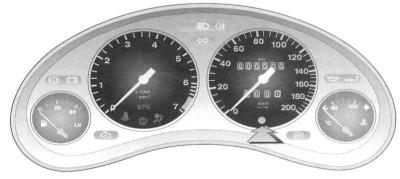
Tachometer
The tachometer is a meter that measures the engine speed. The tachometer dial is mounted on the left in the central part of the instrument cluster and allows you to determine the engine crankshaft speed in revolutions per minute (the reading from the scale should be multiplied by 100).
Layout of control lamps, indicator lights and control and measuring instruments on the instrument panel of petrol models (the arrow shows the location of the digital display setting button)
Speedometer
The speedometer shows the current speed of the vehicle. The speedometer dial is mounted on the right in the central part of the instrument cluster.
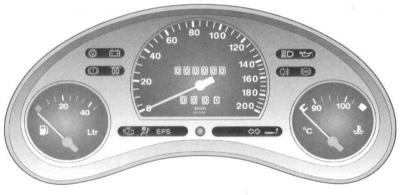
Layout of control lamps, indicator lights and control and measuring instruments on the instrument panel of diesel models
Odometer
The odometer is used to record the total mileage of the vehicle. The odometer readings are displayed in a field mounted in the upper part of the speedometer dial.
Current mileage counter
The counter is designed to record the current mileage of the car from the moment of zeroing its own readings. The counter readings are displayed in a field mounted in the lower part of the speedometer dial. Zeroing the counter is done by pressing the setting button when the current mileage indication is activated.
Engine coolant temperature gauge
The engine coolant temperature gauge is mounted on the right side of the instrument cluster and serves to monitor the temperature characteristics of the power unit.
For design reasons, coolant temperature control can only be performed when there is a sufficient level of coolant in the system. The engine's entry into normal operating temperature mode is confirmed by the pointer moving to the middle position (between 80 and 100 marks).
When the engine is running, the cooling system is under excess pressure, so the readings on the gauge may briefly rise above the 100°C mark. If the needle moves into the red range of the scale, this indicates overheating - you should immediately stop driving, turn off the engine and check the coolant level (if necessary, make appropriate adjustments). Another reason for overheating may be a failure of the cooling system fan - check the proper functioning of the corresponding D/V.
Fuel consumption indicator
The fuel consumption indicator is located on the left side of the instrument cluster. When the pointer drops into the red range of the measuring scale and the fuel reserve indicator lamp comes on, you should refuel the car at the first opportunity.
Try not to let the fuel run out completely! This warning applies especially to diesel models, where removing air from the fuel system is a rather labor-intensive procedure.
Controls located on the instrument panel and steering column
Switch for controlling the operation of external lighting devices, instrument lighting and interior lighting
This switch is used to turn on the exterior lighting, instrument panel lighting, and interior lighting. In position 0 when the rotary switch knob is pressed, all lights and instrument panel lighting remain off.
When the handle is moved to the middle position, the parking lights, rear license plate lights and instrument lighting are turned on.
To switch the car's headlights to low or high beam mode, turn the switch handle to the extreme right position.
Pulling the rotary handle towards you forces the interior lighting to turn on.
The brightness of the instrument lighting and information display is adjusted using the potentiometer knob mounted under the switch handle and marked with a pictogram
 . The information display and ashtray illumination turns on automatically when the ignition is turned on.
When equipped with a car phone, the brightness of the information display backlight cannot be adjusted.
Rear fog light switch
The pushbutton switch for controlling the operation of the rear fog lights is marked with a pictogram
 . Located to the right of the handle of the switch controlling the operation of the external lighting devices.
When the lights are on, a control lamp built into the switch button is activated.
Switch for controlling the operation of external lighting devices, instrument lighting and interior lighting
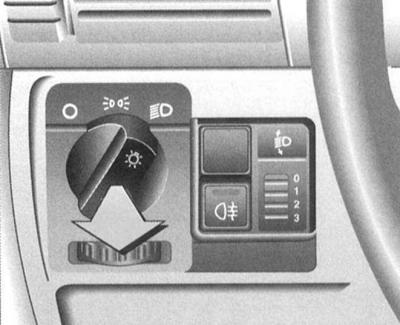
0 Off
 The side lights are on
 Low or high beam headlights are on
 When the handle is pulled out, the interior lighting and instrument lighting are turned on
Headlight optical axis direction regulator
The wheel-lever switch is mounted to the right of the handle of the switch for controlling the operation of the external lighting devices and is marked at the top with a pictogram
 . The adjustment is made by moving the switch lever to one of the four standard positions with the low beam headlights on. With the correct adjustment of the headlight tilt relative to the body, the risk of blinding drivers of oncoming and passing vehicles is eliminated. The adjustment table is given in the Specifications at the beginning of the Chapter Controls and operating techniques.
Depending on the vehicle's equipment, the range of change of the tilt of the optical axes of the headlights between positions 2 and 3 of the switch may be very narrow.
Left steering column switch
The left steering column switch is used to select the headlight operating mode (low beam or high beam), high beam signaling is performed, and the direction indicators are activated.
High beam alarm
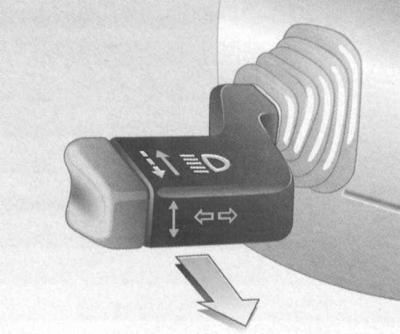
In normal position (closer to the steering wheel) the headlight switch levers are in low beam mode (with the corresponding position of the rotary handle of the switch for controlling the operation of external lighting devices). To switch the headlights to high beam mode, you should press the switch lever away from you, moving it to the second stationary position - the corresponding indicator lamp on the instrument panel will work. Returning the switch to its original position (normal) this position turns off the high beam and switches the headlights to low beam mode.
To briefly turn on the high beam headlights to give a light signal, pull the left steering column switch lever towards you.
Activating the direction indicators
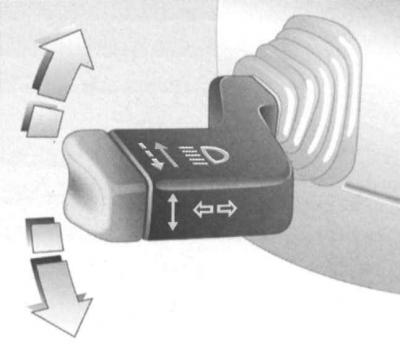
High beam signalling can be performed in any position of the rotary handle of the external lighting control switch.
Moving the left steering column switch lever to the upper or lower stationary position (until it clicks) activates the corresponding turn signal indicators.
The direction indicators are switched off automatically when the lever is returned to the neutral (middle) position when the steering wheel is returned to the straight-ahead position.
There is also the possibility of turning on the indicators for a short time (for example, to warn about a change in traffic lane), - you should move the lever up or down without making it click - in this case, the indicators will turn off when you release the lever.
Activation of the direction indicators is accompanied by the activation of the corresponding indicator lights on the instrument panel and distinct clicks emitted by the interrupter.
Right steering column switch
This switch controls the operation of the windshield wipers and the supply of windshield washer fluid.
The right steering column switch lever can move in a vertical plane and be set to one of four stationary positions; pictograms corresponding to each position are applied to the front side of the switch.
The windshield wipers are controlled using the right steering column switch
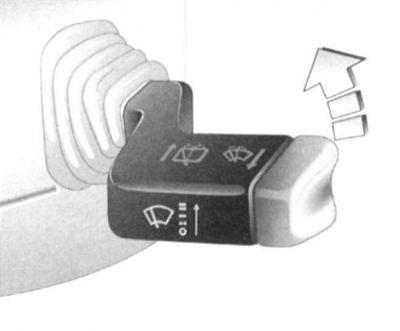
O Windscreen wipers are off
— Intermittent/automatic windscreen wiper operation
- Continuous low-speed windshield wiper operation
= Continuous high-speed windshield wiper operation
Pulling the right steering column switch towards you turns on the supply of washer fluid to the windshield and headlight lenses (if the latter are included). When supplying fluid to the windshield, the windshield wipers perform several working cycles.
Turning on the supply of windshield and headlight washer fluid
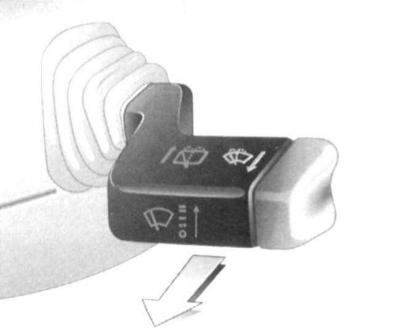
To turn on the rear window wiper and washer, pull the right steering column switch lever away from you. There are two operating positions for the lever, the first of which turns on only the windshield wiper, while the second (hold the lever down until it stops) additionally, the supply of washer fluid to the glass is activated.
Control of windshield wiper operation and washer fluid supply to the rear door glass
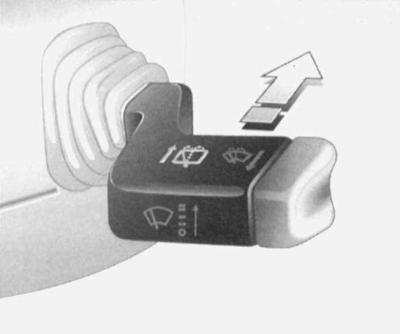
In the first operating position, the rear window wiper will operate in interval mode with a fixed delay, in the second - continuously.
Hazard warning switch
The push-button switch for the hazard warning lights is located in the central part of the instrument panel between the grilles of the central air vents (refer to illustration). Switching on the alarm system causes all direction indicators to be activated simultaneously in normal flashing mode, and is also accompanied by the operation of the indicator lamp inside the switch button. The frequency of flashing is the same as when the direction indicators are operating due to the use of a common interrupter. The hazard warning lights are switched off by pressing the switch again.
Sound signal
To turn on the horn, simply press the central pad of the steering wheel, marked with pictograms depicting a horn (refer to illustration).
Visitor comments