


Radio
All radios for "Opel" are made using high-quality technology. Despite this, the reception in the FM range is not always stable.
While the car is moving, the voltage on the antenna constantly changes due to:
- 1 by changing the distance to the transmitter,
- 2 increase in reception range due to wave reflection,
- 3 blocking direct reception by tall objects.
Therefore, if noise, sound distortion, unstable reception, etc. appear, switch to a stronger FM station.
If your vehicle has window antennas, be careful not to damage the fine fibers.
Electromechanical watches
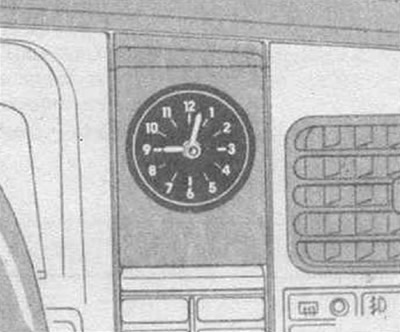
The time is adjusted by pressing and rotating the knurled adjustment button.
Tachometer
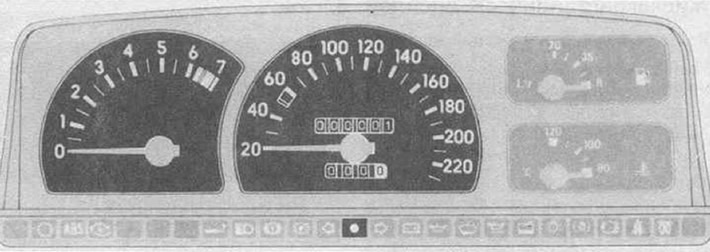
Allows you to save fuel:
- indicates the crankshaft rotation speed per minute.
- Black sector: normal frequency. Try to drive in any gear with minimum engine speed if possible (approximately 2000-3000 rpm) and at a uniform speed.
- Red sector: dangerous RPM sector. Engine damage possible.
Speedometer
Indicates the speed of movement.
Total mileage counter
Registers the total mileage of the vehicle in kilometers.
Daily mileage counter
The reset button is located below the speedometer.
Control lamps
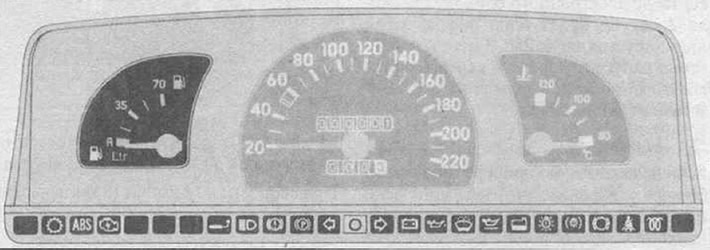
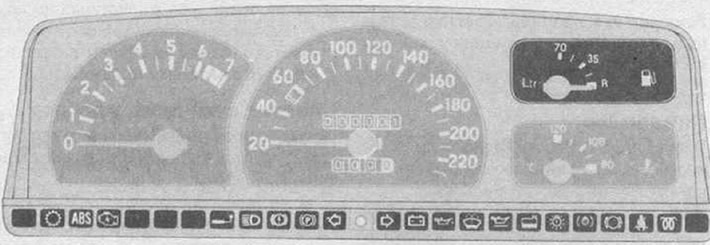
 — fuel reserve
Lights up when the indicator arrow enters the red sector, and earlier on turns, never completely empty the fuel tank!
 — automatic transmission
Position D3 (button pressed) for driving on the road in 1st, 2nd and 3rd gears.
ABS
 — engine electrical equipment
Lights up when moisture gets into the ignition system and during start-up. As soon as the engine starts, it goes out. Lighting up with the engine running means a malfunction. The engine electronics switches to the emergency mode program. You can continue driving to the nearest service station. Long-term operation of the car in this mode is not allowed. Sometimes there may be cases of a short-term one-time lighting of the lamp - this is a normal phenomenon. If after this the lamp goes out and does not light up again, there is no reason to worry.
 — trailer direction indicators
Lights up and flashes at intervals of the turn signals. If it does not light up or stops flashing, one of the trailer turn signal lamps has burned out.
 — high beam
Lights up simultaneously with the high beam or headlight signal.
 — brake system
Lights up when the brake fluid level drops to a critical level. Specialist assistance is required.
In the system self-diagnosis mode, it lights up together with the generator indicator lamp.
 — parking brake and clutch
Lights up when the ignition is on and the parking brake is applied. In all other cases, it warns of a clutch malfunction.
 — direction indicators
Light up simultaneously with the turn signals. An increase in the flashing frequency warns that one of the turn signals has failed.
 — generator, battery charging
Lights up when the ignition is off. Goes out after the engine starts and reaches a certain engine speed.
If it lights up while driving, stop and turn off the engine. The battery is not charging, cooling may deteriorate. The brake booster may fail on a diesel engine. Driving cannot be resumed until the cause of the malfunction is eliminated.
 — engine oil pressure
Lights up when the ignition is turned on. Goes out after the engine starts. May light up briefly when the engine is idling. Should go out when the revs increase. If it lights up while driving, stop the car immediately and turn off the engine. The engine lubrication process may be disrupted. Driving cannot be resumed until the cause of the malfunction is eliminated.

Automatic control system
 — seat belt
Lights up for a few seconds after the ignition is turned on. At the same time, a warning acoustic signal sounds: fasten your seat belts.
 — preheating
Lights only while the preheater is operating (diesel engine) - until the required temperature in the combustion chambers is reached.
Visitor comments