
OpelBook.ru
Cars AvtoVAZ Cars Mitsubishi Cars BMW Cars Mercedes Cars Nissan Cars Toyota Cars Chevrolet
English Русский
Български
Беларускі
Український
Српски
Hrvatski
Română
Polski
Slovenský
Magyar
 |  Sitemap  |  Contacts  |    


Main Astra Corsa Insignia Kadett Omega Vectra Zafira Others Articles
Omega A (1986-1993) Omega B (1993-1999) Omega B2 (1999-2003)
  • Main
  • Omega
  • Omega A
  • General information
  • User manual
  • On-board computer

On-board computer (Opel Omega A)

            0

On-board computer


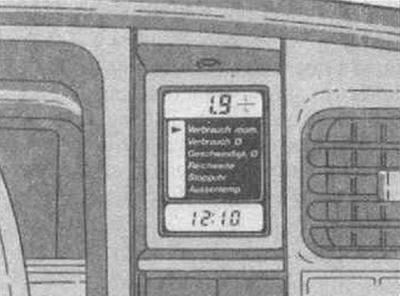
The Opel on-board computer provides the necessary information about the trip, engine operating mode, etc., which it continuously monitors and processes. By pressing the data change button, you can get the following information:
  • instantaneous fuel consumption,
  • average fuel consumption,
  • average speed of movement,
  • power reserve,
  • stopwatch,
  • outside air temperature,
  • time of day and travel time.

Display indications:
  • when ignition is off - time,
  • with the ignition on - time,
  • when you press the data change button - the selected data area.

The letter F (error) on the display indicates that the data is incorrect. The computer needs to be checked at a service station.

Data change button (front)
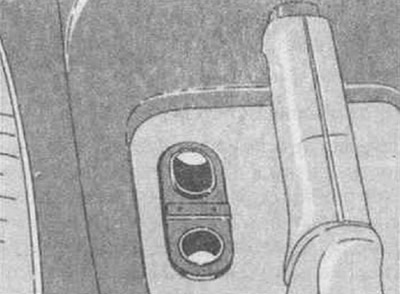


Data change button (front)


Press to select the desired data area.


Start button (rear)
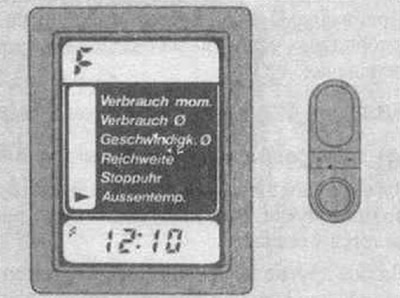


Start button (rear)


By clicking on it (not less than 2 seconds) the average fuel consumption and average speed counter is turned on. Previous information is automatically erased and the stopwatch is set to "0" (zero).

The following information is not reset:
  • times of Day,
  • instantaneous fuel consumption,
  • power reserve,
  • outside air temperature.

Time of day is not set:


When the voltage in the electrical network is disconnected or when it drops to 7 volts, all data is reset.

Original source is on the website: opelbook.ru

After such a voltage drop, followed by starting the engine using the battery of another car and returning to normal voltage, it will be necessary to reactivate the computer.

To do this, you need to disconnect the battery terminals from the engine for at least 2 minutes.

Time is set
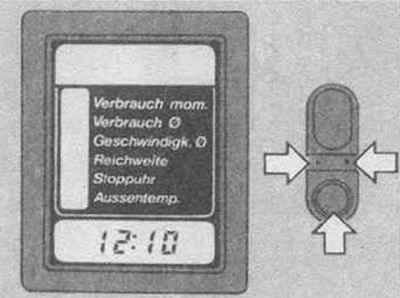


Time is set


Left: hour adjustment button Right: minute adjustment button Using a ballpoint pen, press the adjustment button to set the corresponding time of day with a delay of 1 minute.


When the exact time signal sounds, press the start button.

The time of day is set in two options: 24 hours or 12 hours.

Instantaneous fuel consumption
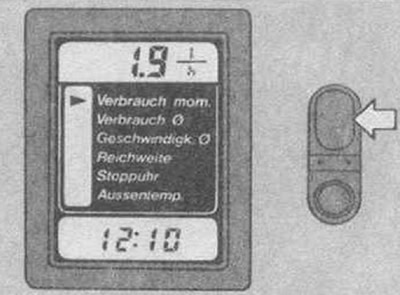


Instantaneous fuel consumption


Readings vary depending on driving speed.
  • Readings in l/h up to 13 km/h.
  • Readings in l/100 km over 13 km/h.
  • Readings 0 l/100 km with traction off.

Average fuel consumption
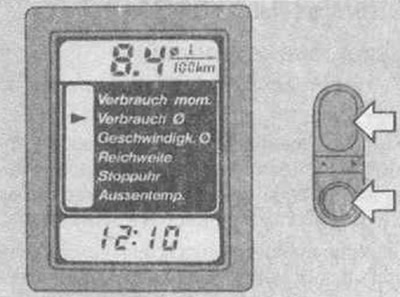


Average fuel consumption


A new calculation of average fuel consumption can be started each time you refuel by pressing the start button.
Readings in 0 l/100 km

Average speed of movement
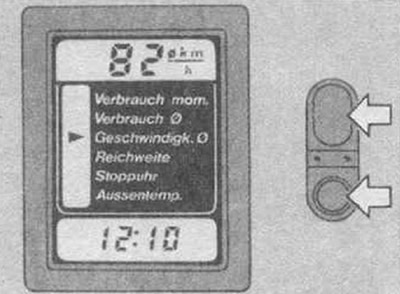


Average speed of movement


A new average speed reading can be started, for example, before each trip by pressing the start button.


The computer does not take into account breaks in movement, stops with the ignition turned off.

Readings at 0 km/h

Power reserve over 50 km
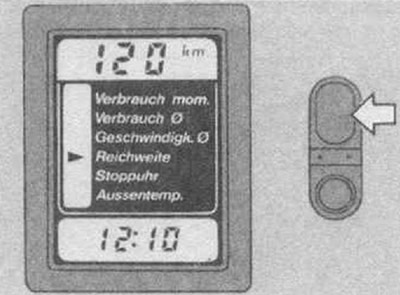


Power reserve over 50 km


The range is calculated based on the actual remaining fuel in the tank and the average fuel consumption over the last 20-30 km of travel.

The new range readings start to count down after refuelling and pressing the start button, or they are automatically displayed on the display after the first approximately 10 km have been driven.

Readings in km

Power reserve up to 50 km
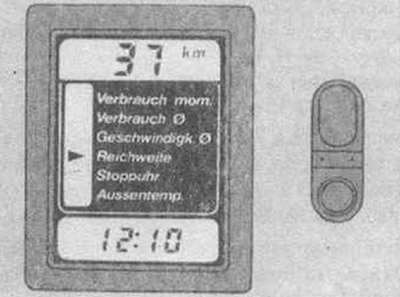


Power reserve up to 50 km


The range indications are displayed on the display automatically without pressing the data selection button if the fuel in the tank is less than 50 km away. They will flash.

They are switched off by selecting and installing the next data area. The power reserve indicators will be automatically switched on again after each stop of the car when the movement is resumed.


Readings in km

Stopwatch


Zero - start - stop - zero...
By pressing the start button
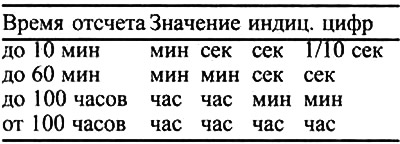
By pressing the start button

The stopwatch counts the time independently of the average fuel consumption data, average speed of movement and in turn does not affect them.

Outside air temperature
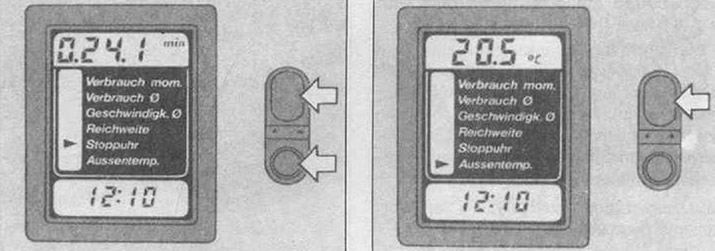


Outside air temperature


Real data on the outside temperature comes from a sensor blown by air during movement. Temperature decrease indicators are indicated immediately. Information on its increase - with a slight delay in order to exclude, if possible, the side effect of thermal radiation of the engine on real readings.

Readings in°C


This article is available at russian, bulgarian, belarusian, ukrainian, serbian, croatian, romanian, polish, slovak, hungarian
Checking the article: Zinoviev Kirill

Share information:

Previous articles
Opel Omega A: User manual
Next articles

Automatic control system
Instruments (LCD instrument panel)
Instruments (pointer instrument panel)
Temperature, fuel and control lamps
Stopping the car
Starting the engine
Door control
Trunk lid, tailgate
Interior Elements Management
Structural safety of the body
Lighting fixtures
Windows, retractable sunroof


See similar ones from other Opel car manuals:
▶ On-board computer Opel Astra J (2009-2015, petrol)
▶ On-board computer Opel Insignia A (2008-2017)
▶ On-board computer Opel Kadett E (1984-1995)
▶ On-board computer Opel Vectra A (1988-1995, petrol)
▶ On-board computer — description, replacement of parts Opel Ascona C (1981-1988)
Link to this page in different formats

Visitor comments


No comments yet


How much will 32 + 27 =


Omega B2 (1999-2003) 
  • General information
  • User manual
  • Maintenance
  • Troubleshooting
  • Power unit
  • Petrol 4-cylinder
  • Petrol 6-cylinder
  • Engine overhaul
  • Diesel engines 2.0 l
  • Diesel engines 2.5 l
  • Cooling and heating
  • Injection system (gasoline)
  • Fuel system (diesel)
  • Fuel system
  • Exhaust system
  • Ignition system
  • Transmission
  • Clutch
  • Mechanical gearbox
  • Automatic gearbox
  • Main gear and shafts
  • Chassis
  • Brake system
  • Car suspension
  • Steering
  • Body
  • Body elements
  • Electrical equipment
  • Equipment and devices
  • Electrical circuits
Omega B (1993-1999) 
  • General information
  • User manual
  • Tips for the car owner
  • Maintenance (gasoline)
  • Maintenance (diesel)
  • Power unit
  • Petrol engine SOHC 2.0 l
  • Petrol engine DOHC 2.0 l
  • Petrol engines 2.5 and 3.0 l
  • Repair of gasoline engines
  • Diesel engine 2.0 l
  • Diesel engine repair 2.0 l
  • Diesel engine 2.5 l
  • Cooling and heating
  • Power system (petrol)
  • Emission reduction
  • Fuel system (diesel 2.0 l)
  • Fuel system (diesel 2.5 l)
  • Launch system
  • Ignition system
  • Transmission
  • Clutch
  • Mechanical gearbox
  • Automatic gearbox
  • Drive shafts
  • Chassis
  • Brake system
  • Wheel suspension
  • Steering
  • Body
  • Exterior
  • Interior
  • Doors and windows
  • Electrical equipment
  • Equipment and devices
  • Wiring diagrams (early)
  • Wiring diagrams (late)
Omega A (1986-1993) 
  • General information
  • User manual
  • Maintenance
  • Changes and additions
  • Troubleshooting
  • Power unit
  • Gasoline engines
  • Diesel engines
  • Cooling system
  • Fuel system (gasoline)
  • Fuel system (diesel)
  • Ignition system
  • Transmission
  • Clutch
  • Mechanical gearbox
  • Automatic gearbox
  • Cardan shaft
  • Drive shafts
  • Chassis
  • Brake system
  • Car suspension
  • Steering
  • Body
  • Exterior
  • Interior
  • Electrical equipment
  • Power devices
  • Lighting and appliances
  • Electrical circuits
OpelBook.ru © 2017–2026 · Mobile version · · Sitemap: EN BG BY UA RS HR RO PL SK HU · Feedback · Site search
Astra F, petrol · Astra G, petrol · Astra G · Astra H · Astra J, petrol · Corsa B · Corsa C, petrol · Corsa C · Insignia A · Kadett D · Kadett E · Omega A · Omega B · Omega B2 · Vectra A, petrol · Vectra A · Vectra B, petrol · Vectra B · Vectra C · Zafira A, petrol · Frontera A, petrol · Frontera B · Ascona C · Vivaro A ·
We want your visit to be comfortable 🤝! We use cookies 🍪 to make that happen.