
OpelBook.ru
Cars AvtoVAZ Cars Mitsubishi Cars BMW Cars Mercedes Cars Nissan Cars Toyota Cars Chevrolet
English Русский
Български
Беларускі
Український
Српски
Hrvatski
Română
Polski
Slovenský
Magyar
 |  Sitemap  |  Contacts  |    


Main Astra Corsa Insignia Kadett Omega Vectra Zafira Others Articles
Astra F (1991-1998, petrol) Astra G (1998-2004, petrol) Astra G (1998-2004) Astra H (2004-2009) Astra J (2009-2015, petrol)
  • Main
  • Astra
  • Astra H
  • General information
  • Maintenance
  • Engine oil

Engine oil (Opel Astra H)

            0

Contents: Visual inspection of leaks ⬇ Checking the level ⬇

Visual inspection of leaks


2. If the engine is oily and has a high oil consumption, check the most likely places where leaks are developing:
  • a) Open the filler cap and check the seal for cracks or damage;
  • b) Crankcase ventilation: e.g. ventilation hose from cylinder head cover to air intake hose;
  • c) Cylinder head cover gasket;
  • d) Cylinder head gasket;
  • e) Oil drain plug (sealing ring);
  • f) Oil pump gasket;
  • g) Oil pan gasket;
  • h) Front and rear crankshaft oil seals.

Since the oil spreads over the engine surface when there are leaks, it is difficult to immediately identify the leak locations. To detect leaks, proceed as follows:

3. Wrap the generator in plastic. Spray the engine with a regular cold cleaner and after a short time rinse with water at a car wash.

4. Sprinkle the outside of the engine component joints with lime or talc.

5. Check the oil level and top up if necessary.

6. Perform a test drive to warm up the oil to normal operating temperature.

7. Finally, examine the engine with a lamp and locate the leaks, eliminating the faults.

Checking the level


8. The engine oil level is checked using a dipstick inserted into the guide tube and lowered into the engine to the bottom of the oil pan.

9. The oil level should be checked before the first trip of the day, or about 5 minutes after the engine has been stopped. If the check is performed immediately after the engine has been turned off, the results will not adequately reflect the situation, since some of the oil will be distributed throughout the internal galleries and components of the engine.


10. Remove the dipstick from the guide tube and wipe its blade dry with a clean rag or paper towel. Insert the dipstick back into the tube until it stops, then remove it again. Inspect the dipstick blade to assess the size of the area wetted with oil. The oil level should be between the upper and lower marks on the dipstick blade (see accompanying illustrations). If necessary, add the appropriate amount of oil of the required grade to the engine.
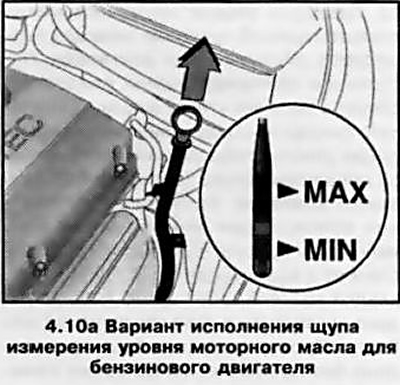
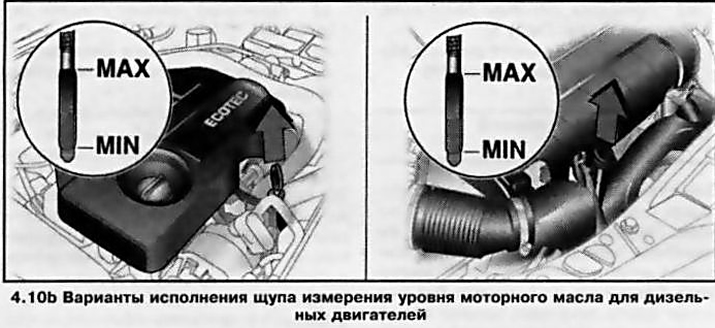
10. Remove the dipstick from the guide tube and wipe its blade dry with a clean rag or paper towel.…


10. Remove the dipstick from the guide tube and wipe its blade dry with a clean rag or paper towel.…


11. To raise the level from the lower (MIN) mark on the dipstick to the upper (MAX) mark, approximately 1 liter of oil is required. Lowering the level beyond the lower limit of the permissible range leads to the development of oil starvation of the engine, which is fraught with serious mechanical damage to the latter. Also try not to overfill the oil above the upper mark, as this can lead to spark plugs being thrown or failure of the power unit seals as a result of excessive pressure increase - if the oil is overfilled, it should be pumped out using a special device.


12. To fill the engine with oil, remove the threaded filler cap. To avoid oil splashing when filling the engine, use a funnel or a long-nosed oiler. After filling the engine with oil, screw on and tighten the cap securely, then start the engine and carefully inspect the drain plug and the surface of the oil filter mating with the block for signs of leaks. Turn off the engine, wait about 5 minutes for the oil to drain into the pan, then check its level again.

13. Checking the engine oil level is an important preventive maintenance procedure for the engine. A constant decrease in the level indicates oil leaks due to failure of seals, damage to sealing gaskets, wear of piston rings or valve guides. If the oil is milky in color or consistency, or if there are drops of water in it, this indicates possible damage to the cylinder head gasket, or the formation of cracks in the body of the head(s) or block. The check should be done without delay. When measuring the oil level, always also check its condition. Use your thumb and forefinger to remove traces of oil from the dipstick blade - if there are small metal particles in it, the oil must be replaced (see Section 6).


This article is available at russian, bulgarian, belarusian, ukrainian, serbian, croatian, romanian, polish, slovak, hungarian
Checking the article: Simonov Timofey

Share information:

Previous articles
Opel Astra H: Maintenance
Next articles

Checking fluid levels
General information about settings and adjustments
Maintenance. General information
Maintenance under severe operating conditions
Additional maintenance work
Maintenance work
Engine coolant
Windshield/Headlight Washer Fluid
Battery electrolyte
Hydraulic fluid for brake and clutch systems
Power steering fluid
Manual transmission oil


See similar ones from other Opel car manuals:
▶ Starting the engine from an auxiliary power source Opel Corsa B (1993-2000)
▶ Engine compartment fuse box Opel Insignia A (2008-2017)
▶ Engine hood Opel Kadett E (1984-1995)
▶ Starting the engine Opel Omega A (1986-1993)
▶ Engine oil level Opel Vectra A (1988-1995, petrol)
Link to this page in different formats

Visitor comments


No comments yet


How much will 39 + 12 =


Astra J (2009-2015, petrol) 
  • General information
  • Vehicle device
  • User manual
  • Faults en route
  • Maintenance
  • Power unit
  • Engine repair
  • Cooling and lubrication system
  • Engine power system
  • Exhaust system
  • Transmission
  • Clutch
  • Car gearbox
  • Drive shafts
  • Chassis
  • Front suspension
  • Rear suspension
  • Steering
  • Brake system
  • Wheels and tires
  • Body
  • Exterior
  • Interior
  • Doors and windows
  • Body Care
  • Heating and air conditioning
  • Security systems
  • Electrical equipment
  • Equipment and devices
  • Lighting and signaling
  • Power devices
  • Electrical circuits
Astra H (2004-2009) 
  • General information
  • Introduction to the guide
  • Troubleshooting
  • User manual
  • Maintenance
  • Power unit
  • Engine repair
  • Cooling and heating
  • Power and exhaust system
  • Ignition system
  • Launch and charge system
  • Transmission
  • Mechanical gearbox
  • Automatic gearbox
  • Drive shafts
  • Chassis
  • Brake system
  • Car suspension
  • Steering
  • Body
  • Interior
  • Exterior
  • Electrical equipment
  • Equipment and devices
  • Electrical circuits
Astra G (1998-2004) 
  • General information
  • Introduction to manual
  • User manual
  • Maintenance
  • Power unit
  • SOHC gasoline engines
  • DOHC gasoline engines
  • Diesel engines 1.7 and 2.0
  • Engine repair
  • Cooling system
  • Supply system
  • Injection system (gasoline)
  • Injection system (diesel)
  • Exhaust system
  • Charge and launch system
  • Ignition system (gasoline)
  • Preheat system (diesel)
  • Transmission
  • Manual gearbox
  • Automatic gearbox
  • Clutch
  • Drive shafts
  • Chassis
  • Brake system
  • Wheel suspension
  • Steering
  • Body
  • Exterior
  • Interior
  • Doors and windows
  • Ventilation and heating
  • Electrical equipment
  • Equipment and devices
  • Electrical circuits
Astra G (1998-2004, petrol) 
  • General information
  • User manual
  • Car care
  • Maintenance
  • Power unit
  • Single shaft engines
  • Twin shaft engines
  • Engine repair
  • Cooling and heating
  • Fuel and exhaust systems
  • Starting and charging system
  • Ignition system
  • Transmission
  • Clutch
  • Mechanical gearbox
  • Automatic gearbox
  • Drive shafts
  • Chassis
  • Brake system
  • Car suspension
  • Steering
  • Body
  • Interior
  • Exterior
  • Electrical equipment
  • Equipment and devices
  • Wiring diagrams Opel Astra
  • Wiring diagrams Opel Zafira
Astra F (1991-1998, petrol) 
  • General information
  • Maintenance
  • Power unit
  • Engine in car
  • Engine removed
  • Cooling system
  • Heating and ventilation
  • Fuel supply (carburetor)
  • Fuel supply (injector)
  • Emission control
  • Ignition system
  • Transmission
  • Clutch
  • Mechanical gearbox
  • Automatic gearbox
  • Drive shafts
  • Chassis
  • Brake system
  • Car suspension
  • Steering
  • Body
  • Exterior
  • Interior
  • Electrical equipment
  • Equipment and devices
  • Electrical circuits
OpelBook.ru © 2017–2026 · Mobile version · · Sitemap: EN BG BY UA RS HR RO PL SK HU · Feedback · Site search
Astra F, petrol · Astra G, petrol · Astra G · Astra H · Astra J, petrol · Corsa B · Corsa C, petrol · Corsa C · Insignia A · Kadett D · Kadett E · Omega A · Omega B · Omega B2 · Vectra A, petrol · Vectra A · Vectra B, petrol · Vectra B · Vectra C · Zafira A, petrol · Frontera A, petrol · Frontera B · Ascona C · Vivaro A ·
We want your visit to be comfortable 🤝! We use cookies 🍪 to make that happen.