


Contents: Lubrication of door hinges and locks ⬇ Checking the rear brake pads and…⬇ Checking the suspension, steering…⬇ Checking the Automatic Transmission…⬇
Lubrication of door hinges and locks
Lubricate the hood, door and trunk or cargo compartment hinges with low-viscosity machine oil. Lubricate the lock tongues, latches and retainers with the same oil. Check the operation and reliability of all hinges, latches and locks. Lightly lubricate the hood release mechanism and the cable sections coming out of the casings with consistent grease. Check the condition of the rear lid pillars. If the pillar does not hold the lid or if fluid leaks are detected, replace the pillars.
Checking the rear brake pads and drums
The verification procedure is discussed in Chapter 9.
Checking the suspension, steering and CV joint boots
1. Set the handbrake, lift the front of the car and place it on stands.
2. Inspect the rubber boots of the ball joints and steering gear, check for cracks, tears and wear. Any damage to these parts leads to loss of lubrication, ingress of dirt and water, and accelerated wear of the parts.
3. On cars with power steering, check the condition of the hydraulic steering hoses, the presence of signs of aging and wear on them, also check the tightness of all tubes and hoses at the points of connection with the fittings. Also check for leakage of fluid under pressure from under the rubber boots of the steering gear. Traces of leakage indicate failure of the steering gear seals.
4. Rock the wheel in a vertical plane, holding the upper and lower handles (see photo). A barely noticeable movement of the wheel is allowed, however, if the play is noticeable, then you should find the cause. Ask an assistant to press the brake pedal and swing the wheel in the vertical plane again. If the play disappears or decreases significantly, then the cause is the failure of the hub bearings. If the play changes slightly when swinging the wheel while pressing the brake, then the suspension ball joints or the parts that fasten the suspension arms to the body are worn out.
Material copied from this website: www.opelbook.ru
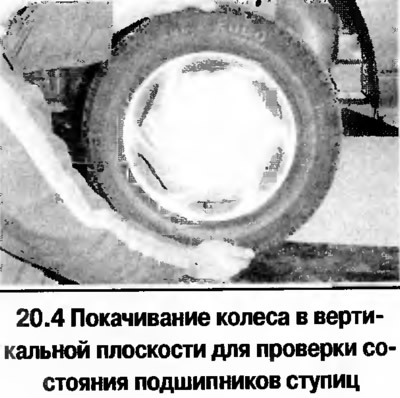
5. Rock the wheel in a horizontal plane. Any noticeable play in this plane may be caused by wear of the hub bearings or tie rod ends. If the inner or outer ends are worn, there will be noticeable play in the wheel.
6 To check the wear of the front suspension bushings, rock the part into which the bushing is pressed with a large screwdriver or crowbar. A small amount of play is allowed due to the elasticity of the rubber. Significant play in the bushings will be easily noticeable. Also check the condition of all visible rubber bushings for cracks, delamination, or swelling of the rubber.
7. Lower the car and ask an assistant to turn the steering wheel in both directions by one eighth of a turn. There should be no play in the steering wheel at all, a barely noticeable play is also acceptable. Otherwise, carefully check all the suspension joints, in addition, check the condition of the steering column cardan joint, as well as the steering gear parts.
Checking the rear suspension
8. The inspection procedure is no different from that discussed above for the front suspension.
Checking shock absorbers
9. The serviceability of the shock absorbers can be checked by pressing sharply on the front part of the car wing. After releasing, the body should return to its previous position without oscillating. Weak vibrations of the body after pressing indicate a possible malfunction of the strut mounts or shock absorbers.
Checking axle shaft covers
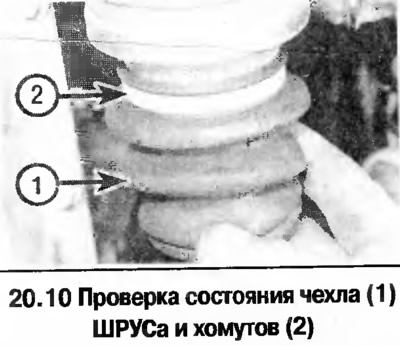
10. Raise the car and place it on stands. Turn the steering wheel all the way and slowly rotate the wheel. Check the condition of the rubber boot of the outer CV joint by spreading the folds of the boot. Check for cracks, tears and signs of aging of the rubber, which can cause the grease to be washed out and dirt and water to get inside the joint. Also check the tightness and condition of the boot clamps. Repeat the same steps for the inner CV joint (see photo) If any damage or signs of wear are found, the covers should be replaced (see Chapter 8).
11. Check the condition of the CV joints by holding the axle shaft and trying to turn the wheel. Then try to turn the axle shaft while holding the inner joint. Any noticeable play indicates wear of the joint splines, axle shaft splines, or looseness of the axle shaft nut.
Checking the Automatic Transmission Fluid Level
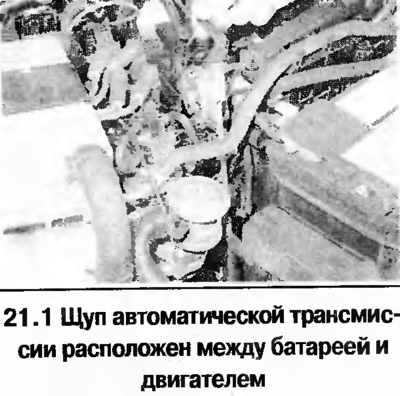
1. Take a short drive to warm up the transmission fluid, then park the car on a level surface. The transmission fluid level is checked with the dipstick, which is located between the battery and the engine.
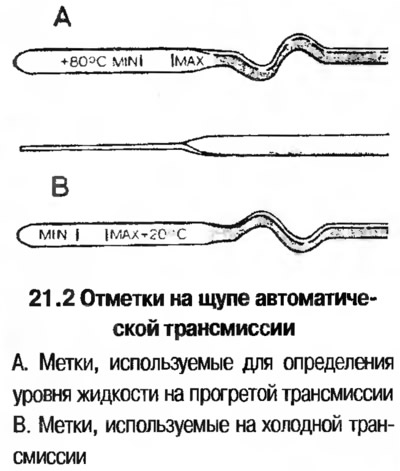
2. Switch the engine to idle mode, set the selector lever to the "P" position. Remove the dipstick from the measuring pipe and wipe dry. Insert the dipstick back into place until it stops in the pipe, then remove the dipstick. Determine the level by the position of the liquid film boundary, which should be between the two marks (see photo). On a warm transmission, marks with the inscription +80°C are used, on a cold transmission - marks with the inscription +20°C (from the opposite side of the probe).
3. Add fluid to the transmission (if necessary) should be through the measuring pipe, inserting a funnel with a thin metal mesh so as not to spill the liquid and exclude the ingress of foreign impurities. It is necessary to add liquid until the level is established between the upper and lower marks of the dipstick. Attention! The liquid level should always be below the upper mark, pouring liquid is prohibited to avoid failure of the transmission.
4. When finished, take a short drive to allow the fluid to distribute evenly throughout the transmission, then check the level again and top up if necessary.
5. Always keep the fluid level between the upper and lower marks. If the level drops below the lower mark, it may cause transmission damage.
Visitor comments