
OpelBook.ru
Cars AvtoVAZ Cars Mitsubishi Cars BMW Cars Mercedes Cars Nissan Cars Toyota Cars Chevrolet
English Русский
Български
Беларускі
Український
Српски
Hrvatski
Română
Polski
Slovenský
Magyar
 |  Sitemap  |  Contacts  |    


Main Astra Corsa Insignia Kadett Omega Vectra Zafira Others Articles
Vectra A (1988-1995, petrol) Vectra A (1988-1995) Vectra B (1995-2002, petrol) Vectra B (1995-2002) Vectra C (2002-2008)
  • Main
  • Vectra
  • Vectra B
  • Power unit
  • Exhaust system
  • Exhaust Gas Recirculation (AGR)

Exhaust Gas Recirculation (AGR) (Opel Vectra B)

            0

At high combustion temperatures in the engine, the proportion of nitrogen oxides in the exhaust gases inevitably increases. The possibility of reducing the temperature in the combustion chambers is ensured by introducing exhaust gases into them. From the flow of gases exhausted by the engine, a part is separated by a system regulated by a valve. Its amount is dosed depending on the engine load and returned to the intake manifold. Since the exhaust gases contain almost no particles capable of combustion, they cannot burn again. But they reduce the flow of fresh fuel-air mixture and, thus, affect the reduction of the temperature in the combustion chamber and, consequently, the reduction of the proportion of nitrogen oxides. Since recirculation of exhaust gases is necessary only at partial load, the ignition/injection control unit has a special program for recirculation of exhaust gases. The following design units are involved in this process, some of which are described in detail in the chapters devoted to injection:

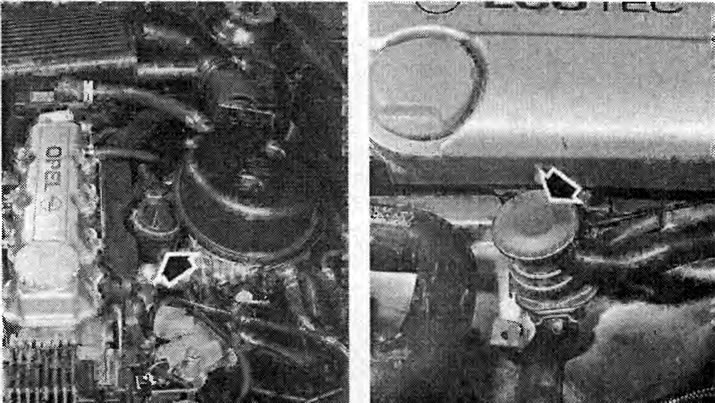
The photo on the left shows the EGR valve (arrow) in the 8-valve 1.6L Vectra engine. On the right…

The photo on the left shows the EGR valve (arrow) in the 8-valve 1.6L Vectra engine. On the right is the EGR valve (arrow) in the 16V 1.6L engine.
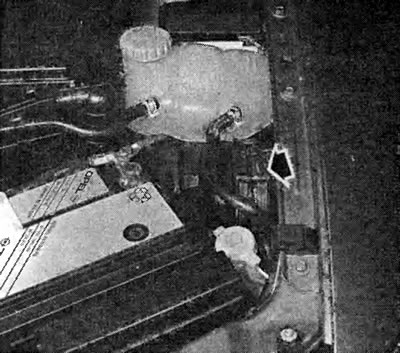

The secondary air pump (arrow) in vehicles with 16V engines is installed at the front left in the…

The secondary air pump (arrow) in vehicles with 16V engines is installed at the front left in the engine compartment.


Idle switch contact in throttle potentiometer; it ensures that exhaust gases are not recirculated at idle and in forced idle mode.


Coolant temperature sensor: When the engine is cold, recirculation is not needed. During the warm-up phase, a reduced amount of exhaust gases are recirculated.

Pulse sensor for signaling the speed of rotation to disable exhaust gas recirculation at speeds above 3000 rpm.

The EGR valve with pulse sensor opens the path for recirculated exhaust gases into the intake manifold, while the current valve position is signaled to the ignition/injection control unit.

The ignition/injection control unit, depending on the need, sends an activation signal to the EGR valve via two electromagnetic valves (taking into account the mentioned information at the entrance).

Advice: Malfunctions in the exhaust gas recirculation system are hardly noticeable by engine malfunctions. Preventive monitoring is not provided. In case of doubt, contact an Opel workshop with its control devices.


(Article posted on a web portal: OpelBook.ru)


This article is available at russian, bulgarian, belarusian, ukrainian, serbian, croatian, romanian, polish, slovak, hungarian
Checking the article: Shapovalov Yaroslav

Share information:

Previous articles
Opel Vectra B: Exhaust system
Next articles

Operating a vehicle with a catalytic converter
Lambda probe function
Reducing toxicity of exhaust gases
What does the engine emit?
Ensuring clean exhaust
Replacing the exhaust system
Secondary air boost


See similar ones from other Opel car manuals:
▶ Exhaust Gas Recirculation System — Check Opel Astra F (1991-1998, petrol)
▶ Exhaust gas recirculation system components Opel Omega B (1993-1999)
▶ Exhaust Gas Recirculation Valve — Replacement Opel Zafira A (1999-2005, petrol)
▶ Exhaust gas recirculation system Opel Vivaro A (2001-2014)
▶ Checking the exhaust system Opel Corsa B (1993-2000)
Link to this page in different formats

Visitor comments


No comments yet


How much will 35 + 20 =


Vectra C (2002-2008) 
  • General information
  • User manual
  • Vehicle device
  • Maintenance
  • Troubleshooting
  • Power unit
  • Engine repair
  • Cooling system
  • Power and control system
  • Engine electrics
  • Transmission
  • Clutch
  • Car gearbox
  • Drive shafts
  • Chassis
  • Car suspension
  • Steering
  • Brake system
  • Body
  • Exterior
  • Interior
  • Doors, locks and windows
  • Heating and ventilation
  • Electrical equipment
  • Equipment and devices
  • Headlights and lighting
  • Electrical circuits
Vectra B (1995-2002) 
  • General information
  • User manual
  • Weekly checks
  • Maintenance (gasoline)
  • Maintenance (diesel)
  • Troubleshooting
  • Power unit
  • SOHC gasoline engine
  • DOHC petrol engine
  • Diesel engine 1.7 liter
  • Diesel engine 2.0 liters
  • Engine repair
  • Cooling system
  • Fuel system (gasoline)
  • Fuel system (diesel)
  • Charging system
  • Launch system
  • Ignition and preheat
  • Transmission
  • Clutch
  • Mechanical gearbox
  • Automatic gearbox
  • Drive shafts
  • Chassis
  • Brake system
  • Wheel suspension
  • Steering
  • Body
  • Exterior
  • Interior
  • Doors and windows
  • Heating and ventilation
  • Electrical equipment
  • Equipment and devices
  • Electrical circuits
Vectra B (1995-2002, petrol) 
  • General information
  • Maintenance
  • Help with malfunctions
  • Power unit
  • Engine repair
  • Exhaust system
  • Cooling system
  • Fuel system
  • Multec injection system
  • Four point injection
  • Transmission
  • Clutch
  • Gearbox and drive
  • Chassis
  • Wheel suspension
  • Steering
  • Brake system
  • Wheels and tires
  • Body
  • Exterior
  • Interior
  • Electrical equipment
  • Fuses and electronics
  • Power devices
  • Ignition system
  • Lighting and signaling
  • Equipment and devices
  • Heating and ventilation
  • Electrical circuits
Vectra A (1988-1995) 
  • Power unit
  • Engine repair
  • Ignition system
  • Lubrication system
  • Cooling system
  • Injection system
  • Fuel system (carburetor)
  • Fuel system (diesel)
  • Exhaust system
  • Transmission
  • Clutch
  • Car gearbox
  • Chassis
  • Front suspension
  • Rear suspension
  • Steering
  • Brake system
  • Wheels and tires
  • Body
  • Exterior
  • Interior
  • Electrical equipment
  • Electrical circuits
Vectra A (1988-1995, petrol) 
  • General information
  • User manual
  • Maintenance
  • Power unit
  • SOHC engine
  • DOHC engine
  • Cooling and ventilation
  • Fuel system (carburetor)
  • Fuel system (injector)
  • Exhaust converter
  • Transmission
  • Clutch
  • Mechanical gearbox
  • Automatic gearbox
  • Drive shafts
  • Chassis
  • Brake system
  • Car suspension
  • Steering
  • Body
  • Body elements
  • Electrical equipment
  • Power devices
  • Equipment and devices
  • Electrical circuits
OpelBook.ru © 2017–2026 · Mobile version · · Sitemap: EN BG BY UA RS HR RO PL SK HU · Feedback · Site search
Astra F, petrol · Astra G, petrol · Astra G · Astra H · Astra J, petrol · Corsa B · Corsa C, petrol · Corsa C · Insignia A · Kadett D · Kadett E · Omega A · Omega B · Omega B2 · Vectra A, petrol · Vectra A · Vectra B, petrol · Vectra B · Vectra C · Zafira A, petrol · Frontera A, petrol · Frontera B · Ascona C · Vivaro A ·
We want your visit to be comfortable 🤝! We use cookies 🍪 to make that happen.