


That's why:
- Rolling, moving or towing is not a problem if the starter does not turn the engine due to a dead battery.
- Towing over long distances - which, for example, can happen with faulty ignition - is unacceptable, since a large amount of unburned fuel gets into the exhaust system, which has especially harmful consequences if the catalytic converter has not yet warmed up.
- If interruptions or defects in ignition allow us to conclude that there is a malfunction in the ignition system, then it should be checked immediately (in the workshop). Avoid high engine speeds during long trips.
- During prolonged engine operation at full gas flow, the catalytic converter also cannot overheat, since the increased gas flow acts to a certain extent as a cooling agent on the catalytic converter. Its center is much hotter due to "residual combustion" than the temperature of the exhaust gases ejected from the engine.
Besides:
- In the middle of summer after a long drought, do not park your car on dry leaves, hay, etc. Under particularly unfavorable circumstances, this could lead to a fire under the car.
- If necessary, check the raised vehicle to ensure that the heat shields are not damaged or missing.
What else you need to know:
- Additives in fuel and motor oils do not harm the catalytic converter. And you can be completely sure of this if the working substances are approved by Opel.
Material copied from this resource OPELBOOK.ru
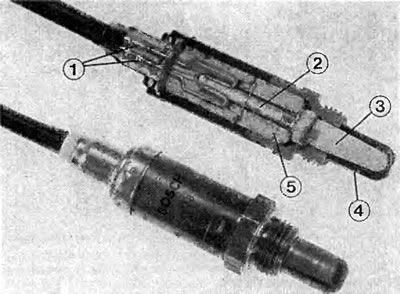
Lambda probe assembled and in section. The numbers indicate:
1 - connection of probe heating;
2 - heating rod;
3 - probe ceramics;
4 - protective tube;
5 - supporting ceramics.
Defects in the catalytic converter or lambda probe can be detected by an exhaust gas test. A catalytic converter with thermal damage is recognized by a knocking sound. The ceramic body of the catalytic converter is compressed by partial melting, which leads to its free movement in the metal shell.
Tip: Sometimes cars with a catalytic converter attract attention with a strong smell. The bad smell is emitted by small amounts of the sulfur compound H ₂ S (hydrogen sulfide), which can form in the catalytic converter. This toxic substance is completely harmless at the concentrations found in cars. Help: none. As an experiment, fill up at a different gas station to find fuel with a lower sulfur content.
Visitor comments