


Find the appropriate electrical diagram for each switch.
First, it is checked whether voltage is supplied to the switch at all; for these purposes, you need to turn on the ignition or lighting.
Then it is checked whether the switch supplies voltage in the appropriate position.
Using the ignition/start switch as an example, it looks like this:
Remove the steering column trim to gain access to the connecting wire.
Connect the test lamp wire to ground.
Use the test tip to pierce the insulation:
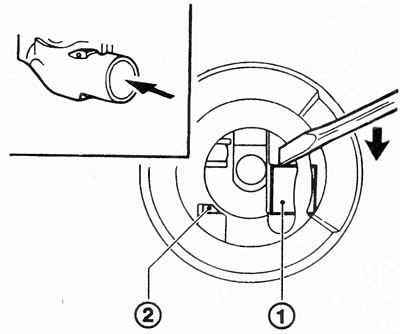
If the steering lock bolt (1) is locked when installing the lock drum, use a screwdriver to press the bolt down until the locking pin (2) locks. Now install the lock drum.
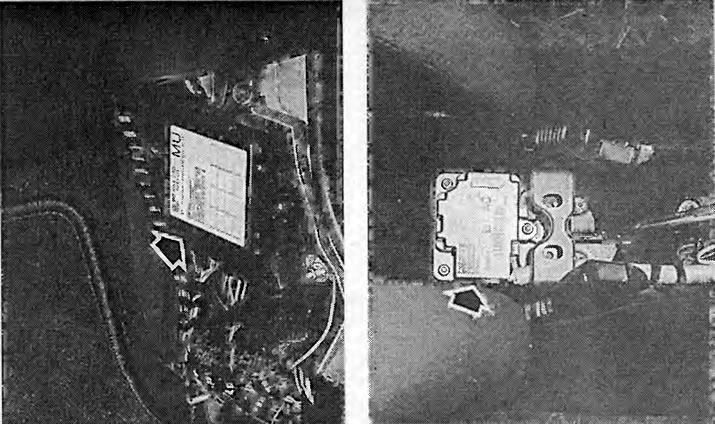
The photo on the left shows the central locking or anti-theft system control unit on the right at the passenger's feet next to the driver.
Right: the airbag control unit is located between the front seats under the center console.
There is voltage at terminal 1 5A of the thinner black wire only when the key is in the "ignition on" position.
(Material copied from the portal: opelbook)
The thick black wire of terminal 1 5 is energized only in the "ignition on" and "engine start" positions.
The black/red wire at terminal 50, which sends the crank signal to the starter, is only energized in the "Engine Start" position.
In this way you can check switches whose connecting wires you can get to with a test lamp. If you cannot get to the connecting wire of a switch without great effort, you can check as follows:
Example of rear seat heating key switch: remove the switch.
First, check if the switch is OK. Connect an ohmmeter to the tongues of contacts "2" and "3".
When the switch is in the "on" position, the ohmmeter should show 0 Ohms. When the switch is in the "off" position, the device shows ∞ Ohms.
If the switch is OK, the connecting terminals are checked.
To identify the connection terminals, first grasp the switch. The marked contact tabs (1 through 5) can be used to identify the connection terminals.
Now you can check whether current is supplied through the corresponding terminals and, accordingly, whether there is contact with the ground.
Visitor comments