
OpelBook.ru
Cars AvtoVAZ Cars Mitsubishi Cars BMW Cars Mercedes Cars Nissan Cars Toyota Cars Chevrolet
English Русский
Български
Беларускі
Український
Српски
Hrvatski
Română
Polski
Slovenský
Magyar
 |  Sitemap  |  Contacts  |    


Main Astra Corsa Insignia Kadett Omega Vectra Zafira Others Articles
Vectra A (1988-1995, petrol) Vectra A (1988-1995) Vectra B (1995-2002, petrol) Vectra B (1995-2002) Vectra C (2002-2008)
  • Main
  • Vectra
  • Vectra A
  • Chassis
  • Steering
  • General information and structure

General information and structure (Opel Vectra A)

            0

The steering system consists of a steering wheel, steering gear, and steering rods. The steering wheel is mounted on a steering column, which transmits force to the steering gear. The steering rods, connected to a toothed rack, transmit force to the wheels.

The rack and pinion steering has a smooth movement and no play. It also does not require maintenance, except for checking the condition of the sealing cuffs.

Some versions of cars are equipped with a power steering system, which makes it much easier to turn the steering wheel. The power steering system consists of an oil pump, an oil tank and oil lines. The pump is driven by a wedge or (on a 1.6 l engine) toothed belt. In all-wheel drive vehicles, the oil tank has a larger capacity, since the hydraulic system also ensures the operation of the disengaging fluid coupling. The pump sucks oil from the tank and delivers it under high pressure to the distributor valve. The valve is located on the steering gearbox, and, being mechanically connected to the steering column, supplies oil (depending on the degree of steering wheel rotation in one direction) to a certain side of the working cylinder. In the cylinder, the oil presses on the piston of the toothed rack, thereby facilitating the turning of the steering wheel. At the same time, the piston squeezes oil from the other side of the working cylinder through the drain hole and then through the drain pipe back into the tank.

There is also a steering option with the ability to adjust the steering column height relative to the floor of the passenger compartment. Thanks to this, the driver has the ability to choose the most comfortable position for the steering wheel. The steering wheel height is adjusted manually using a lock. When the lock is pulled out, the steering column is released, and under the action of the spring, the steering wheel is set to the highest possible position, which makes it easier to lift it in different positions of the driver's seat. In this position of the lock, the steering wheel can be set to one of five different positions, the most comfortable for the driver. To fix the column in the desired position, release the lock. The steering column height adjustment mechanism does not require maintenance.


Caution! If the mechanism is disassembled, use new self-locking nuts. Do not perform any welding or straightening work on the steering! Figure D0247 shows the steering without the height adjustment mechanism.
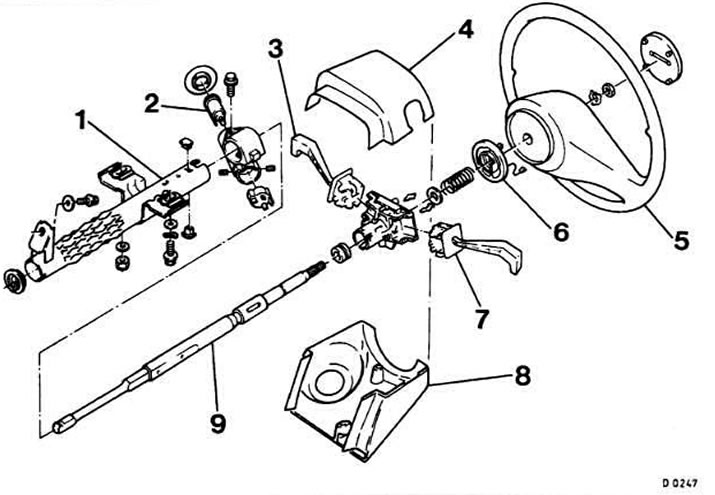

1 - steering column support pipe

1 - steering column support pipe
2 - lock cylinder
3 - Windscreen wiper switch
4 - Upper steering column trim
5 - steering wheel
6 - contact ring
7 - direction indicator switch
8 - lower steering column trim
9 - steering shaft
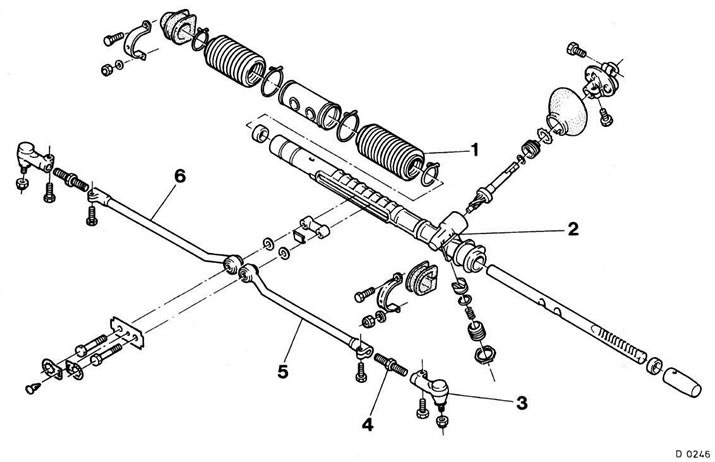

1 - protective cover

1 - protective cover
2 - steering gear
3 - steering rod end
4 - adjusting pin
5 - left steering rod
6 - right steering rod


This article is available at russian, bulgarian, belarusian, ukrainian, serbian, croatian, romanian, polish, slovak, hungarian
Checking the article: Zinoviev Kirill

Share information:

Previous articles
Opel Vectra A: Steering
Next articles

Removal and installation the steering wheel
Removal and installation of steering rods
Removal and installation tie rod ends
Removal and installation the power steering reservoir
Removal and installation the power steering pump
Bleeding the hydraulic system (front-wheel drive vehicles)


See similar ones from other Opel car manuals:
▶ Trunk — structure and contents Opel Astra J (2009-2015, petrol)
▶ Cylinder head structure Opel Insignia A (2008-2017)
▶ The structure of the system «Motronic ML4.1» Opel Kadett E (1984-1995)
▶ Sunroof (sliding/tilting type) — removal and installation… Opel Ascona C (1981-1988)
Link to this page in different formats

Visitor comments


No comments yet


How much will 40 + 31 =


Vectra C (2002-2008) 
  • General information
  • User manual
  • Vehicle device
  • Maintenance
  • Troubleshooting
  • Power unit
  • Engine repair
  • Cooling system
  • Power and control system
  • Engine electrics
  • Transmission
  • Clutch
  • Car gearbox
  • Drive shafts
  • Chassis
  • Car suspension
  • Steering
  • Brake system
  • Body
  • Exterior
  • Interior
  • Doors, locks and windows
  • Heating and ventilation
  • Electrical equipment
  • Equipment and devices
  • Headlights and lighting
  • Electrical circuits
Vectra B (1995-2002) 
  • General information
  • User manual
  • Weekly checks
  • Maintenance (gasoline)
  • Maintenance (diesel)
  • Troubleshooting
  • Power unit
  • SOHC gasoline engine
  • DOHC petrol engine
  • Diesel engine 1.7 liter
  • Diesel engine 2.0 liters
  • Engine repair
  • Cooling system
  • Fuel system (gasoline)
  • Fuel system (diesel)
  • Charging system
  • Launch system
  • Ignition and preheat
  • Transmission
  • Clutch
  • Mechanical gearbox
  • Automatic gearbox
  • Drive shafts
  • Chassis
  • Brake system
  • Wheel suspension
  • Steering
  • Body
  • Exterior
  • Interior
  • Doors and windows
  • Heating and ventilation
  • Electrical equipment
  • Equipment and devices
  • Electrical circuits
Vectra B (1995-2002, petrol) 
  • General information
  • Maintenance
  • Help with malfunctions
  • Power unit
  • Engine repair
  • Exhaust system
  • Cooling system
  • Fuel system
  • Multec injection system
  • Four point injection
  • Transmission
  • Clutch
  • Gearbox and drive
  • Chassis
  • Wheel suspension
  • Steering
  • Brake system
  • Wheels and tires
  • Body
  • Exterior
  • Interior
  • Electrical equipment
  • Fuses and electronics
  • Power devices
  • Ignition system
  • Lighting and signaling
  • Equipment and devices
  • Heating and ventilation
  • Electrical circuits
Vectra A (1988-1995) 
  • Power unit
  • Engine repair
  • Ignition system
  • Lubrication system
  • Cooling system
  • Injection system
  • Fuel system (carburetor)
  • Fuel system (diesel)
  • Exhaust system
  • Transmission
  • Clutch
  • Car gearbox
  • Chassis
  • Front suspension
  • Rear suspension
  • Steering
  • Brake system
  • Wheels and tires
  • Body
  • Exterior
  • Interior
  • Electrical equipment
  • Electrical circuits
Vectra A (1988-1995, petrol) 
  • General information
  • User manual
  • Maintenance
  • Power unit
  • SOHC engine
  • DOHC engine
  • Cooling and ventilation
  • Fuel system (carburetor)
  • Fuel system (injector)
  • Exhaust converter
  • Transmission
  • Clutch
  • Mechanical gearbox
  • Automatic gearbox
  • Drive shafts
  • Chassis
  • Brake system
  • Car suspension
  • Steering
  • Body
  • Body elements
  • Electrical equipment
  • Power devices
  • Equipment and devices
  • Electrical circuits
OpelBook.ru © 2017–2026 · Mobile version · · Sitemap: EN BG BY UA RS HR RO PL SK HU · Feedback · Site search
Astra F, petrol · Astra G, petrol · Astra G · Astra H · Astra J, petrol · Corsa B · Corsa C, petrol · Corsa C · Insignia A · Kadett D · Kadett E · Omega A · Omega B · Omega B2 · Vectra A, petrol · Vectra A · Vectra B, petrol · Vectra B · Vectra C · Zafira A, petrol · Frontera A, petrol · Frontera B · Ascona C · Vivaro A ·
We want your visit to be comfortable 🤝! We use cookies 🍪 to make that happen.