
OpelBook.ru
Cars AvtoVAZ Cars Mitsubishi Cars BMW Cars Mercedes Cars Nissan Cars Toyota Cars Chevrolet
English Русский
Български
Беларускі
Український
Српски
Hrvatski
Română
Polski
Slovenský
Magyar
 |  Sitemap  |  Contacts  |    


Main Astra Corsa Insignia Kadett Omega Vectra Zafira Others Articles
Frontera A (1991-1998, petrol) Frontera B (1998-2004) Ascona C (1981-1988) Vivaro A (2001-2014)
  • Main
  • Opel
  • Frontera B
  • General information
  • User manual
  • Adjusting the front seat position

Adjusting the front seat position (Opel Frontera B)

            0

Contents: Adjusting the longitudinal position…⬇ Adjusting the angle of the front…⬇ To make it easier to get into the…⬇ Driver's seat height adjustment ⬇
Adjust the driver's seat to a position that allows easy operation of the pedals, steering wheel, and instrument panel switches while still providing good visibility.

Warnings:
  • Do not adjust the driver's seat position while the vehicle is moving, as full attention should be given to driving the vehicle. The seat may suddenly move, resulting in loss of vehicle control.
  • After adjustment, gently rock the seat to ensure it is securely in place.
  • No objects are allowed in the footwell, as they may get caught under the pedals in the event of emergency braking. In this case, you will not be able to brake, press the clutch pedal or the accelerator pedal. It is important for the driver and front passenger to maintain a minimum distance of 25 cm from the steering wheel/instrument panel. Otherwise, the airbag system will not be able to perform its protective function, which is life-threatening. In addition, the front seats and headrests should always be installed according to height.
  • Adjust the seat position only before starting to move.


Adjusting the longitudinal position of the front seat
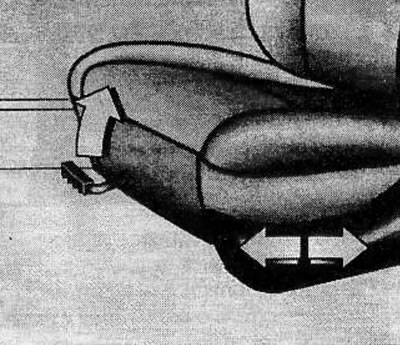


Adjusting the longitudinal position of the front seat


Pull up on the seat adjustment lever and move the seat forward or backward to the desired position. After adjustment, release the adjustment lever to lock the seat in the new position.


Warnings:
  • To make sure the seat is securely locked, try moving it forward or backward without using the adjustment lever.
  • It is important for the driver and front passenger to maintain a minimum distance of 25 cm from the steering wheel/instrument panel. Otherwise, the airbag system will not be able to perform its protective function, which is life-threatening. In addition, the front seats and headrests should always be installed according to height.


Adjusting the angle of the front seat backrest
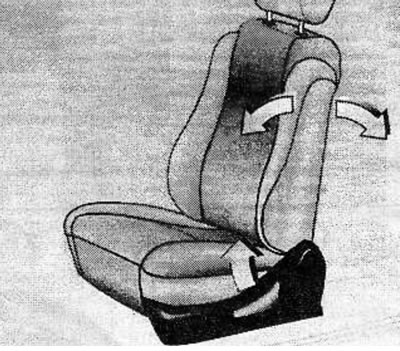


Adjusting the angle of the front seat backrest


The angle of the seat back is adjusted after lifting the handle. To tilt the seat back forward, first lean your body away from the back. After releasing the handle, the seat back will lock into place.

Warnings:
  • To reduce the risk of injury in the event of a collision or sudden braking, the seatbacks should be kept in a nearly upright position while the vehicle is moving. The effectiveness of seat belts may be significantly reduced if the seat back is reclined. In this case, there is a risk that the passenger will slip out from under the seat belt and as a result will be seriously injured.
  • Do not place pillows, etc. between your back and the seat back while traveling in a car. This will reduce the effectiveness of the head restraints in the event of an accident.


To make it easier to get into the back seat
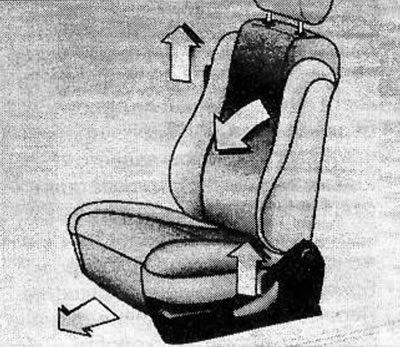


To make it easier to get into the back seat


To make it easier to get into the back seat, move the front seat forward. Press the backrest locking lever located on the side of the backrest, which will unlock the seat back and tilt it forward. The backrest is returned to its original position after being lifted up.

After setting the seat to its original position, adjust its position.

Driver's seat height adjustment
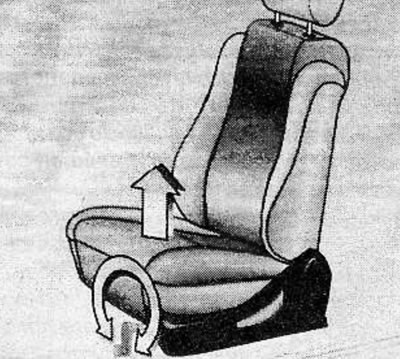


Driver's seat height adjustment


To raise or lower the seat, turn the handle in the appropriate direction.


This article is available at russian, bulgarian, belarusian, ukrainian, serbian, croatian, romanian, polish, slovak, hungarian
Checking the article: Chernov Alexander

Share information:

Previous articles
Opel Frontera B: User manual
Next articles

Door locks
Key numbers and codes
Instrument panel
Headrests — adjustment
Central rear headrest
Steering column adjustment
Seat belt
Adjusting the rear view mirrors
Ignition switch and engine start


See similar ones from other Opel car manuals:
▶ Adjusting the position of the front seats Opel Astra J (2009-2015, petrol)
▶ Adjusting the position of the steering wheel and seat Opel Zafira A (1999-2005, petrol)
▶ Folding the front passenger seat back Opel Corsa C (2000-2006, petrol)
▶ Adjusting the position of the steering wheel Opel Insignia A (2008-2017)
▶ Adjusting the clearance in the front wheel hub bearing Opel Kadett E (1984-1995)
Link to this page in different formats

Visitor comments


No comments yet


How much will 46 + 18 =


Vivaro A (2001-2014) 
  • General information
  • User manual
  • Power unit
  • Petrol engine F4R
  • Diesel engine F9Q
  • Diesel engine G9U
  • Transmission
  • Clutch and drive shafts
  • Manual gearbox
  • Chassis
  • Front suspension
  • Rear suspension
  • Brake system
  • Body
  • Exterior
  • Interior
  • Electrical equipment
  • Heating and ventilation
  • Air conditioner
  • Equipment and devices
  • Electrical diagrams
Ascona C (1981-1988) 
  • General information
  • Maintenance
  • Power unit
  • Gasoline engines
  • Diesel engines
  • Cooling system
  • Fuel and exhaust system
  • Contact ignition system
  • Contactless ignition system
  • Transmission
  • Clutch
  • Mechanical gearbox
  • Automatic gearbox
  • Drive shafts
  • Chassis
  • Steering
  • Brake system
  • Car suspension
  • Body
  • Exterior
  • Interior
  • Doors and windows
  • Electrical equipment
  • Equipment and devices
  • Power devices
  • Electrical circuits
Frontera B (1998-2004) 
  • General information
  • User manual
  • Maintenance
  • Power unit
  • Petrol engines 2.2 l
  • Petrol engines 3.2 l
  • Diesel engines 2.2 l
  • Cooling system
  • Fuel system (petrol)
  • Fuel system (diesel)
  • Ignition system
  • Transmission
  • Clutch
  • Manual gearbox MUA5C
  • Automatic gearbox 4L30E
  • Chassis
  • Suspension and axles
  • Steering
  • Brake system
  • Body
  • Exterior
  • Interior
  • Doors, locks and windows
  • Heating and air conditioning
  • Electrical equipment
  • Power devices
  • Equipment and devices
  • Lighting and signaling
  • Electrical diagrams
Frontera A (1991-1998, petrol) 
  • General information
  • Introduction to guide
  • User manual
  • Maintenance
  • Power unit
  • Engine repair
  • Lubrication system
  • Cooling system
  • Power and exhaust system
  • Engine electrics
  • Transmission
  • Clutch
  • Mechanical gearbox
  • Cardan shafts
  • Chassis
  • Brake system
  • Front suspension
  • Rear suspension
  • Steering
  • Body
  • Repair and care
  • Electrical equipment
  • Equipment and devices
  • Electrical circuits
OpelBook.ru © 2017–2026 · Mobile version · · Sitemap: EN BG BY UA RS HR RO PL SK HU · Feedback · Site search
Astra F, petrol · Astra G, petrol · Astra G · Astra H · Astra J, petrol · Corsa B · Corsa C, petrol · Corsa C · Insignia A · Kadett D · Kadett E · Omega A · Omega B · Omega B2 · Vectra A, petrol · Vectra A · Vectra B, petrol · Vectra B · Vectra C · Zafira A, petrol · Frontera A, petrol · Frontera B · Ascona C · Vivaro A ·
We want your visit to be comfortable 🤝! We use cookies 🍪 to make that happen.