


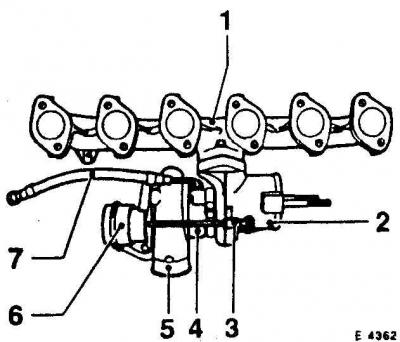
1. Exhaust manifold
2. Turbocharger
3. Air supply control valve rod
4. Connection of the return oil line
5. Compressor body
6. Discharge pressure control valve
7. Oil pipeline
Intake Manifold Parts
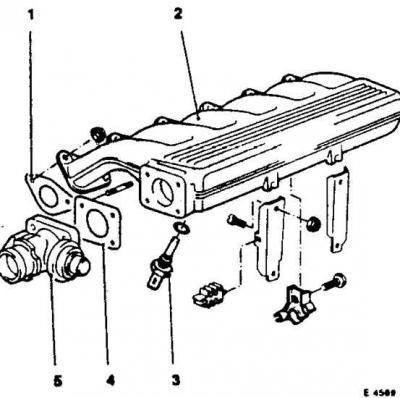
1. Gasket
2. Intake manifold
3. Charge air temperature sensor
4. Gasket
5. Exhaust gas return valve Warning! Remove the cylinder head only on a cooled engine.
The exhaust and intake manifolds are unscrewed from the cylinder head and remain on the vehicle.
A faulty cylinder head can be identified by various signs.
Cars without air conditioning
Removal
1. Disconnect the battery ground cable.
Warning! This will erase data from the electronic memory, such as the radio's security code.
2. Remove the lower engine compartment shield.
3. Drain the coolant (also from the cylinder block).
4. Drain the engine oil.
5. Remove the vacuum hose with the elbow on the brake booster.
6. Disconnect the thin vacuum tubes at the vacuum hose check valve.
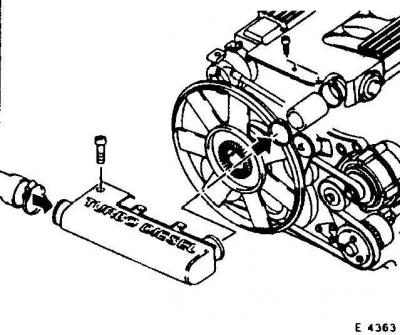
7. Unscrew the air injection pipe on the cylinder head and disconnect the air hoses after loosening the clamps.
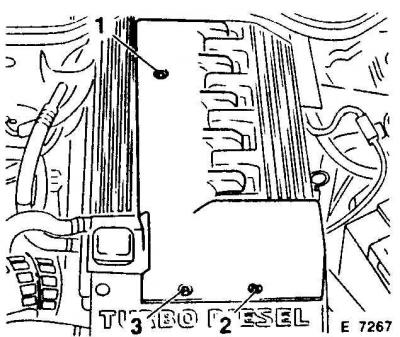
8. Unscrew the top engine shield and remove it (1, 2, 3 – screw).
9. Remove the engine ventilation hose on the cylinder head cover, as well as the intake air hose from the air filter housing and turbocharger, to do this, loosen and slide back the clamps.
10. Unscrew the exhaust manifold on the cylinder head. In doing so, first loosen the bolts evenly from the outside inwards, first by half a turn, then loosen them completely. Unscrew the exhaust manifold (3 bolts) on the turbocharger.
Warning: Cover the turbocharger openings with a clean cloth and make sure that no foreign objects enter the turbocharger, as this may cause serious engine damage.
11. Remove the exhaust manifold gaskets from the engine. Note the installation position: the gasket brackets are facing away from the engine.
12. Remove the intake manifold from the cylinder head.
13. To do this, disconnect the cable at the charge air temperature sensor, disconnect the vacuum hose at the EGR valve and at the bottom of the intake manifold.
14. Loosen the air supply tube and disconnect it.
15. Unscrew the intake manifold on the cylinder head and on the holder and remove with gaskets.
16. There is no need to unscrew the exhaust gas return valve with the gasket.
17. Unscrew the injection pipes from the high-pressure fuel pump and injectors using a slotted open-end wrench.
Warning: Do not change the bend shape of the pipes.
18. Disconnect the coolant hose from the thermostat housing by loosening the hose clamp.
19. Remove the multi-ribbed V-belt.
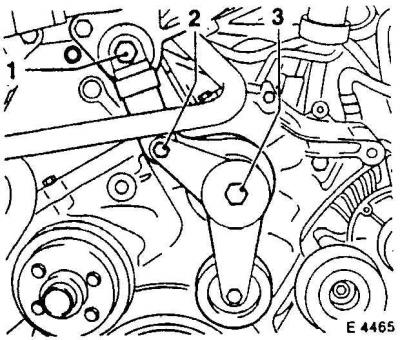
20. Remove the multi-ribbed V-belt tensioner. To do this, unscrew the damper bolts (1 and 2), as well as the plug (3), when removing and installing, pay attention to the gasket.
Warning! The tensioner damper may only be stored in an upright position. If the storage instructions are accidentally violated, it can be made usable again by squeezing it several times in an upright position.
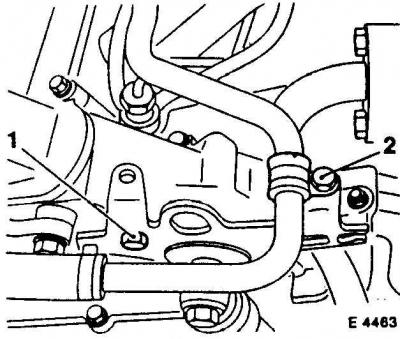
21. Unscrew bolts (1) and (2).
Installation
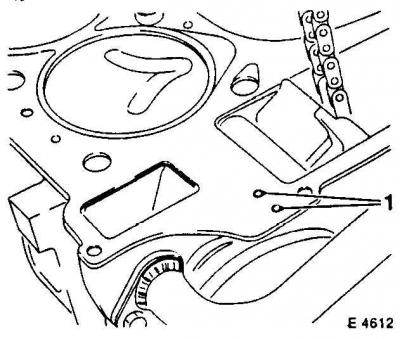
1. Remove the cylinder head gasket (1). The gasket thickness is indicated by holes. There are gaskets with 2 and 3 marks. The gasket of the previous thickness must be installed.
2. If work has been carried out on the crank mechanism, the gasket thickness must be determined again (is carried out with the workshop).
3. Clean the sealing surface of the cylinder block with a suitable scraper.
4. Be careful not to let dirt get into the cylinder block holes.
5. Cover the holes with a cloth.
Warning! The cylinder head bolt holes must be free of oil and coolant residue. Blow out the holes with compressed air or wrap the screwdriver in a rag and dry the holes. Otherwise, pressure will build up when screwing in, which may cause the cylinder block to crack or improper tightening torque.
6. Clean the cylinder head sealing surface.
7. Check the evenness of the block and cylinder head surfaces.
Warning! Sealing surfaces cannot be treated.
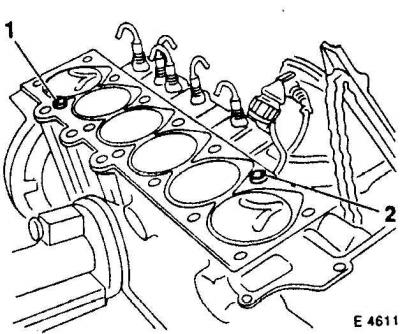
8. Insert the guide bushings (1 and 2) correctly.
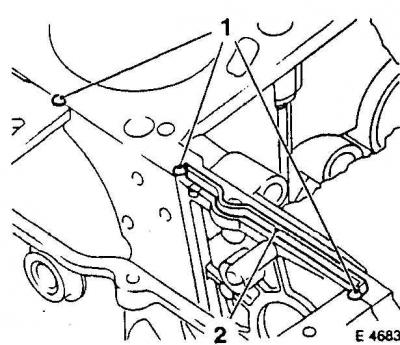
9. Insert the new sealing strip (2) into the groove of the cylinder block sealing surface (1 – connection).
10. Apply OPEL 15 03 294 sealant to the connection point.
11. Apply a new head gasket of the same thickness. The "TOP" inscription should face upwards towards the cylinder head. The channels should not be covered by the gasket.
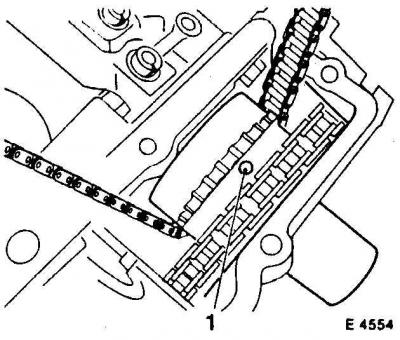
12. Before installing the cylinder head, make sure that the mark (1) on the injection pump sprocket faces upward.
13. If not, remove the test rod on the flywheel and rotate the crankshaft forward 1 revolution until the mark faces up and the test rod can be reinserted.
14. If the camshaft was removed, after installing the shaft, you should pause for 10 minutes before installing the head. Otherwise, the hydraulic tappets will not have time to sit and there will be a risk of pistons colliding with the valves.
15. Carefully install the head on the gasket with the help of an assistant. In this case, the camshaft must be fixed in the TDC position of the piston of the 1st cylinder.
16. Pass the chain through the head.
17. Use new cylinder head bolts.
18. Coat the bolts with engine oil on the threads and mating surfaces of their heads.
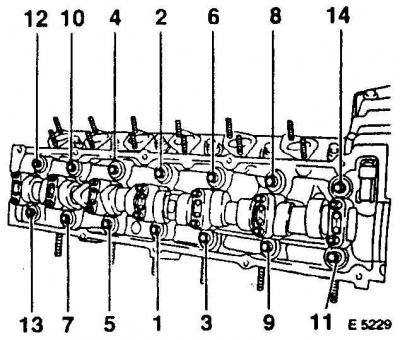
19. Tighten the bolts using a torque wrench in a cross pattern from the inside out to 80 Nm.
20. On the second pass, loosen the bolts in a spiral from the inside out by 180° (1/2 turn).
21. On the third pass, tighten the bolts crosswise in a spiral from the inside out to 50 Nm.
22. On the fourth pass, tighten the bolts 90° further (1/4 turn).
23. On the fifth pass, tighten the bolts another 90°.
24. To accurately maintain the 90° angle, it is advisable to apply the appropriate markings to the camshaft housing cover.
25. To do this, place the key on the bolt and make a mark with chalk at a distance of 90°; if necessary, cut a 90° template out of cardboard.
26. The HAZET 6690 company also has such a template.
Warning! After engine assembly and 25 minutes of warm-up, the cylinder head bolts should be tightened by 90°.
27. Screw in the upper chain guide plate mounting pin.
28. Unscrew the mounting bolt from the cylinder block.
29. Connect the plugs to the glow plugs and both coolant temperature sensors.
30. Connect the injection start sensor plug to the 4th cylinder injector.
31. Install the chain onto the sprocket.
32. Tighten the oil spray nozzle by hand.
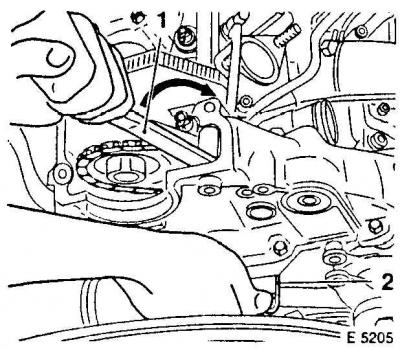
33. Press the chain tensioner with the KM-822 lever, while pulling out the fastening pin (2) (1 – bolt).
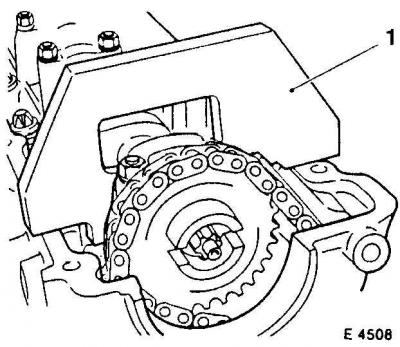
34. Check the valve timing using a special device (1). The crankshaft is in the TDC position of the piston of the 1st cylinder. At the same time, the adjusting device should be adjacent to the sealing surface of the cylinder head on both sides.
Warning! This only applies to new timing chains or those with a mileage of up to 20,000 km.
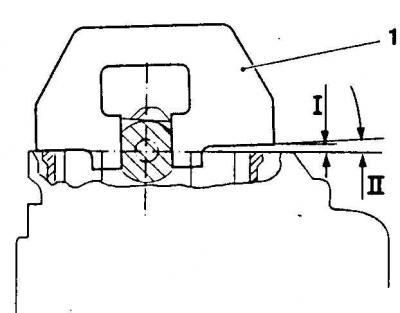
35. For chains with a mileage of over 20,000 km, a spacer must be placed under the locking device (1) on the intake side to compensate for the elongation (flat feeler gauge) (I) 4.61 mm thick. This corresponds to the angle of 2° (II) at which the camshaft is turned.
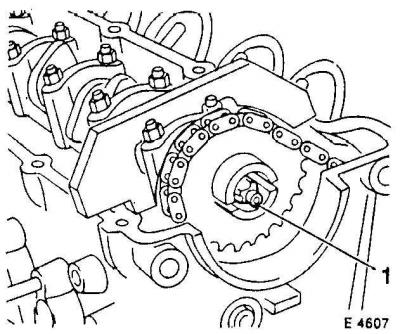
36. In this position, screw on the sprocket with the new oil spray nozzle (1 – channel).
37. Holding the camshaft by the hexagon with a wrench, tighten the bolt to 20 Nm, then turn it an additional 35° with a rigid wrench.
38. In order to precisely maintain the 35° angle, it is advisable to apply the corresponding markings on the cylinder head. To do this, place the key on the bolt and at a distance of 35° apply a mark with chalk, if necessary, cut a template out of cardboard. Such a template is also available from the HAZET 6690 company.
39. Remove the locking devices on the crankshaft and camshaft and turn the crankshaft 2 revolutions.
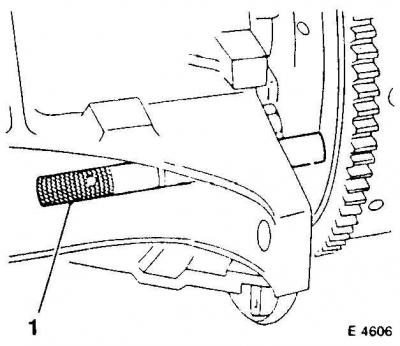
40. Insert the test rod back into the flywheel (1 - pin).
41. The camshaft tester should now be inserted in the same manner as before tightening the sprocket.
42. Repeat adjustment if necessary.
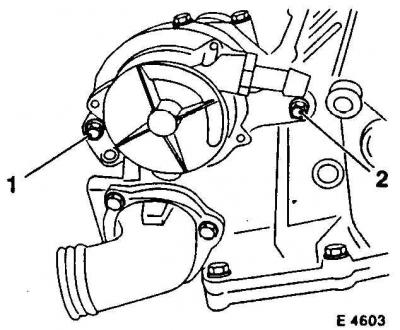
43. Insert the vacuum pump with a new O-ring and a new bolt (2), with the drive cams engaging the camshaft sprocket (1 - bolt).
44. Lubricate the seal with Vaseline or silicone grease before installation. Connect the vacuum line.
45. Install the fuel lines to the fuel filter.
46. Connect the upper hose from the radiator to the cylinder head, as well as the heater coolant hose from the pipe, secure with clamps.
47. Screw in the multi-ribbed V-belt tensioner.
48. Screw the damper onto the cylinder head with a force of 40 Nm, onto the guide lever with a force of 20 Nm.
49. Screw the plug onto the pin and tighten to 20 Nm.
50. Screw in the bolts.
51. Screw the injection pipes onto the high-pressure fuel pump and injectors with a torque of 25 Nm.
52. Install the exhaust manifold, replace all gaskets.
53. The gasket clamps between the exhaust manifold and the cylinder head are directed away from the head. Screw the exhaust manifold onto the turbocharger (3 bolts) with a force of 45 Nm, onto the cylinder head with a force of 25 Nm, tighten the bolts crosswise from the inside out.
54. Screw the intake manifold onto the cylinder head with a torque of 25 Nm, replace all gaskets.
55. Screw the oil filter housing support and the exhaust gas return valve pipe onto the intake manifold with a torque of 25 Nm.
56. Insert the vacuum hose with the elbow onto the brake booster.
57. Connect thin vacuum lines to the vacuum hose check valve.
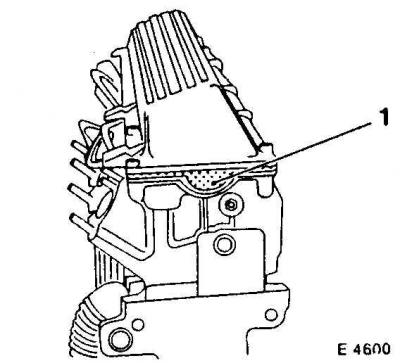
58. Install the cylinder head cover with a new gasket (1) and screw it from the inside out with a torque of 15 Nm. Observe the installation position of the gasket on the rear side of the cylinder head.
59. Connect the crankcase ventilation hose and secure it with a clamp.
60. Screw the coolant pipe holder onto the cylinder head cover.
61. Install the crankcase ventilation hose to the cylinder head cover, as well as the intake air hose from the air filter housing and turbocharger, secure the clamps.
62. Install the top engine shield.
63. Screw the air intake pipe onto the cylinder head, install the air hoses, and secure with clamps.
Cars with air conditioning
Removal
1. Remove the viscous fan and air diffuser on the radiator.
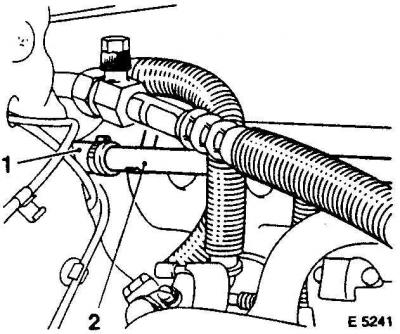
2. Disconnect the upper coolant hose (1) from the radiator on the cylinder head, and also the heater coolant hose from the pipe (2) after loosening the hose clamps.
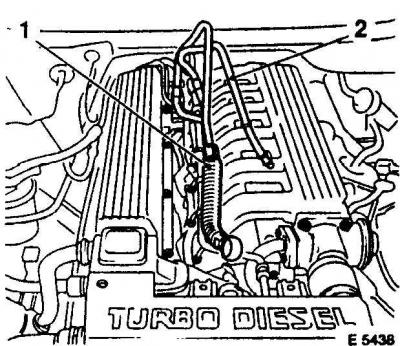
3. Remove both fuel lines (1 and 2) on the fuel filter. The supply line is slightly thicker than the return line.
4. Collect any leaking fuel with a thick cloth.
5. Release the pipes from the fasteners and lift slightly, unscrew the fuel pipes approximately 130° counterclockwise. Make sure that the pipes do not bend.
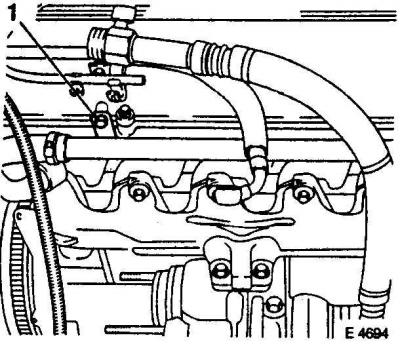
6. Unscrew the coolant pipe holder (1) from the cylinder head cover.
7. Disconnect the engine ventilation hose from the cylinder head cover by loosening the hose clamp.
8. Unscrew and remove the cylinder head cover.
9. Disconnect all cable plugs.
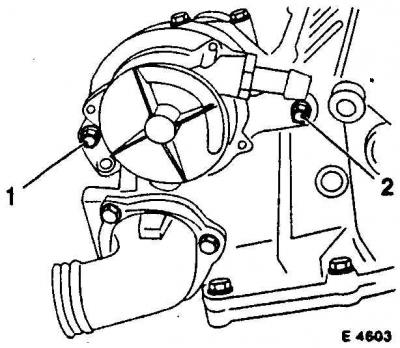
10. Unscrew the bolts (1 and 2) on the vacuum pump.
11. Disconnect the vacuum line.
Warning! The bolt (2) also serves to secure the upper chain guide bar. It must always be replaced, as it has a micro-notch for fixation.
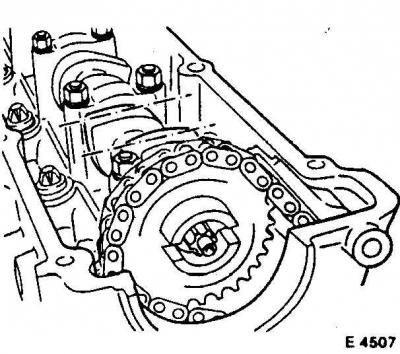
12. Set the piston of the 1st cylinder to the TDC position.
13. To do this, set the gearbox to neutral and apply the handbrake. Fit a bent open-end wrench or socket head with a ratchet to the central bolt of the belt pulley.
14. Slowly turn the crankshaft clockwise by hand until the cams of the first cylinder are simultaneously facing upward.
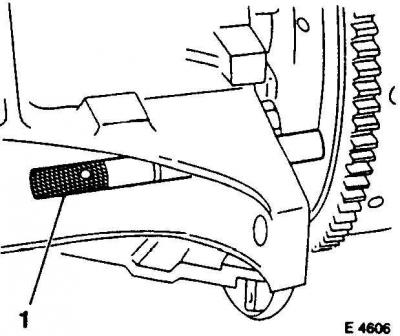
15. In this position the test rod (1) (OPEL KM-813) through the hole in the cylinder block it can be inserted into the hole in the flywheel.
16. You can also use another suitable rod, such as a drill.
17. Remove the existing plug and install the rod.
Warning! Insert the rod only to check the TDC position, do not use it to lock the crankshaft.
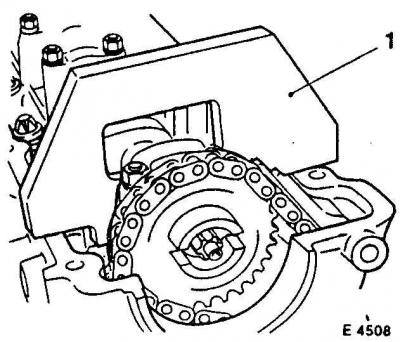
18. Fix the camshaft with the OPEL KM-811 locking device (1). The device should fit both sides to the sealing surface of the cylinder head cover. It holds the camshaft in the TDC position of the piston of the 1st cylinder. If there is no such device, make a similar device yourself.
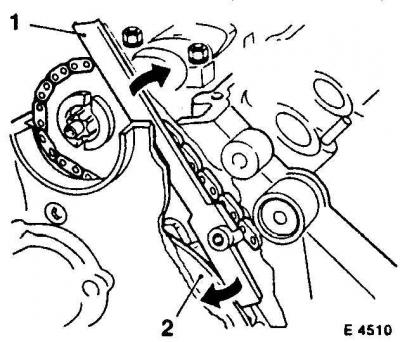
19. Install the KM-822 lever (1) between the upper tensioner bar and the mounting pin and press the tension bar in the direction of the arrow (2 - installation location). This loosens the drive chain.
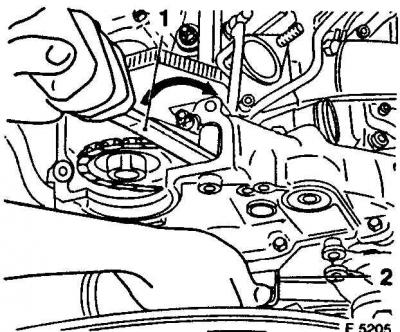
20. When loosening the drive chain with the lever (1), you can insert the KM-823 fastening pin into the tensioner hole (2 – location).
21. First unscrew the plug where the pin is installed. The chain tensioner is fixed with a pin. Hold the camshaft by the hexagon with a wrench.
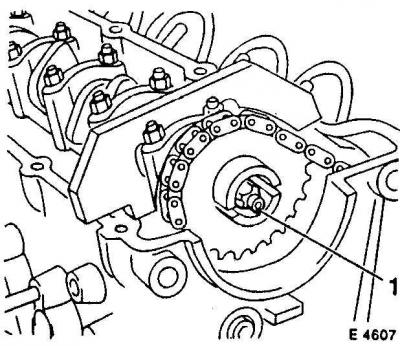
22. Unscrew the oil spray nozzle (1) from the camshaft sprocket.
23. Remove the sprocket.
24. Unscrew the bolts of the timing gear drive housing.
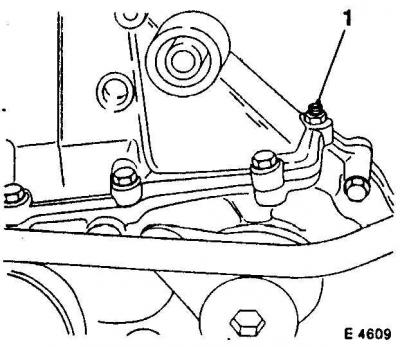
25. Unscrew the nut (1) securing the stud to the camshaft drive housing.
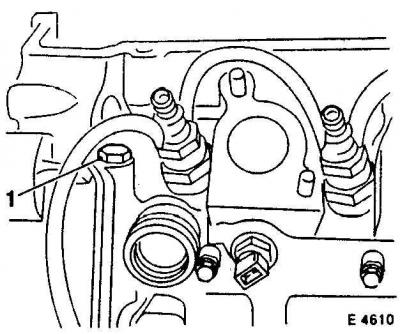
26. Unscrew the mounting bolt (1) from the cylinder block.
Source is on this resource (www.OPELBOOK.ru)
27. Disconnect the plugs from the glow plugs and from both coolant temperature sensors on the cylinder head.
28. Disconnect the injection start sensor plug on the 4th cylinder injector (4th cylinder front).
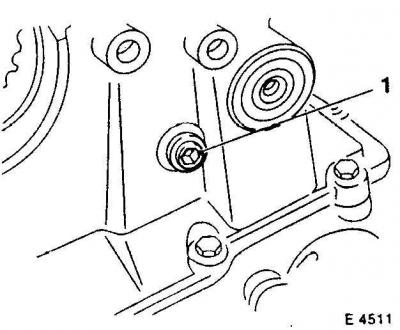
29. Unscrew the pin (1) securing the upper chain guide bar.
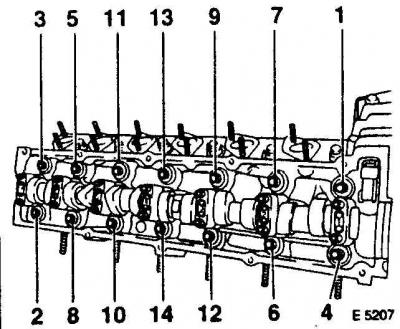
30. Loosen the cylinder head bolts in a specific sequence from the outside in, first by half a turn, then by another half a turn.
31. Remove the cylinder head with the help of an assistant.
Warning! When removing, make sure that the upper guide plate of the drive chain is not damaged and that the chain does not remain hanging on the cylinder head. Place the head on a wooden board to avoid damaging the sealing surface.
Installation
1. Install the viscous fan and air diffuser on the radiator.
2. Check all plugs and hoses, connect if necessary.
3. Fill with coolant.
4. Install the multi-ribbed V-belt.
5. Check the engine oil level and top up if necessary. If the cylinder head was removed due to a faulty head gasket, change the oil and oil filter as there may be coolant in the engine oil.
6. Connect the ground cable to the battery. Set the time on the clock, set the radio receiver security code.
Warning: Remove the test rod and close the hole with a plug.
7. Install the lower engine compartment shield.
8. Start the engine and warm it up for 25 minutes.
9. Remove the cylinder head.
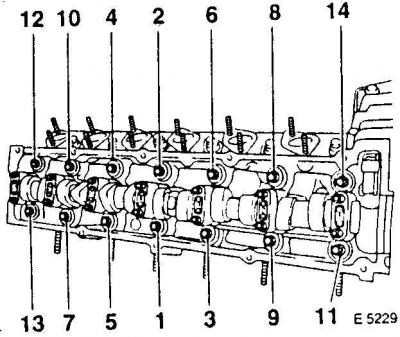
10. Tighten the cylinder head bolts from the inside out in a specific sequence using a rigid wrench at 90° (1/4 turn), without loosening them first.
11. Screw the coolant pipe holder onto the cylinder head cover.
12. Install the crankcase ventilation hose on the cylinder head cover, as well as the intake air hose from the air filter housing and turbocharger, secure with clamps.
13. Screw on the top engine shield.
14. Screw the air intake pipe onto the cylinder head, install the air hoses, and secure with clamps.
Visitor comments