


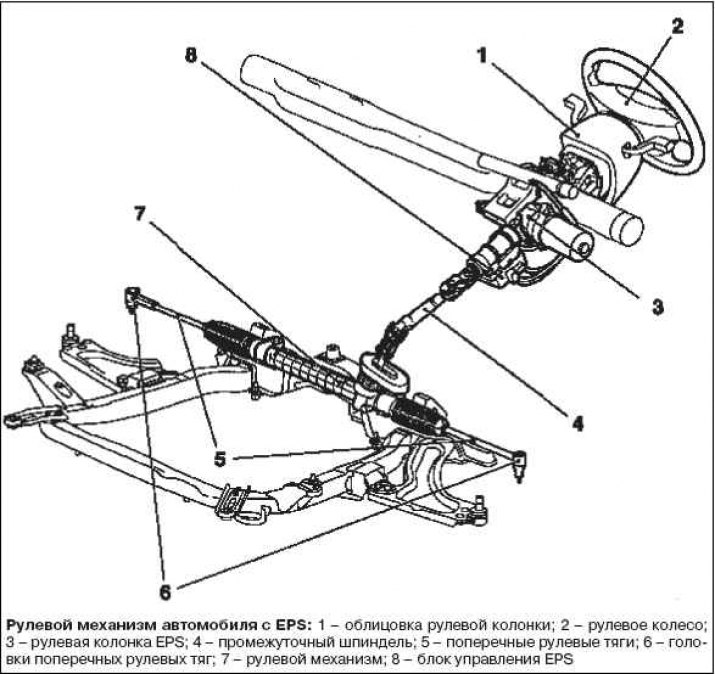
Electro-hydraulic power steering reduces the effort required to operate the steering gear. The hydraulic system operates in the same way as the power steering system used on other models, but it includes an electrically driven hydraulic pump independent of the vehicle's engine. The control unit and hydraulic pump form a single module and can only be replaced as an assembly.
The EPS force is regulated by the control unit as a function of the engine speed and in accordance with the three-dimensional control characteristic of the engine.
The vehicle uses two different EPS systems.
The EPS from TRW is used on versions with low-power petrol engines and Z 17 DTL and is not included in the CAN bus system. For diagnostic purposes, this system has its own diagnostic line (diagnostic output 7). TRW EPS provides two-stage, load-dependent pump speed control (2 speeds). The load value is determined by the current that the electric motor consumes from the vehicle's electrical system.
ZF EPS is used on high-performance petrol engines and the Z 17 DTH and is linked to the HS CAN bus. ZF EPS operates depending on speed and load and uses two different control maps. The respective driving conditions are determined by the vehicle speed as a function of the steering wheel offset, and the steering servo assistance is reduced as the driving speed increases. On vehicles with a sports chassis, the second control map can be activated via the sports mode button.
The EPS control unit controls the system according to the map, depending on the angular speed of rotation of the hydraulic system pump. The vehicle speed is transmitted to the EPS control unit via the CAN bus.
Text copied from this portal: www.OPELBOOK.ru
Angle sensor
TRW's non-CAN-bus EPS does not have a steering angle sensor, but instead uses information about the increase in pressure in the steering gear that occurs when the steering wheel is turned. Vehicles with the ESP MK60 anti-lock brake system have a steering angle sensor in the CIM. On vehicles with ZF EPS, the information from the CIM steering angle sensor is transmitted via the HS CAN bus to the EPS control unit. Due to the high power consumption, the hydraulic pump is not activated while the engine is not running. If the alternator fails during driving, the hydraulic pump is switched off to protect the battery from discharge.
Visitor comments