


Contents: General information ⬇ Access ⬇ Luggage compartment shelf/curtain ⬇ Removable barrier net (combo models) ⬇ Features of installing the net…⬇ Permanently installed fencing net…⬇ Placement and securing of luggage ⬇ Storage space for spare wheel, jack,…⬇ Storage space for first aid kit and…⬇ Roof rack ⬇ Seats ⬇
Please note: The luggage compartment must not under any circumstances be used for transporting passengers!
General information
The luggage compartment is designed for carrying hand luggage, large items and cargo. On models with the appropriate configuration, if necessary, the volume of the luggage compartment can be increased by folding the rear bench seat (see Section 12).
The dynamic characteristics of a loaded vehicle are directly dependent on the correct distribution of the load. Try to place heavy loads as far forward as possible, reserving the rear part of the luggage compartment for the transportation of lighter items - remember, the luggage should always be adjacent to the backs of the front or multi-seat rear seats. Make sure that the folded luggage does not rise above the upper edges of the seat backs.
Note: If possible, loads should be placed behind unoccupied seats with their backs in an upright position.
Remember that the total mass of the vehicle, including the mass of passengers, must not exceed the maximum permissible value (see Specifications), the same applies to the distributed load on each of the vehicle's axles.
Access
A description of the methods of access to the luggage compartment of a vehicle is given in Part A of this chapter (see Section 3).
Luggage compartment shelf/curtain
To protect items stored in the luggage compartment from prying eyes or from exposure to direct sunlight, the Hatchback models are equipped with a special decorative shelf, and the Combo models have a horizontal curtain.
Hatchback models
Decorative shelf (see illustration 17.34) from the passenger compartment side it is secured in special side guides and held in a vertical position using fastening cables, one end of which is secured to the shelf, and the other is secured to the tailgate. If dismantling is necessary, it is necessary to disconnect the upper ends of the cables from the fastening elements on the tailgate, lift the shelf and pull it towards you from the side guides. Installation is carried out in the reverse order.
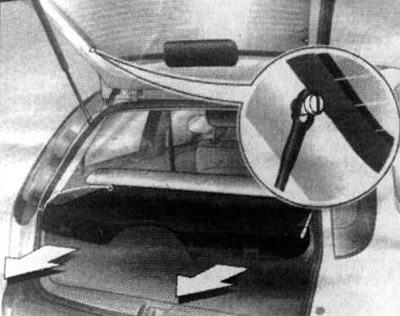
17.34. Removing the decorative luggage compartment shelf (hatchback models)
Combo models
Attention: Never place any objects, even very light ones, on the stretched horizontal curtain - the spring effect of the curtain may cause these objects to fall into the passenger compartment during sudden braking of the car and lead to unforeseen consequences!
The horizontal curtain casing is mounted in a spacer in the front part of the luggage compartment. The curtain is pulled out through the groove of the casing and fixed in special holders near the opening of the tailgate (see illustration 17.35).
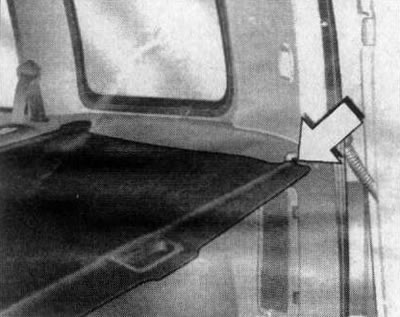
17.35. Horizontal curtain (combo models)
When there is no need to use the curtain, it is rolled up inside its casing, for which it is necessary to release the edge of the curtain from the tailgate side from the holders - the curtain is rolled up automatically.
To close the curtain, pull it out of the casing by the handle and secure it in the final position in the holders.
To remove the curtain, you must first roll it into the casing, then press the push-button lock on the right (in the direction of the vehicle's movement) sides of the casing and, pulling it to the left, fix the end element of the casing (see illustration 17.36). Remove the cover from the fasteners - first the right edge, then the left edge. Do not leave the removed curtain cover unfastened in the car.
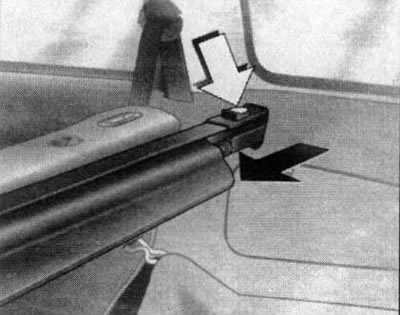
17.36. Removing the luggage compartment curtain (combo models)
The installation of the horizontal curtain casing is carried out in the reverse order.
Removable barrier net (combo models)
To prevent accidental movement of cargo from the luggage compartment into the passenger compartment, a protective net can be installed on Combo models. It is possible to install the net both behind the rear bench seat and behind the front seats (with the rear seat fully folded down - see Section 12).
Installing a net behind the rear bench seat
Before installing the mesh, it is necessary to dismantle the horizontal curtain casing (see above).
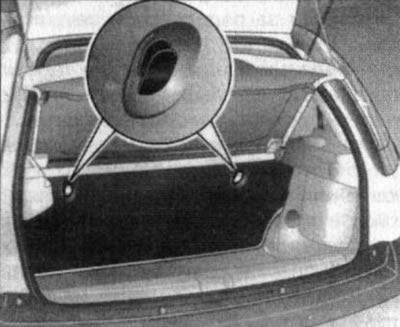
There are two mounting holes in the roof frame at the level of the rear bench seat backrest (see illustration 17.37), closed with decorative lids.
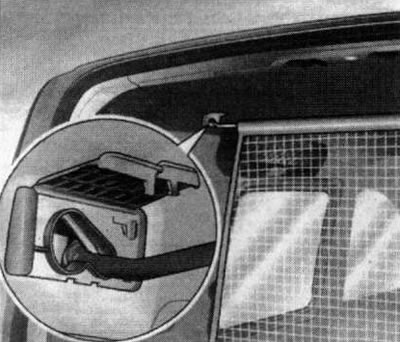
17.37. Mounting hole for the barrier net (combo models)
To install the net, remove the decorative covers, insert the upper anchor supports of the net into the mounting holes first on one side and then on the other, fix them and close the covers. Then fold the sections of the back of the rear bench seat, adjust the length of the fastening straps on the underside of the net and secure them in special eyes on the floor of the luggage compartment on the right and left (see illustration 17.38). Return the rear seat back to the vertical position and lock it. Removing the net is done in the reverse order.
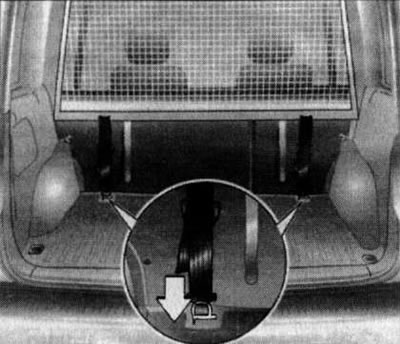
17.38. Fastening the safety net to the eyelets in the luggage compartment (combo models)
Features of installing the net behind the front seats
For installing the safety net with the rear bench seat fully folded down, there are similar mounting holes in the roof frame at the level of the front seat backs (see illustration 17.37). The tie-down straps are secured in eyelets under the raised rear seat cushions (see illustration 17.39).
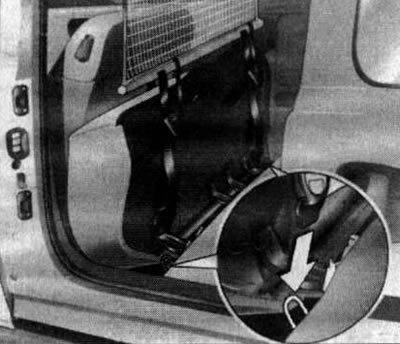
17.39. Fastening the safety net belt when installed behind the front seats (combo models)
Permanently installed fencing net (combo models)
On Combo models with cargo configuration, a permanent safety net is installed behind the front seats to prevent accidental movement of cargo from the luggage compartment.
To maximise the luggage space, the right section of the two-piece luggage net can be swung forward. Fold the front passenger seat first (see Section 12), then pull up the lower side lock (see illustration 17.40) the right section of the barrier section and fix it in the upper position.
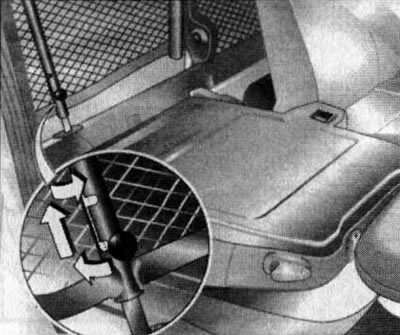
17.40. Lower side lock of the right section of the barrier net (combo models)
Caution: Moving the section of the barrier section with the lock released downwards may result in damage to the back of the front passenger seat!
Rotate the net section forward around the support axis, insert the lower side lock into the hole on the back of the folded front passenger seat backrest and secure the net. This way, the net encloses the driver's seat and allows additional cargo to be placed on the front passenger seat.
Placement and securing of luggage
The securing of cargo transported in the luggage compartment of a vehicle must be done using belts and elastic bandage straps (for fastening light objects) or special tie-down straps (for fastening heavy objects), hooked onto special anchor eyes fixed to the floor of the luggage compartment.
If equipped accordingly, hooks for bags can be installed on the back of the rear bench seat (see illustration 17.41).
17.41. Hooks (with appropriate equipment) for bags on the back of the rear seat
Storage space for spare wheel, jack, wheel brace
Depending on the variant, the vehicle may be supplied with a spare wheel, a special compact type wheel, or a tire repair kit (see Chapter 1, Section 5).
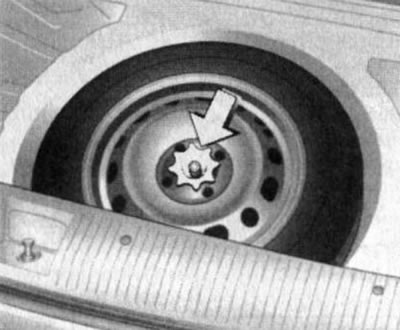
17.42. Storage location of the spare/emergency wheel on Corsa C models - to remove the wheel, first unscrew the wing nut
On Corsa C models, a spare wheel space is provided in a niche in the luggage compartment floor equipped with a removable cover (see illustration 17.42). On-board tool kit (including jack and wheel wrench) stored under the spare tire (see illustration 17.43).
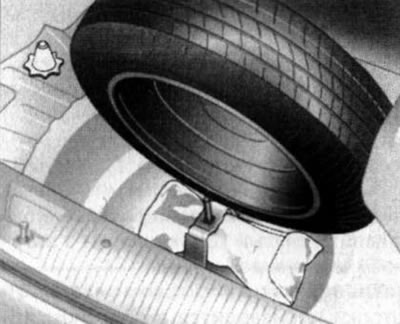
17.43. Storage space for on-board tool kit (corsa C models)
On Combo models, the spare/compact wheel is secured using a special holder on the outside, under the bottom of the luggage compartment (see illustration 17.44). The on-board tool kit on these models is stored in a storage compartment built into the right side of the luggage compartment (see illustration 17.45).
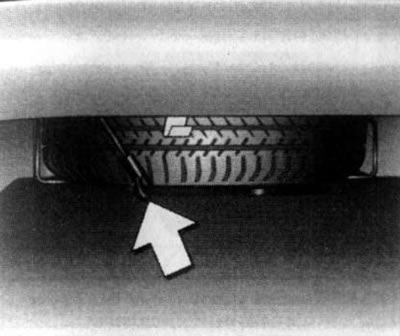
17.44. Spare/compact wheel mounting on Combo models
Note: On Combo van models the tool kit is secured to the underbody of the vehicle under the front seats (see illustration 17.49).
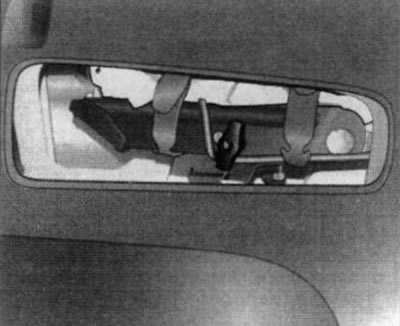
17.45. On Combo models, the jack is secured in the storage compartment on the right side of the luggage compartment using a wing nut, and the tool kit is secured to the jack using elastic straps
To remove the spare wheel, use the wheel brace to turn the mounting screw counterclockwise until it stops (see illustration 17.46). Lift the holder with the spare tire up and remove the holder from the hook. Lower the holder slightly and disconnect the safety cable from it, then lower the holder completely and remove the spare tire.
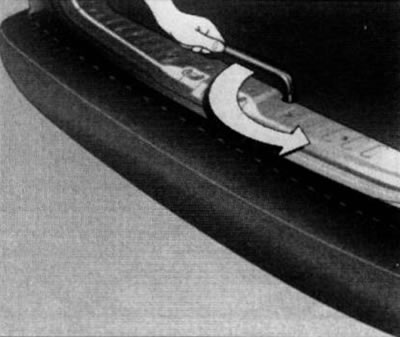
17.46. To remove the spare wheel, unscrew the mounting screw until it stops (combo models)
Installation is carried out in the reverse order. After replacement, place the removed wheel in the holder with the outer side facing up.
When a vehicle is equipped with a compact spare wheel, a special spacer ring is installed between it and the bottom, designed to compensate for the smaller size of the wheel and securely fasten it in the storage position. If a full-size wheel is installed in the holder after replacement (damaged), there is no need to install the spacer ring.
Storage space for first aid kit and hazard warning sign
[Material published on the website www.OpelBook.ru]
On all models described in this manual, the first aid kit and the warning triangle are stored together.
On Corsa C models, the first aid kit and warning triangle are mounted on the right (in the direction of the vehicle's movement) on the side of the luggage compartment using elastic straps (see illustration 17.47).
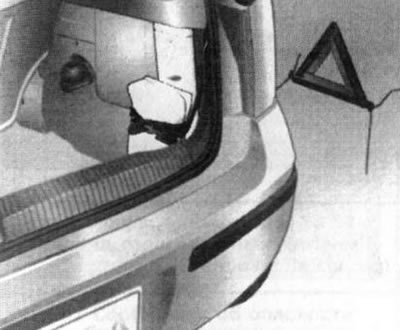
17.47. Storage space for first aid kit and warning triangle on Corsa C models
On Combo Combi/Tour models the first aid kit and badge are stored in the left-hand storage compartment (see above) in the luggage compartment (see illustrations 17.48).
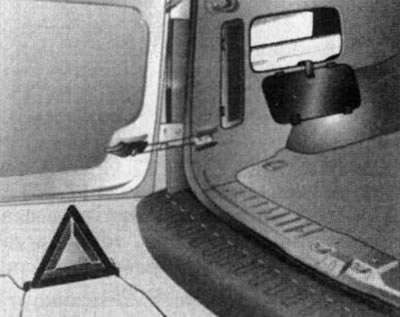
17.48. The first aid kit and warning triangle on Combo Combi/Tour models are stored in the left-hand stowage compartment of the luggage compartment
On Combo van models, the first aid kit and warning triangle are located in the storage compartment behind the front seat (see illustration 17.49).
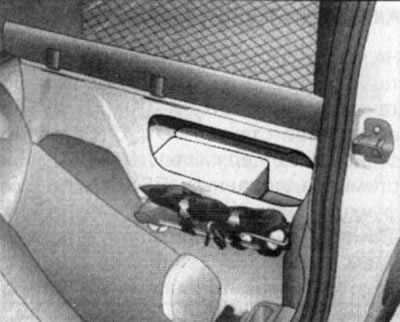
17.49. On Combo van models, a storage compartment behind the front seats is provided for storing a first aid kit and warning triangle
Roof rack
Note: The roof rack is not included with the vehicle and must be purchased separately.
Before purchasing a roof rack, consult an Opel service station about the rack designs approved for a specific car model. The rack must be installed in accordance with the instructions supplied with it and only using the special fasteners with which the car roof is equipped. To access the fasteners, first pry up and remove the decorative covers with a coin. When installing, first insert the front edge of the corresponding cover, then press the rear edge to fix the cover in place.
Seats
Information on seat adjustment and transformation is provided in Part A (see Section 12).
Visitor comments