
OpelBook.ru
Cars AvtoVAZ Cars Mitsubishi Cars BMW Cars Mercedes Cars Nissan Cars Toyota Cars Chevrolet
English Русский
Български
Беларускі
Український
Српски
Hrvatski
Română
Polski
Slovenský
Magyar
 |  Sitemap  |  Contacts  |    


Main Astra Corsa Insignia Kadett Omega Vectra Zafira Others Articles
Corsa B (1993-2000) Corsa C (2000-2006, petrol) Corsa C (2000-2006)
  • Main
  • Corsa
  • Corsa C
  • Chassis
  • Steering
  • Removal and installation tie rod ends

Removal and installation tie rod ends (Opel Corsa C)

            0

1. Set the parking brake, jack up the front of the car and place it on stands, the wheels should rotate freely.

2. Check the steering rod ends for play by moving the steering rods. If there is play, the rod ends must be replaced.

3. Remove the corresponding front wheel.

4. Measure the length of the free threaded part of the rod (see accompanying illustration), or count the number of free turns. Remember or write down the measurement result.
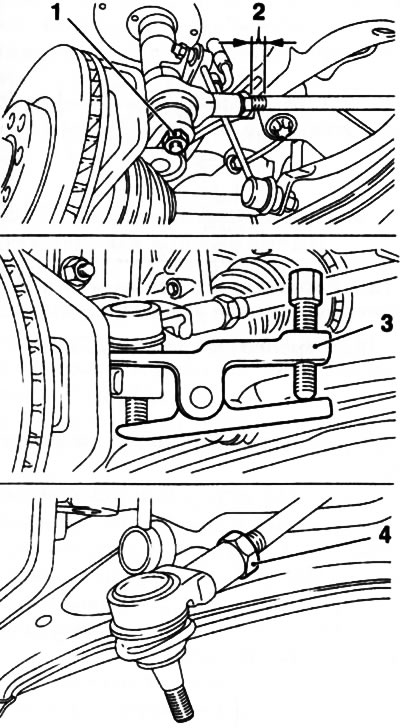
14.4. Removing the tie rod end: 1. Ball joint stud fastening nut; 2. Free threaded part; 3. Hazet…

14.4. Removing the tie rod end: 1. Ball joint stud fastening nut; 2. Free threaded part; 3. Hazet 779 puller; 4. Tie rod end lock nut


5. Loosen the nut securing the ball joint of the steering rod to the steering knuckle a few turns (see illustration 14.4).

6. Using a puller (see illustration 14.4), press the ball pin of the tip out of the steering knuckle, while the device should rest on the fastening nut.

7. Finally loosen the fastening nut and separate the tip from the steering knuckle.

8. Loosen the lock nut on the tie rod end, holding the end from turning - if necessary, first clean the threads with a wire brush and lubricate them with a special compound to corrode rust.


9. Unscrew the tip and remove it from the steering rod. Remember the number of turns for subsequent assembly.

10. When installing, screw the tip onto the steering rod by the number of turns counted during dismantling. At the same time, check whether the screwing depth dimension "2" has been preserved (see illustration 14.4), which was recorded during removal, otherwise the wheel alignment angles will be disturbed. Tighten the lock nut manually.

11. Insert the ball pin into the control arm on the steering knuckle and tighten the new self-locking mounting nut to the required torque - if the pin turns, press it into the conical hole in the control arm.

12. Hold the end with an open-end wrench to prevent it from turning and tighten the lock nut to the required torque. Install the wheel, lower the vehicle to the ground and tighten the wheel bolts.

13. At the earliest opportunity, take the vehicle to a specialized service station to check and adjust the front wheel alignment angles.


This article is available at russian, bulgarian, belarusian, ukrainian, serbian, croatian, romanian, polish, slovak, hungarian
Checking the article: Kornev Georgy

Share information:

Previous articles
Opel Corsa C: Steering
Next articles

Removal and installation the steering wheel
Removal and installation the driver's airbag module
Safety precautions when working with the steering system
Removal and installation steering gear boots


See similar ones from other Opel car manuals:
▶ Tie rod ends — removal and installation Opel Astra G (1998-2004, petrol)
▶ Removal and installation tie rod ends Opel Vectra A (1988-1995)
▶ Replacing outer tie rods and tie rod ends Opel Frontera A (1991-1998, petrol)
Link to this page in different formats

Visitor comments


No comments yet


How much will 20 + 40 =


Corsa C (2000-2006) 
  • General information
  • Introduction to guide
  • Troubleshooting
  • Vehicle device
  • User manual
  • Maintenance
  • Power unit
  • Engine repair
  • Cooling system
  • Power and exhaust system
  • Control system
  • Engine electrical equipment
  • Transmission
  • Clutch
  • Mechanical gearbox
  • Automatic gearbox
  • Drive shafts
  • Chassis
  • Brake system
  • Wheel suspension
  • Steering
  • Body
  • Exterior
  • Interior
  • Doors and windows
  • Heating and air conditioning
  • Electrical equipment
  • Equipment and devices
  • Lamps and lighting
  • Electrical circuits
Corsa C (2000-2006, petrol) 
  • User manual
  • Car access
  • Governing bodies
  • Seat control
  • Heating and air conditioning
  • Driving and maintenance
  • Engines 1.0 and 1.2 l
  • Engine repair
  • Cooling and lubrication system
  • Injection system
  • Engines 1.4, 1.6 and 1.8 l
  • Engine repair
  • Cooling and lubrication system
  • Injection system
  • Transmission
  • Clutch
  • Mechanical gearbox
  • Automatic gearbox
  • Drive shafts
  • Chassis
  • Wheels and tires
  • Wheel suspension
  • Steering
  • Brake system
  • Body
  • Exterior
  • Doors and windows
  • Electrical equipment
  • Equipment and devices
  • Lighting system
  • Electrical circuits
Corsa B (1993-2000) 
  • General information
  • Introduction to guide
  • User manual
  • Maintenance
  • Power unit
  • SOHC gasoline engines
  • DOHC gasoline engines
  • Diesel engines
  • Engine repair
  • Cooling system
  • Supply system
  • Injection system (gasoline)
  • Injection system (diesel)
  • Exhaust systems
  • Control system (gasoline)
  • Preheat system (diesel)
  • Charge and launch system
  • Transmission
  • Mechanical gearbox
  • Automatic gearbox
  • Clutch and drive shafts
  • Chassis
  • Brake system
  • Front suspension
  • Rear suspension
  • Steering
  • Body
  • Ventilation and heating
  • Exterior
  • Interior
  • Doors and windows
  • Electrical equipment
  • Equipment and devices
  • Lamps and lighting
  • Electrical circuits
OpelBook.ru © 2017–2026 · Mobile version · · Sitemap: EN BG BY UA RS HR RO PL SK HU · Feedback · Site search
Astra F, petrol · Astra G, petrol · Astra G · Astra H · Astra J, petrol · Corsa B · Corsa C, petrol · Corsa C · Insignia A · Kadett D · Kadett E · Omega A · Omega B · Omega B2 · Vectra A, petrol · Vectra A · Vectra B, petrol · Vectra B · Vectra C · Zafira A, petrol · Frontera A, petrol · Frontera B · Ascona C · Vivaro A ·
We want your visit to be comfortable 🤝! We use cookies 🍪 to make that happen.