OpelBook.ru
Cars AvtoVAZ Cars Mitsubishi Cars BMW Cars Mercedes Cars Nissan Cars Toyota Cars Chevrolet
English Русский
Български
Беларускі
Український
Српски
Hrvatski
Română
Polski
Slovenský
Magyar
 |  Sitemap  |  Contacts  |    


Main Astra Corsa Insignia Kadett Omega Vectra Zafira Others Articles
Astra F (1991-1998, petrol) Astra G (1998-2004, petrol) Astra G (1998-2004) Astra H (2004-2009) Astra J (2009-2015, petrol)
  • Main
  • Astra
  • Astra G
  • Power unit
  • Single shaft engines
  • Compression is the procedure for checking and interpreting the results obtained

Compression is the procedure for checking and interpreting the results obtained (Opel Astra G)

            0

1. If engine performance is clearly deteriorating, or if cylinders are malfunctioning despite the fuel and ignition systems being known to be in good working order, it is necessary to check the compression in the cylinders. The results of the compression test provide the most reliable information about the engine condition.

2. To obtain accurate test results, the engine must be warm, the battery must be fully charged, and the spark plugs must be removed (see Chapter 1). You will also need the help of another person.

3. Completely turn off the ignition and fuel system by disconnecting the connector from the ignition unit and removing the fuel pump relay from the panel in the engine compartment (Chapter 4A).

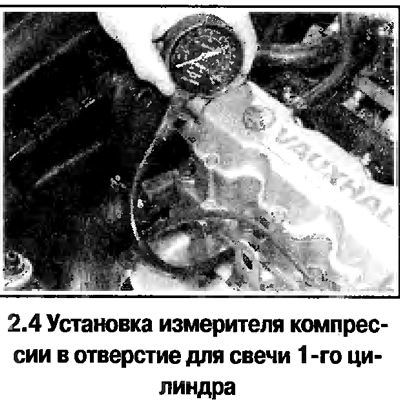
4. Insert the compression gauge into the spark plug hole of cylinder 1 (see photo). It is preferable to use a gauge with a threaded tip.

4. Insert the compression gauge into the spark plug hole of cylinder 1 (see photo). It is…


5. Ask an assistant to fully depress the throttle pedal and engage the starter for a few seconds. After the first two crankshaft revolutions, the pressure in the gauge should increase to maximum. Record the maximum reading on the gauge.

6. Repeat the measurements for the remaining cylinders, record the meter readings.


7. The compression readings in the cylinders should be almost the same. If the difference in compression exceeds the norm, the engine is faulty. On a serviceable engine, the pressure should increase quickly. Low pressure after the first stroke of the piston and a slow increase during subsequent compression strokes indicates wear of the piston rings. If the pressure is low after the first stroke of the piston and does not increase during subsequent compression strokes, the cause is a leak in the valves or a leak in the cylinder head gasket (cracks in the cylinder head may also be the cause). A decrease in compression can also be caused by carbon deposits on the valve heads.

8. If the pressure in each cylinder is at or below the lower limit, then inject some engine oil into the cylinder through the spark plug hole (about a full teaspoon), then repeat the tests.

9. If the compression increases after adding oil to the cylinder, then we can make a clear conclusion that the cylinder walls and pistons are worn out. If the compression increases slightly or does not increase at all, then the leak is caused by burnt valves or a leak in the cylinder head gasket.

10. If the compression is equally low only in two adjacent cylinders, then the most likely cause is a burnt gasket between these cylinders. An additional sign is the presence of traces of coolant in the oil.

11. If the compression in one of the cylinders is 20% lower than in the others and the engine runs unstably at idle, then the cause is wear of the camshaft cam of this cylinder.


12. If the compression value is significantly higher than normal, then the combustion chamber is covered with carbon deposits. In this case, the cylinder head must be removed and the carbon removed.

13. After completing the measurements, screw in the spark plugs and connect the connector to the ignition unit.


This article is available at russian, bulgarian, belarusian, ukrainian, serbian, croatian, romanian, polish, slovak, hungarian
Checking the article: Kornev Georgy

Share information:

Previous articles
Opel Astra G: Single shaft engines
Next articles

General information
Technical data
The order of setting the piston of the 1st cylinder at TDC of the compression stroke
Cylinder Head Cover — Removal and Installation
Crankshaft pulley — removal and installation
Timing Belt Covers — Removal and Installation
Timing Belt for Camshaft Drive — Removal and Installation
Tensioner and sprockets — removal and installation


See similar ones from other Opel car manuals:
▶ Checking the compression pressure in the cylinders and… Opel Corsa B (1993-2000)
▶ Checking the compression in the cylinders Opel Insignia A (2008-2017)
▶ Checking the compression in the cylinders Opel Kadett D (1979-1984)
▶ Checking the compression in the engine cylinders Opel Omega B (1993-1999)
▶ Checking the compression pressure Opel Vectra B (1995-2002)
Link to this page in different formats

Visitor comments


No comments yet


How much will 15 + 48 =


Astra J (2009-2015, petrol) 
  • General information
  • Vehicle device
  • User manual
  • Faults en route
  • Maintenance
  • Power unit
  • Engine repair
  • Cooling and lubrication system
  • Engine power system
  • Exhaust system
  • Transmission
  • Clutch
  • Car gearbox
  • Drive shafts
  • Chassis
  • Front suspension
  • Rear suspension
  • Steering
  • Brake system
  • Wheels and tires
  • Body
  • Exterior
  • Interior
  • Doors and windows
  • Body Care
  • Heating and air conditioning
  • Security systems
  • Electrical equipment
  • Equipment and devices
  • Lighting and signaling
  • Power devices
  • Electrical circuits
Astra H (2004-2009) 
  • General information
  • Introduction to the guide
  • Troubleshooting
  • User manual
  • Maintenance
  • Power unit
  • Engine repair
  • Cooling and heating
  • Power and exhaust system
  • Ignition system
  • Launch and charge system
  • Transmission
  • Mechanical gearbox
  • Automatic gearbox
  • Drive shafts
  • Chassis
  • Brake system
  • Car suspension
  • Steering
  • Body
  • Interior
  • Exterior
  • Electrical equipment
  • Equipment and devices
  • Electrical circuits
Astra G (1998-2004) 
  • General information
  • Introduction to manual
  • User manual
  • Maintenance
  • Power unit
  • SOHC gasoline engines
  • DOHC gasoline engines
  • Diesel engines 1.7 and 2.0
  • Engine repair
  • Cooling system
  • Supply system
  • Injection system (gasoline)
  • Injection system (diesel)
  • Exhaust system
  • Charge and launch system
  • Ignition system (gasoline)
  • Preheat system (diesel)
  • Transmission
  • Manual gearbox
  • Automatic gearbox
  • Clutch
  • Drive shafts
  • Chassis
  • Brake system
  • Wheel suspension
  • Steering
  • Body
  • Exterior
  • Interior
  • Doors and windows
  • Ventilation and heating
  • Electrical equipment
  • Equipment and devices
  • Electrical circuits
Astra G (1998-2004, petrol) 
  • General information
  • User manual
  • Car care
  • Maintenance
  • Power unit
  • Single shaft engines
  • Twin shaft engines
  • Engine repair
  • Cooling and heating
  • Fuel and exhaust systems
  • Starting and charging system
  • Ignition system
  • Transmission
  • Clutch
  • Mechanical gearbox
  • Automatic gearbox
  • Drive shafts
  • Chassis
  • Brake system
  • Car suspension
  • Steering
  • Body
  • Interior
  • Exterior
  • Electrical equipment
  • Equipment and devices
  • Wiring diagrams Opel Astra
  • Wiring diagrams Opel Zafira
Astra F (1991-1998, petrol) 
  • General information
  • Maintenance
  • Power unit
  • Engine in car
  • Engine removed
  • Cooling system
  • Heating and ventilation
  • Fuel supply (carburetor)
  • Fuel supply (injector)
  • Emission control
  • Ignition system
  • Transmission
  • Clutch
  • Mechanical gearbox
  • Automatic gearbox
  • Drive shafts
  • Chassis
  • Brake system
  • Car suspension
  • Steering
  • Body
  • Exterior
  • Interior
  • Electrical equipment
  • Equipment and devices
  • Electrical circuits
OpelBook.ru © 2017–2026 · Mobile version · · Sitemap: EN BG BY UA RS HR RO PL SK HU · Feedback · Site search
Astra F, petrol · Astra G, petrol · Astra G · Astra H · Astra J, petrol · Corsa B · Corsa C, petrol · Corsa C · Insignia A · Kadett D · Kadett E · Omega A · Omega B · Omega B2 · Vectra A, petrol · Vectra A · Vectra B, petrol · Vectra B · Vectra C · Zafira A, petrol · Frontera A, petrol · Frontera B · Ascona C · Vivaro A ·
We want your visit to be comfortable 🤝! We use cookies 🍪 to make that happen.