


Position the piston/connecting rod assemblies and new piston ring sets so that the ring sets match their piston and cylinder, and perform clearance measurements and assemble the engine in sequence.
Insert the top ring into the first cylinder and push it down with the top of the piston. This will ensure that the ring remains perpendicular to the cylinder walls. Position the ring as close to the bottom of the cylinder as possible.
Measure the ring gap using a feeler gauge.
Repeat the measurement operations, but at the top of the cylinder, and compare the measurements with the required values.
If the gap in the ring lock is too small (which is unlikely if Vauxhall/Opel parts are used), it must be increased, otherwise the ends of the ring may close during engine operation and cause serious damage.
If the rings are new, it is unlikely that the gap between the ring ends will be too large, but if the gaps are too large, check that the rings are correct for your engine and in particular for the cylinder size.
Repeat the procedure for checking each ring for the first cylinder, and then for the rings of the remaining cylinders.
After checking the clearances, the rings can be installed on the pistons.
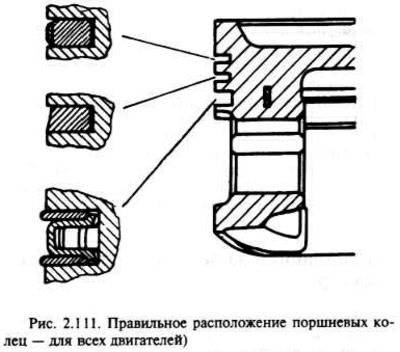
Oil scraper ring (lower on piston) consists of three sections and it is necessary to install it first. Install the lower steel ring, then install the expander and finally the upper steel ring.
Once the oil scraper ring is installed, the second (middle) ring can be installed. It is usually marked with the "TOP" side, which should be facing the top of the piston. As with removing the rings, carefully use feeler gauges to place the ring on the middle groove.
Install the top ring so that the "TOP" marking matches the ring position. If piston rings are installed with an overlapping lock, install the ring with the smaller diameter first.
Repeat the operations with the remaining pistons and rings.
Visitor comments