


2. It should be noted right away that this procedure is quite complicated for an ordinary car enthusiast and requires the use of fairly serious lifting and rigging and some other equipment. Of great importance is the availability of an appropriate work platform, which should have enough space to place the car on it, a strong workbench/assembly stand, as well as the necessary materials, equipment and components removed from the engine. The best option is a large garage or indoor workshop equipped with racks with wide shelves. In extreme cases, a flat area with asphalt or concrete pavement will do.
3. During the process of removing the unit from the car, there are many situations when you will need the help of an assistant - agree in advance with someone you know or a neighbor in the garage. If the engine is being removed by an amateur mechanic for the first time, you should definitely enlist the support of a specialist or someone who has already performed this procedure on the same car. Some operations can only be performed at a service station (for example, removing refrigerant from the A/C system), therefore, some of the procedures that require highly qualified personnel and the use of special equipment will have to be entrusted to car service specialists.
4. Try to plan the entire sequence of actions in advance. Prepare the necessary tools and equipment. It is advisable to wash the engine and transmission. Prepare a set of wrenches and replaceable socket heads with a suitable (preferably ratchet) drive, a couple of strong wooden blocks, and enough rags and solvent to remove traces of fuel, oil and coolant.
5. Due to the specifics of the engine layout and suspension, it is removed together with the gearbox on the subframe. The power unit is removed by lowering it from the engine compartment downwards, so equipment will be required to lift the car to a sufficiently high height and securely fix it in the raised position. When performing work to unfasten the engine suspension, it must be held from above using a winch (hoist), or from below using a hydraulic jack and a special device for holding the unit on the jack.
Note: The jack must be capable of lifting the unit at least 100 cm (1 m).
Attention! Make sure that the lifting capacity of the hoist and rigging corresponds to the total weight of the power unit (engine with transmission). Do not forget about the need to strictly comply with safety regulations! Perform work slowly and in an organized manner!
6. First of all, it is necessary to discharge the air conditioning system (with appropriate equipment). This operation is performed using special equipment - contact service station specialists.
Attention! The K/V system tract is constantly under pressure!
7. Remove the crankcase guard/multi-rib belt cover (depending on the model). Remove the front wheels of the car.
8. Drain the coolant and release the pressure in the fuel system through the service nipple using a special device KM-J-34730-91.
Warning! Do not exaggerate that fuel is a highly flammable liquid! When working with fuel system components, observe all accepted fire safety measures! Do not smoke, do not approach the work site with an open flame or unprotected portable lamp! Fuel, like most other technical liquids, is classified as a carcinogenic and toxic substance. Try to avoid getting fuel on covered areas of the body - use protective rubber gloves and glasses, in case of accidental unexpected contact, wash your hands thoroughly with warm water and soap. Collect spilled fuel without delay and do not put rags soaked in fuel and lubricants near open fire sources. Always keep a class B fire extinguisher at hand!
9. If the engine is removed for subsequent disassembly or transportation, remove the oil filter and drain the oil. It is advisable to drain the oil from the gearbox as well.
10. You should also drain the headlight washer fluid.
11. Below is a list of the main operations for preparing the engine for removal, most of which are described in the relevant chapters of the Manual.
Note: Depending on the arrangement of the attachments on the engine and in the engine compartment, the number and order of removal of the attachments may vary.
- a) Remove the air cleaner assembly with air ducts, disconnect all turbocharger air ducts;
- b) Disconnect and remove the battery and battery support tray;
- c) Remove partially or completely the exhaust system and crankcase ventilation hoses;
- d) Disconnect the fuel supply system lines;
- e) Disconnect the brake booster servo vacuum hose;
- f) Disconnect the hose from the vacuum pump and EGR valve, - move the hose to the side;
- d) Disconnect and move aside the gas and (with appropriate equipment) tempostat cable - try to remember the cable routes;
- h) Loosen the clamps and remove the upper and lower cooling system hoses from the radiator. Disconnect all cooling system hoses from the engine, remove the expansion tank;
- i) Remove the front bumper;
- j) On models equipped with air conditioning, disconnect the refrigeration lines from the engine and move them to the side;
- k) Disconnect the electrical wiring;
- l) Release the wiring harnesses from all intermediate fasteners and place them on top of the engine, remove the fuse box if necessary;
- m) Disconnect the gear shift rods/selector cable from the transmission;
- n) Disconnect the hydraulic hose of the clutch release drive (manual transmission);
- o) On AT models, disconnect the electrical wiring from the transmission.
12. Disconnect the intermediate shaft of the steering column, disconnect the steering rods from the steering knuckles and remove both drive shafts
13. Install the right/left mount remover. Remove the right and left engine mounts.
14. Once again, make sure that all communication lines are disconnected and nothing interferes with the removal of the power unit from the engine compartment.
Attention! Do not open the refrigeration line of the A/C system under any circumstances (with appropriate equipment)!
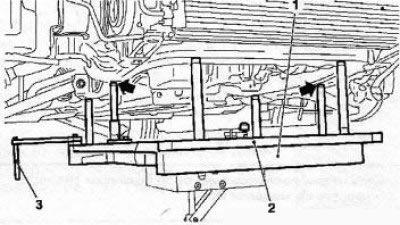
20.15 Installation of devices KM904 (1) and KM-6312 (2) on the front subframe: 3. Centering axes
15. Place a trolley jack under the engine. Raise and install the fixture on the front subframe KM-904 and KM-6312 (see illustration) - the devices must enter with their guide axes into the corresponding holes of the subframe and be firmly fixed on the subframe without any play.
Note: Centering pins are used when installing the engine, when removing they must be in the lower position (see ibid).
(Text was copied from the portal: «OpelBook»)
16. After unscrewing the mounting bolts, separate the front subframe from the car body.
17. Lower the power unit on the front subframe, taking care not to pinch any hoses or wiring or damage the radiator/fan. If necessary, get an assistant to help.
18. Roll the jack with the power unit secured to it out from under the car. Hang the power unit and remove the subframe, disconnecting the front and rear supports. Unscrew the clutch dome mounting bolts and separate the gearbox from the engine.
19. Installation of all units and removed components is carried out in the reverse order of removal.
Visitor comments