
OpelBook.ru
Cars AvtoVAZ Cars Mitsubishi Cars BMW Cars Mercedes Cars Nissan Cars Toyota Cars Chevrolet
English Русский
Български
Беларускі
Український
Српски
Hrvatski
Română
Polski
Slovenský
Magyar
 |  Sitemap  |  Contacts  |    


Main Astra Corsa Insignia Kadett Omega Vectra Zafira Others Articles
Vectra A (1988-1995, petrol) Vectra A (1988-1995) Vectra B (1995-2002, petrol) Vectra B (1995-2002) Vectra C (2002-2008)
  • Main
  • Vectra
  • Vectra C
  • Power unit
  • Engine repair
  • Checking the condition and replacing the powertrain suspension supports

Checking the condition and replacing the powertrain suspension supports (Opel Vectra C)

            0

Contents: Examination ⬇ Replacement ⬇

Examination


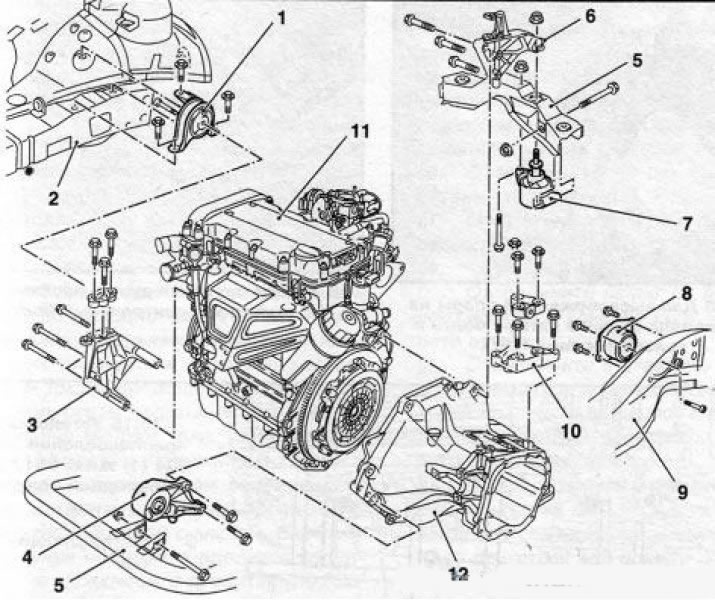
1. The engine is rigidly connected to the transmission assembly and has a common suspension with it, which is made in the form of a subframe and 4 supports - the right and left supports are attached to the side members, the front and rear supports are attached to the subframe. The general layout of the powertrain suspension supports is shown in the accompanying illustration.
19.1 General schematic diagram of the location of the powertrain suspension supports on Opel…

19.1 General schematic diagram of the location of the powertrain suspension supports on Opel models: 1. Right support, 2. Frame, 3. Right support bracket, 4. Front support, 5. Subframe beam, 6. Rear support bracket, 7. Torque damper, 8. Left support, 9. Subframe, 10. Transmission support, 11. Engine, 12. Transmission


2. If necessary, jack up the front of the vehicle and support it to ensure free access. If equipped, remove the crankcase guard.

3. Check the condition of the rubber support cushions. If cracks, delamination, separation from the metal base, signs of rubber hardening, or other similar defects are detected, replace the support.

4. Using a torque wrench, check the tightening force of the support fasteners.


5. Using a crowbar, check the bearings for signs of excessive play - if necessary, ask an assistant to rock the unit in different directions and observe the behavior of the bearings. Play present in new components leads to rapid wear of the bearings. Replace defective components.

Replacement


Note: Before removing components, mark their installation positions with paint.


Right support


6. To remove the right support, it is necessary to install special devices and unscrew the bolts securing the support to the side member and to the engine bracket

Front and rear supports


7. To remove the front support, set the parking brake, then jack up the front of the vehicle and place it on supports.

8. To unload the support, support the engine with a trolley jack - to distribute the load, place a wooden block between the jack head and the oil pan. If you have the appropriate equipment, you can hang the power unit as when replacing the right support.

Attention! When jacking up the power unit, be careful - do not load the exhaust system, if necessary, disconnect the inlet pipe from the exhaust manifold


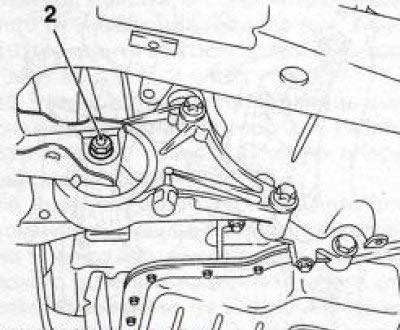
9. Loosen the nut that secures the support to the bracket and remove it along with the washer. Remove the mounting bolt (see illustration).
19.9 Front support to bracket fastening nut

19.9 Front support to bracket fastening nut


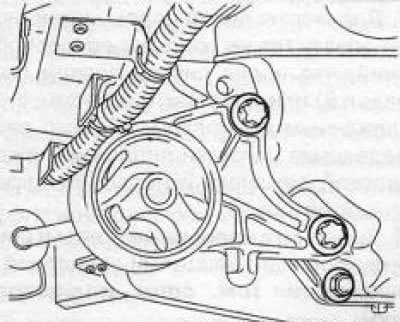
10. Remove the bolts securing the support bracket to the transmission housing (see illustration) and remove it together with the pillow.
19.10 Bolts for fastening the front support bracket to the transmission housing

19.10 Bolts for fastening the front support bracket to the transmission housing


11. Check the condition of all support components. Replace worn or damaged parts.

12. Installation is performed in the reverse order of removal, tighten the mounting bolts and nut to the required force. Lower the car to the ground.
19.13 Bolts (1) for fastening the rear support (2) of the engine - the arrows indicate the bolts…

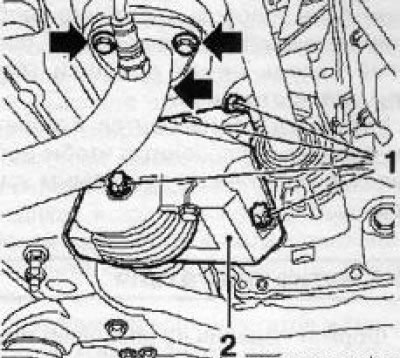
19.13 Bolts (1) for fastening the rear support (2) of the engine - the arrows indicate the bolts for fastening the front section of the exhaust system


13. The rear support fastening is shown in the accompanying illustration. The procedure for removing the rear support is completely similar to that described above.


Left support


14. Set the parking brake, jack up the front of the vehicle, place it on supports and remove the crankcase guard.

15. Remove the battery, unscrew the mounting bolts and remove the battery support tray

[Original posted on the website OPELBOOK]

16. To remove the left support, you can use the same set of tools as for removing the right one, or support the transmission with a trolley jack, placing a wooden block between the jack head and the pan to distribute the load.

17. Remove the mounting bolts and remove the transmission mounting support bracket from the transmission (see illustration).
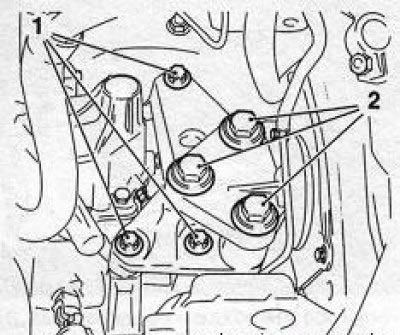
19.17 Six bolts securing the left support

19.17 Six bolts securing the left support


18. Remove the four TORX-head mounting bolts and remove the support, separating it from the body (see illustration).
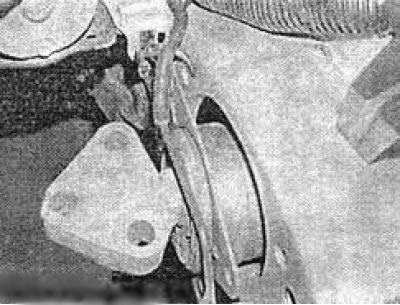
19.18 To release the support from the side member, loosen the four TORX-type head bolts

19.18 To release the support from the side member, loosen the four TORX-type head bolts


19. If necessary, the support can be disassembled by unscrewing a single bolt threaded through the center of the cushion (see illustration).
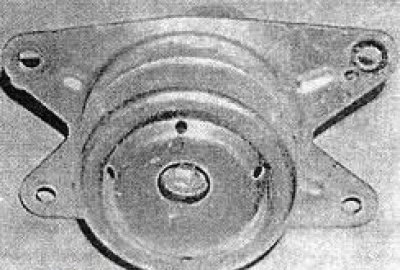
19.19 To remove the cushion, you need to unscrew the central bolt

19.19 To remove the cushion, you need to unscrew the central bolt


20. Installation is carried out in the reverse order. Make sure that all fasteners are tightened to the required force.


This article is available at russian, bulgarian, belarusian, ukrainian, serbian, croatian, romanian, polish, slovak, hungarian
Checking the article: Meshcheryakov Damir

Share information:

Previous articles
Opel Vectra C: Engine repair
Next articles

Replacing crankshaft seals
Removal, checking and installation the flywheel and drive disk
Measuring engine oil pressure
Removal and installation the oil pump
Removal and installation the oil pan
Removal and installation the cylinder head
Removal the engine
Engine threaded connections tightening force (Nm)


See similar ones from other Opel car manuals:
▶ Checking the condition and replacing the powertrain… Opel Astra G (1998-2004)
▶ Checking the condition and replacing the powertrain… Opel Corsa B (1993-2000)
▶ Accessory Drive Belt — Checking Condition and Replacing Opel Zafira A (1999-2005, petrol)
▶ Checking the condition and replacing the engine compartment… Opel Frontera A (1991-1998, petrol)
▶ Cleaning and checking the technical condition of the… Opel Insignia A (2008-2017)
Link to this page in different formats

Visitor comments


No comments yet


How much will 40 + 34 =


Vectra C (2002-2008) 
  • General information
  • User manual
  • Vehicle device
  • Maintenance
  • Troubleshooting
  • Power unit
  • Engine repair
  • Cooling system
  • Power and control system
  • Engine electrics
  • Transmission
  • Clutch
  • Car gearbox
  • Drive shafts
  • Chassis
  • Car suspension
  • Steering
  • Brake system
  • Body
  • Exterior
  • Interior
  • Doors, locks and windows
  • Heating and ventilation
  • Electrical equipment
  • Equipment and devices
  • Headlights and lighting
  • Electrical circuits
Vectra B (1995-2002) 
  • General information
  • User manual
  • Weekly checks
  • Maintenance (gasoline)
  • Maintenance (diesel)
  • Troubleshooting
  • Power unit
  • SOHC gasoline engine
  • DOHC petrol engine
  • Diesel engine 1.7 liter
  • Diesel engine 2.0 liters
  • Engine repair
  • Cooling system
  • Fuel system (gasoline)
  • Fuel system (diesel)
  • Charging system
  • Launch system
  • Ignition and preheat
  • Transmission
  • Clutch
  • Mechanical gearbox
  • Automatic gearbox
  • Drive shafts
  • Chassis
  • Brake system
  • Wheel suspension
  • Steering
  • Body
  • Exterior
  • Interior
  • Doors and windows
  • Heating and ventilation
  • Electrical equipment
  • Equipment and devices
  • Electrical circuits
Vectra B (1995-2002, petrol) 
  • General information
  • Maintenance
  • Help with malfunctions
  • Power unit
  • Engine repair
  • Exhaust system
  • Cooling system
  • Fuel system
  • Multec injection system
  • Four point injection
  • Transmission
  • Clutch
  • Gearbox and drive
  • Chassis
  • Wheel suspension
  • Steering
  • Brake system
  • Wheels and tires
  • Body
  • Exterior
  • Interior
  • Electrical equipment
  • Fuses and electronics
  • Power devices
  • Ignition system
  • Lighting and signaling
  • Equipment and devices
  • Heating and ventilation
  • Electrical circuits
Vectra A (1988-1995) 
  • Power unit
  • Engine repair
  • Ignition system
  • Lubrication system
  • Cooling system
  • Injection system
  • Fuel system (carburetor)
  • Fuel system (diesel)
  • Exhaust system
  • Transmission
  • Clutch
  • Car gearbox
  • Chassis
  • Front suspension
  • Rear suspension
  • Steering
  • Brake system
  • Wheels and tires
  • Body
  • Exterior
  • Interior
  • Electrical equipment
  • Electrical circuits
Vectra A (1988-1995, petrol) 
  • General information
  • User manual
  • Maintenance
  • Power unit
  • SOHC engine
  • DOHC engine
  • Cooling and ventilation
  • Fuel system (carburetor)
  • Fuel system (injector)
  • Exhaust converter
  • Transmission
  • Clutch
  • Mechanical gearbox
  • Automatic gearbox
  • Drive shafts
  • Chassis
  • Brake system
  • Car suspension
  • Steering
  • Body
  • Body elements
  • Electrical equipment
  • Power devices
  • Equipment and devices
  • Electrical circuits
OpelBook.ru © 2017–2026 · Mobile version · · Sitemap: EN BG BY UA RS HR RO PL SK HU · Feedback · Site search
Astra F, petrol · Astra G, petrol · Astra G · Astra H · Astra J, petrol · Corsa B · Corsa C, petrol · Corsa C · Insignia A · Kadett D · Kadett E · Omega A · Omega B · Omega B2 · Vectra A, petrol · Vectra A · Vectra B, petrol · Vectra B · Vectra C · Zafira A, petrol · Frontera A, petrol · Frontera B · Ascona C · Vivaro A ·
We want your visit to be comfortable 🤝! We use cookies 🍪 to make that happen.