
OpelBook.ru
Cars AvtoVAZ Cars Mitsubishi Cars BMW Cars Mercedes Cars Nissan Cars Toyota Cars Chevrolet
English Русский
Български
Беларускі
Український
Српски
Hrvatski
Română
Polski
Slovenský
Magyar
 |  Sitemap  |  Contacts  |    


Main Astra Corsa Insignia Kadett Omega Vectra Zafira Others Articles
Vectra A (1988-1995, petrol) Vectra A (1988-1995) Vectra B (1995-2002, petrol) Vectra B (1995-2002) Vectra C (2002-2008)
  • Main
  • Vectra
  • Vectra C
  • Chassis
  • Steering
  • Steering Specifications and Description

Steering Specifications and Description (Opel Vectra C)

            0

Contents: Safety precautions when repairing…⬇ Tightening force of threaded…⬇
Steering type: Rack and pinion, hydraulically powered.

The main elements of the steering system are the steering wheel with the steering column, the steering gear with the toothed rack and the steering rods (see accompanying illustration). The column is connected to the mechanism by means of an intermediate shaft equipped with crosspieces. The sliding upper section of the steering column is equipped with a lock that blocks the steering gear. The steering column transmits the control movement to the steering gear via a toothed engagement with the rack. The steering gear is mounted on the front suspension subframe. The steering rods are attached to the steering knuckle arms using tips. The steering gear must not have any play and, accordingly, has no adjustment indicators. During maintenance, it is only necessary to check the condition of the dust boots and tips of the steering rods. If the dust boots are damaged or play appears as a result of wear of the tips, the corresponding elements must be replaced. All models are equipped with an electrohydraulic steering system as standard. The hydraulic fluid reservoir is built into the pump assembly. The pump sucks oil from the reservoir and delivers it under high pressure to the steering gear, where, depending on the direction of rotation, it enters the corresponding cavity of the working cylinder and exerts pressure on the piston of the toothed rack and thus ensures the rotation of the wheels. The electric steering pump does not require ongoing maintenance.
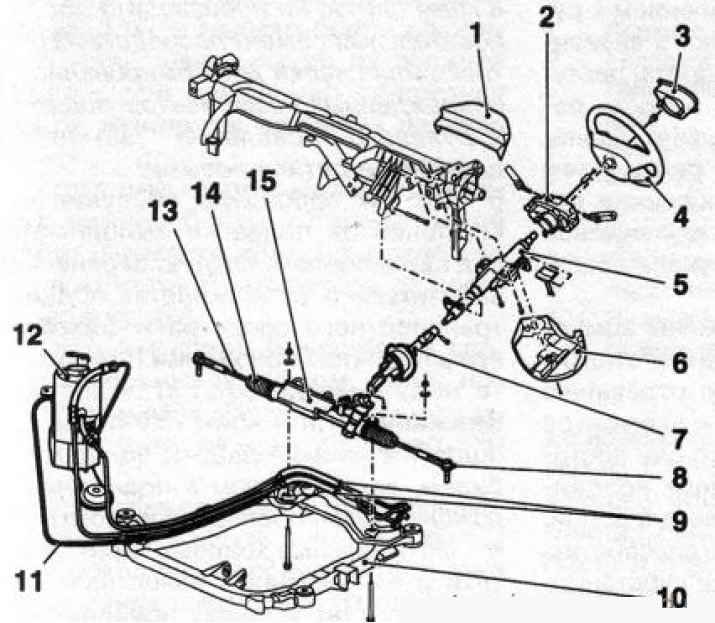


1.3 Steering gear design: 1. Upper steering column trim; 2. Contact block of steering column…

1.3 Steering gear design: 1. Upper steering column trim; 2. Contact block of steering column switches; 3. Front driver airbag module; 4. Steering wheel; 5. Steering column; 6. Lower steering column trim; 7. Intermediate steering shaft; 8. Tie rod end; 9. Pressure and return hydraulic lines of the power steering; 10. Subframe; 11. Steering angle sensor drive (models without ESP); 12. Electric steering pump with reservoir; 13. Steering rod; 14. Steering rod protective cover; 15. Steering mechanism


Attention: Never perform repairs by straightening or welding deformed and damaged suspension and steering components - replace defective parts with new ones!


Safety precautions when repairing steering


Before you begin working on the steering components, carefully read the operating principle, operating rules of the SRS and safety precautions given in the Chapter "Controls and operating techniques".

To ensure that the airbag deploys properly in an emergency collision and to avoid the risk of injury from accidental deployment, certain precautions must be taken (see also Chapter 12):
  • a) Before working on the airbag or near the SRS wiring, be sure to disconnect the negative battery cable first and then the positive battery cable. Insulate the battery terminals to prevent accidental short circuits. Allow at least 1 minute for the backup power supply capacitor to discharge before starting work;
  • b) Do not allow the air bag module to heat up above 80°C. Do not turn the removed air bag module upside down;
  • c) Avoid contact of the module surface with solvents and detergents - use only a clean, slightly damp cloth to wipe the steering wheel;
  • d) The SRS control unit and airbag modules are sensitive to directional overloads (impacts) and must be replaced after a fall from a height of more than 80 cm;
  • e) Before carrying out welding work on the vehicle, be sure to disconnect the SRS control unit wiring;
  • f) To avoid injury, do not install any additional equipment or place any foreign objects in the air bag deployment area.
  • g) Before disconnecting the electrical wiring, you must relieve yourself of electrostatic voltage by briefly touching the metal wedge of the door lock or the car body!
  • h) When connecting the battery, there should be no people in the vehicle!


Tightening force of threaded connections, Nm


Axial bolt for fastening the hydraulic support bushing of the control lever - 40 Nm +40°

Bolts for fastening the power steering assembly to the body - 22

Steering column intermediate shaft mounting bolt - 22

Steering wheel mounting bolt - 30

Steering tie rod ends to steering knuckle nuts - 35

Steering column switch contact block lock nut - 15

Bolt for fastening the contact block of the steering column switches - 15

Tie Rod End Locknuts - 60


This article is available at russian, bulgarian, belarusian, ukrainian, serbian, croatian, romanian, polish, slovak, hungarian
Checking the article: Meshcheryakov Damir

Share information:

Previous articles
Opel Vectra C: Steering
Next articles

Removal and installation the driver's front airbag module
Removal and installation the steering wheel
Removal and installation the steering column switch contact block
Tie Rod Ends — Replacement
Removal and installation steering gear boots
Wheel alignment angles


See similar ones from other Opel car manuals:
▶ Suspension and steering specifications Opel Astra G (1998-2004)
▶ Suspension and steering specifications Opel Corsa B (1993-2000)
▶ Mechanical steering specifications Opel Kadett E (1984-1995)
▶ Steering Specifications Opel Omega A (1986-1993)
▶ Suspension and steering specifications Opel Frontera A (1991-1998, petrol)
Link to this page in different formats

Visitor comments


No comments yet


How much will 10 + 19 =


Vectra C (2002-2008) 
  • General information
  • User manual
  • Vehicle device
  • Maintenance
  • Troubleshooting
  • Power unit
  • Engine repair
  • Cooling system
  • Power and control system
  • Engine electrics
  • Transmission
  • Clutch
  • Car gearbox
  • Drive shafts
  • Chassis
  • Car suspension
  • Steering
  • Brake system
  • Body
  • Exterior
  • Interior
  • Doors, locks and windows
  • Heating and ventilation
  • Electrical equipment
  • Equipment and devices
  • Headlights and lighting
  • Electrical circuits
Vectra B (1995-2002) 
  • General information
  • User manual
  • Weekly checks
  • Maintenance (gasoline)
  • Maintenance (diesel)
  • Troubleshooting
  • Power unit
  • SOHC gasoline engine
  • DOHC petrol engine
  • Diesel engine 1.7 liter
  • Diesel engine 2.0 liters
  • Engine repair
  • Cooling system
  • Fuel system (gasoline)
  • Fuel system (diesel)
  • Charging system
  • Launch system
  • Ignition and preheat
  • Transmission
  • Clutch
  • Mechanical gearbox
  • Automatic gearbox
  • Drive shafts
  • Chassis
  • Brake system
  • Wheel suspension
  • Steering
  • Body
  • Exterior
  • Interior
  • Doors and windows
  • Heating and ventilation
  • Electrical equipment
  • Equipment and devices
  • Electrical circuits
Vectra B (1995-2002, petrol) 
  • General information
  • Maintenance
  • Help with malfunctions
  • Power unit
  • Engine repair
  • Exhaust system
  • Cooling system
  • Fuel system
  • Multec injection system
  • Four point injection
  • Transmission
  • Clutch
  • Gearbox and drive
  • Chassis
  • Wheel suspension
  • Steering
  • Brake system
  • Wheels and tires
  • Body
  • Exterior
  • Interior
  • Electrical equipment
  • Fuses and electronics
  • Power devices
  • Ignition system
  • Lighting and signaling
  • Equipment and devices
  • Heating and ventilation
  • Electrical circuits
Vectra A (1988-1995) 
  • Power unit
  • Engine repair
  • Ignition system
  • Lubrication system
  • Cooling system
  • Injection system
  • Fuel system (carburetor)
  • Fuel system (diesel)
  • Exhaust system
  • Transmission
  • Clutch
  • Car gearbox
  • Chassis
  • Front suspension
  • Rear suspension
  • Steering
  • Brake system
  • Wheels and tires
  • Body
  • Exterior
  • Interior
  • Electrical equipment
  • Electrical circuits
Vectra A (1988-1995, petrol) 
  • General information
  • User manual
  • Maintenance
  • Power unit
  • SOHC engine
  • DOHC engine
  • Cooling and ventilation
  • Fuel system (carburetor)
  • Fuel system (injector)
  • Exhaust converter
  • Transmission
  • Clutch
  • Mechanical gearbox
  • Automatic gearbox
  • Drive shafts
  • Chassis
  • Brake system
  • Car suspension
  • Steering
  • Body
  • Body elements
  • Electrical equipment
  • Power devices
  • Equipment and devices
  • Electrical circuits
OpelBook.ru © 2017–2026 · Mobile version · · Sitemap: EN BG BY UA RS HR RO PL SK HU · Feedback · Site search
Astra F, petrol · Astra G, petrol · Astra G · Astra H · Astra J, petrol · Corsa B · Corsa C, petrol · Corsa C · Insignia A · Kadett D · Kadett E · Omega A · Omega B · Omega B2 · Vectra A, petrol · Vectra A · Vectra B, petrol · Vectra B · Vectra C · Zafira A, petrol · Frontera A, petrol · Frontera B · Ascona C · Vivaro A ·
We want your visit to be comfortable 🤝! We use cookies 🍪 to make that happen.