


Note: Use new flywheel/drive plate mounting bolts and cylinder head mounting bolts.
1. Turn the cylinder block over and wipe the main bearing seats.
2. Insert the main bearing shells into the crankcase. Note that the rear shell contains thrust flanges.
3. Lubricate the bearings with clean engine oil.
4. Carefully lower the crankshaft into the crankcase. Turn it a few times and check that it is seated correctly.
5. Check that the crankshaft side play is within the specifications by inserting a chip between the ribbed main bearing shell and the crankshaft thrust surface.
6. Clean the rear of the lower main bearing shells and caps, then install them in place. Lubricate the shells with clean oil.
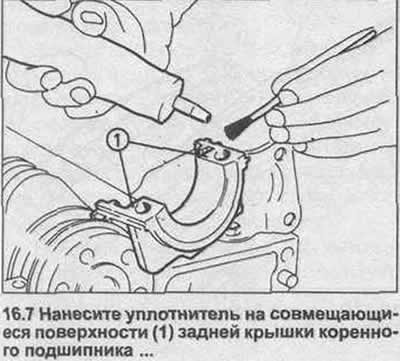
7. Apply suitable sealant to the mating surfaces of the rear main bearing cap (Opel recommends using GM sealant specification 15 04 200 (Part # 08 983 368)) (see illustration).
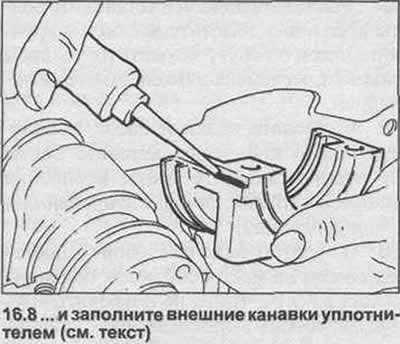
8. Fill the grooves on each outer edge of the rear main bearing cap with a bead of sealant approximately 6 mm in diameter (Opel recommends sealant GM specification 15 03 294 (Part # 90 001 851)) (see illustration).
9. Install all main bearing caps, install cap mounting bolts. Tighten the bolts by hand, then tighten them evenly to the torque specified in the Specification. Check that the grooves of the rear main bearing cap are sufficiently sealed and wipe off excess sealant.
10. Turn the crankshaft and check that it rotates freely without jamming.
11. Lubricate the tabs of the new rear crankshaft oil seal. Place the seal on the crankshaft, tab inward, and press it into the rear main bearing cap.
12. Place the cylinder block on its side, lubricate the cylinder bores and crankshaft journals with oil.
13. Place the piston rings around the pistons so that their cut gaps are 180° apart. For the oil scraper ring, offset the cuts at the top and bottom by 25-50 mm to the right and left of the cut gap of the center section.
14 Clean the rear of the connecting rod bearing shells and caps, then install the shells in place.
15. Turn the crankshaft so that the journal of cylinder No.1 is at BDC.
16. Install the piston ring puller on piston #1, then insert the piston into cylinder #1 with the arrow on the piston head toward the front end of the engine (to the drive chain).
17. Using the hammer handle, drive the piston through the ring compressor into the cylinder, guiding the connecting rod onto the journal.
18. Install the connecting rod piece, then insert the bolts. Tighten the bolts evenly and to the tightening torque specified in the Specification.
19. Check that the crankshaft rotates freely, taking into account the resistance of the piston rings.
20. Repeat the procedure given in steps 15-19 with the remaining pistons.
21. Turn the block over on the bench.
22. Install the Woodruff key into the crankshaft keyway. Install the timing chain sprocket and distributor/oil pump drive.
23. Clean the threads of the drive chain guide bolts and the camshaft sprocket support plate, and coat them with blocking compound. Install the guide and plate, and tighten the bolts securely.
24. Install the flywheel/drive plate on the crankshaft, screw in new mounting bolts, install the bolt marked "P" in the position marked during removal; on models with automatic transmission, be sure to install a spacer and washer between the crankshaft and the drive plate. After locking the crankshaft with the tool shown in Illustration 9.10, tighten the mounting bolts to the tightening torque specified in the Specification.
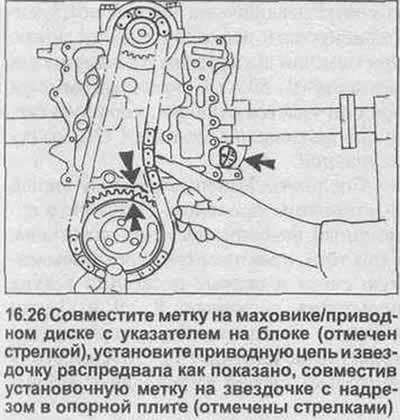
25. Turn the crankshaft so that cylinder No.1 is at TDC and align the mark on the flywheel/drive plate with the pointer on the cylinder block.
26. Install the camshaft sprocket and timing chain assembly to the engine, aligning the marks made during removal. Pull the chain tight on the left side, remove all slack from the right side of the chain and check that the ignition timing point on the camshaft sprocket is aligned with the notch on the backing plate (see illustration). If necessary, disconnect the chain and adjust the position of the sprocket.
27. Install the drive chain tensioner blades and mounting bracket into place.
28. Using a screwdriver, carefully remove the seal from the front cover of the drive chain. Install a new one, with the protrusion inward, and press it into place.
29. Insert the timing chain cover location pins into the block, install new gaskets.
30. Install the drive chain cover and insert the mounting bolts. Tighten the bolts to the torque specified in the Specification.
31. Completely clean the mating surfaces of the block and head.
32. Check that cylinder #1 is still at TDC. The mark on the flywheel/drive plate is aligned with the pointer, the timing mark on the camshaft sprocket is aligned with the notch in the base plate. Install the timing chain tensioner and O-ring, tighten it a couple of turns.
33. Check that the location pins are inserted into the block and apply suitable sealant (Opel recommends GM sealant specification 15 03 294 (Part # 90 001 871)) to the area where the timing chain cover and cylinder head meet.
34. Install a new O-ring into the recess at the top of the timing chain cover, then install the new cylinder head gasket, making sure it is correctly oriented and located on the pins.
35. Check that the camshaft notches are correctly positioned and carefully lower the cylinder head into place.
36 Carefully insert the new cylinder head bolts into the holes (don't throw them away!) and screw it in only by hand as far as possible.
37. Tighten the cylinder head bolts evenly in the sequence shown in Illustration 12.22 to Stage 1 torque.
38 Again, in the sequence shown, tighten the bolts to the stage 2 angle.
39. Wait approximately ten minutes, then tighten the bolts in a circle to the stage 3 angle.
40. Install the two smaller bolts on the front end of the cylinder head, tighten them to the torque specified in the Specification.
41. Fit the sprocket onto the end of the camshaft, tighten the mounting bolts to the tightening torque specified in the Specification. Check that the flywheel/drive plate and camshaft sprocket timing marks are correctly positioned, then tighten the timing chain tensioner to the tightening torque specified in the Specification.
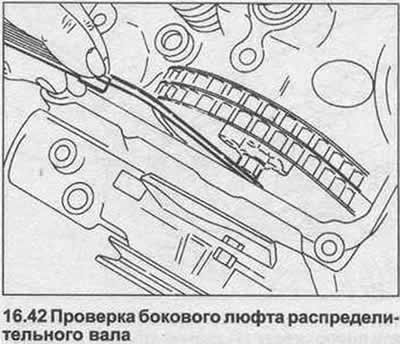
42. Screw in the new plastic side play bolt (included in the gasket set) into the end of the camshaft, then install the access plate and a new gasket on the front end of the cylinder head. Use a feeler gauge to measure the clearance between the side play bolt and the protective cover; this is the lateral play of the camshaft (see illustration). Set the required clearance value by tightening the camshaft side clearance bolt.
43. Install the intake manifold to the drive cover base using a new gasket. Apply blocking compound to the mounting bolts and tighten them securely.
44. Check that the surfaces of the tray and block are clean and dry.
45. Apply suitable sealant (Opel recommends GM specification sealant 1503 294 (Part # 90 001 851)) to the area where the block meets the drive cover and the rear main bearing cap.
46. Fix the gaskets in their positions, insert the rubber gaskets into the grooves in the drive chain cover and the bearing cap and the gaskets into the cylinder block base. Check that the joints between the gaskets are covered with sealant.
47. Clean the threads of the oil pan mounting bolts and apply blocking compound to them. (Opel recommends using blocking compound GM specification 15 10 177 (Part # 90 167 347)).
48. Position the tray and install the mounting bolts. Tighten all bolts by hand, then tighten them in a circle to the tightening torque specified in the Specification.
49. Install the water pump using a new gasket, insert the mounting bolts. Tighten the mounting bolts to the tightening torque specified in the Specification.
50. Carefully slide the crankshaft pulley assembly into place, taking great care not to damage the seal lip, and align the slot with the crankshaft key. Install the pulley retaining bolt, tighten to Specification, locking the flywheel/drive plate.
51. Adjust the valve clearances as described in Chapter 13.
52. Install the cover gasket to the cylinder head and install the cover. Install the cover mounting bolts and tighten them securely.
53. Install the glow plugs and injectors.
54. Install the oil level dipstick.
55. Install the oil pressure sensor and tighten it securely.
56. Install the accessories listed in Chapter 8.
Visitor comments