


Contents: Cleaning ⬇ Visual inspection ⬇ Checking the technical condition of…⬇ Checking the technical condition of…⬇
Cleaning
1. Remove any remaining sealant and gaskets or seals.
2. Clean all surfaces of the cylinder head with a non-corrosive solvent.
3. Blow out the oil passages in the cylinder head with compressed air.
4. Remove carbon deposits and soot from the combustion chamber.
Visual inspection
1. Check the main bearing surfaces of the camshafts in the cylinder head for the presence of:
- Excessive wear and tear.
- Discoloration due to overheating.
- Deformations due to excessive wear.
If any defects are found, the cylinder head must be replaced. Do not bore or grind the main bearings in the cylinder head.
2. Check the cylinder head for:
- Cracks, damage or chipping in the combustion chamber.
- Abrasive particles in oil channels (after removing these particles, flush the oil channels).
- Coolant leaks or damage to sealing surfaces (if there are coolant leaks, it is necessary to check the non-flatness of the contact surfaces of the cylinder head).
- Damage to contact surfaces.
- Burnt or eroded areas in combustion chambers.
- Cracks in exhaust ports and combustion chambers.
- External cracks in the cooling system channels.
- Blockages in the inlet and outlet channels.
- Blockages in the cooling system channels.
- Rust, damage or leakage of plugs.
3. If the cylinder head is cracked or damaged, it must be replaced with a new one. Welding or patching is not allowed.
Checking the technical condition of the valves
1. Clean the valves from soot and oil. The soot is removed using a brush with hard bristles.
2. Check the condition of the valves:
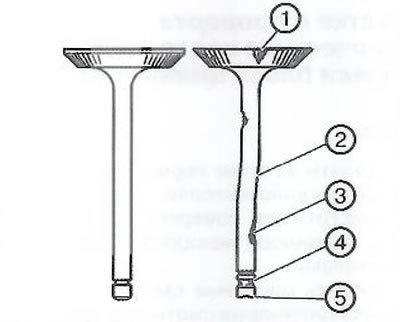
- Check the valve surfaces for burnout and cracks (1). If there are chips, replace the valve and check the corresponding cylinder area on the cylinder head for damage.
- Check the straightness and absence of deformation of the valve stem (2). A deformed valve must be replaced with a new one.
- Check the valve stem for wear (3).
- Check the groove on the valve stem for installing crackers for chips and wear (5). If defects are found, replace the valve with a new one.
3. Use a caliper (1) to measure the length of the valve (2).
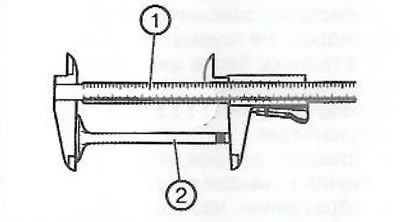
Note: All values are given in the "Service Data and Specification" section at the end of the chapter.
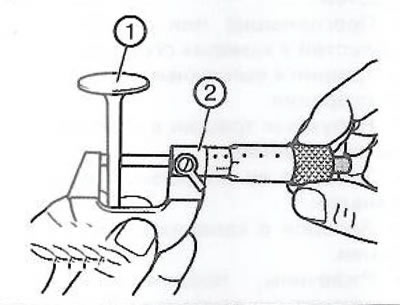
4. Using a micrometer (2), measure the diameter of the valve stem (1). Record the obtained values.
Checking the technical condition of the cylinder head
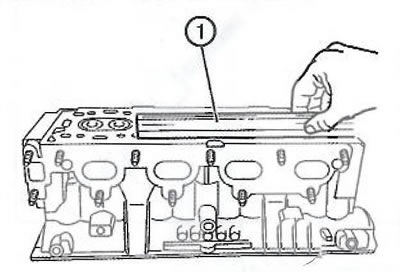
1. Check the non-flatness of the contact surface of the cylinder head using a straight edge (1).
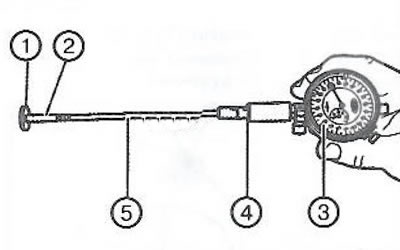
2. Using a dial indicator, measure the clearance between the valve stem and the valve guide. To do this, assemble the EN-6216 dial indicator and the EN-6216-200/300/400 components as follows:
- Install the extension (5) on the support (4).
- Install the bore gauge (2) on the extension (5).
- Place the dial indicator (3) on the support (4) and set to the preliminary value of 1 mm.
- Install the calibration washer (1) as shown in the figure to align the indicator.
- Set the indicator to 0 by rotating the scale.
- Carefully remove the calibration washer (1).
3. Using a dial indicator with a bore gauge (1), measure the inner diameter of the valve guide bushing (2) in various planes (3). Record the obtained values.
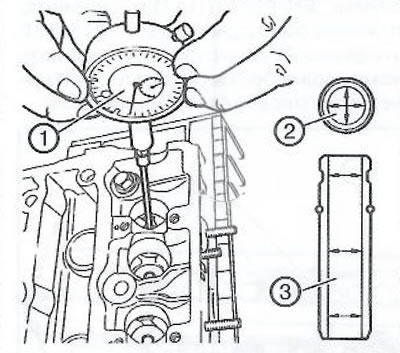
Subtract the valve stem diameter from the average inside diameter of the corresponding guide bushing to obtain the stem-to-guide bushing clearance value.
Visitor comments