


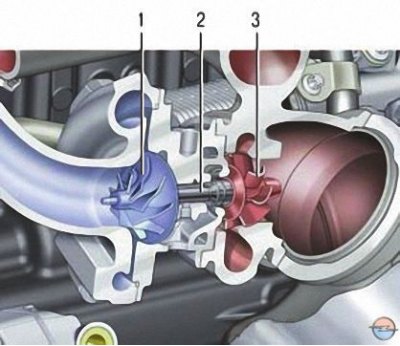
Fig. 1. Turbocharger: 1 – compressor; 2 – shaft; 3 – turbine
The turbocharger consists of turbine impellers 3 (Fig. 1) and compressor 1, mounted on a common shaft 2. The energy of exhaust gases, which rotate its blades, is used to set the turbine in motion. The rotation of the turbine sets the compressor in motion, which in turn compresses and supplies air from the atmosphere to the engine cylinders. The rotation frequency of the turbocharger rotor does not depend on the rotation frequency of the engine crankshaft, since they are not rigidly connected to each other.
The turbocharger is a precision unit operating under high temperatures and dynamic loads, so its repair or replacement requires special equipment and highly qualified personnel. Carry out these works at specialized service stations.
Note: The turbocharger shaft bearings are lubricated under pressure by engine oil from the engine lubrication system. The turbocharger shaft rotates very quickly, so it continues to rotate for a long time even after the engine has stopped, when there is no pressure in the lubrication system. Therefore, to prevent damage to the turbocharger shaft bearings, do not turn off the engine immediately after parking the car. Let it idle for a few minutes so that the turbocharger shaft has time to reduce its rotation speed to a minimum while continuing to lubricate its bearings.
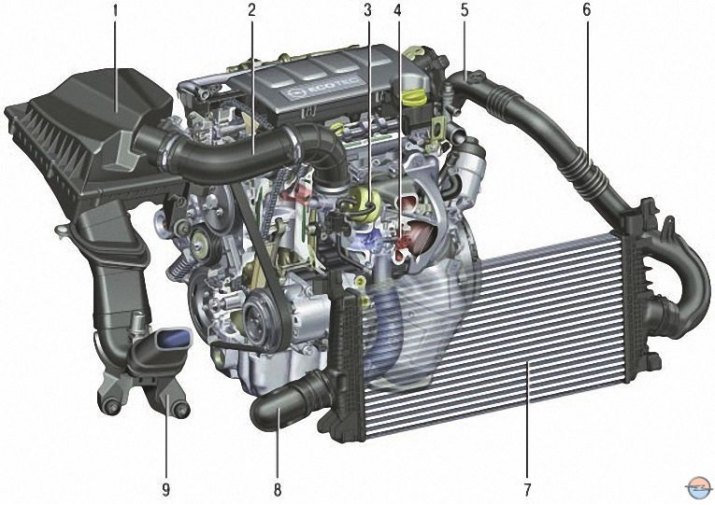
Fig. 2. Turbocharged engine air supply system: 1 – air filter; 2 – low pressure air supply hose; 3 – boost control valve; 4 – turbocharger; 5 – throttle assembly; 6 – air supply hose for cooled supercharged air; 7 – charge air cooling radiator (intercooler); 8 – hot charge air supply hose; 9 – air intake
Air, entering the air intake 9 (Fig. 2), passes through the air filter 1 and through the low-pressure air supply hose 2 enters the turbocharger 4. In the turbocharger, the air is compressed by the rotating compressor wheel and, as a result, is heated. From the turbocharger, the heated supercharged air, through the air supply hose 8, enters the radiator for cooling (intercooler) 7. Cooling of the charge air is necessary for two reasons: firstly, hot air can cause detonation; secondly, cold air is denser, so more oxygen enters the engine. In the intercooler, the air is cooled and through the air supply hose 6 enters the throttle assembly 5. In the engine, the air is mixed with the required amount of fuel and, having done useful work, enters the exhaust manifold in the form of exhaust gases. Having entered the exhaust manifold, the exhaust gases meet the turbocharger turbine wheel on their way and, rotating it, go into the exhaust system. The boost limiting valve 3 serves to bleed off excess air pressure created when the throttle valve is closed. When the valve is triggered, excess air that has passed through the turbocharger enters back into the low-pressure air supply hose.
Useful tips
With a certain amount of skill and attentiveness, many engine and system faults can be determined quite accurately by the color of the smoke coming out of the exhaust pipe. Blue smoke indicates oil getting into the combustion chambers, and constant smoking is a sign of severe wear of the cylinder-piston group parts. The appearance of smoke during revving, after prolonged cranking by the starter, after long idling or immediately after engine braking usually indicates wear of the valve stem seals. Black smoke is a sign of too rich a mixture due to a faulty engine management system or injectors. Gray or thick white smoke with an admixture of moisture (especially after the engine overheats) means that the coolant has entered the combustion chamber through a damaged cylinder head gasket. If this gasket is severely damaged, the liquid sometimes enters the oil pan, the oil level rises sharply, and the oil itself turns into a cloudy whitish emulsion. White smoke (steam) from an unheated engine in damp or cold weather is normal.
Quite often you can see a car standing in the middle of a city traffic jam with the hood open, emitting clouds of steam. Overheating. Of course, it is better not to allow this, looking at the temperature gauge more often. But no one is immune from the fact that the thermostat, electric fan can suddenly fail, or the coolant can simply leak. If you missed the moment of overheating, do not panic and do not aggravate the situation. Overheating is not as scary as its possible consequences. Never turn off the engine immediately - it will get a heat stroke and, perhaps, after cooling down, will refuse to start at all. After stopping, let it run at idle speed, then the circulation of liquid in the system will be maintained. Turn on the heater at maximum power and open the hood. If possible, pour cold water on the radiator. Only after achieving a decrease in temperature, stop the engine. But never immediately open the cap of the expansion tank: on an overheated engine, a geyser from under the open cap is guaranteed. Take your time, let everything cool down, this way you will preserve the health of the machine and your own health.
Almost all car manuals recommend that the clutch must be depressed when starting the engine. This recommendation is only justified in the case of starting in severe frost, so as not to waste battery energy on turning the shafts and gears of the gearbox in thickened oil. In other cases, this is simply a recommendation to prevent the car from moving if a gear is engaged due to forgetfulness. This technique is harmful to the engine, since when the clutch is depressed, significant force is transmitted through it to the crankshaft thrust bearing, and when starting (especially cold) lubrication does not reach it for a long time. The bearing wears out quickly, the crankshaft gets axial play, and starting from a standstill begins to be accompanied by strong vibration. In order not to damage the engine, get into the habit of checking the position of the gearshift lever before starting and starting the engine with the parking brake applied, without squeezing the clutch unless absolutely necessary.
Visitor comments