
OpelBook.ru
Cars AvtoVAZ Cars Mitsubishi Cars BMW Cars Mercedes Cars Nissan Cars Toyota Cars Chevrolet
English Русский
Български
Беларускі
Український
Српски
Hrvatski
Română
Polski
Slovenský
Magyar
 |  Sitemap  |  Contacts  |    


Main Astra Corsa Insignia Kadett Omega Vectra Zafira Others Articles
Astra F (1991-1998, petrol) Astra G (1998-2004, petrol) Astra G (1998-2004) Astra H (2004-2009) Astra J (2009-2015, petrol)
  • Main
  • Astra
  • Astra J
  • Body
  • Security systems
  • Design features of the anti-lock braking system (ABS)

Design features of the anti-lock braking system (ABS) (Opel Astra J)

            0

The anti-lock braking system (ABS) consists of wheel speed sensors, a switch on the brake pedal, a hydro-electronic control module and a warning lamp in the instrument cluster. The anti-lock braking system is also equipped with an emergency braking system that ensures the vehicle brakes with maximum efficiency when the brake pedal is pressed sharply, an electronic brake force distribution system (EBD), and a self-diagnosis system that detects faults in the system components.

ABS is used to regulate the pressure in the brake mechanisms of all wheels when braking in difficult road conditions and thus prevents wheel locking.

The ABS system provides the following benefits:
  • avoiding obstacles with a higher degree of safety, including during emergency braking;
  • reducing the braking distance during emergency braking while maintaining the vehicle's directional stability and controllability, including when turning.

In case of system failure, diagnostic functions and system failure support are provided.
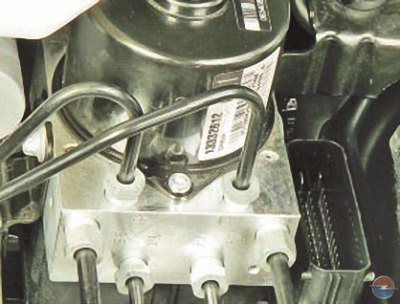
In case of system failure, diagnostic functions and system failure support are provided.


The hydroelectronic control module receives information about the vehicle speed, direction of travel and road conditions from the wheel speed sensors, the power steering pressure sensor and the throttle position sensor. After the ignition is turned on, the control unit supplies voltage to the wheel speed sensors, which use the Hall effect. The sensors generate an output signal in the form of rectangular pulses. The signal changes proportionally to the speed of the sensor's pulse ring.


Based on this information, the control unit determines the optimal wheel braking mode.

The following operating modes of the anti-lock braking system are distinguished:
  • normal braking mode. During normal braking, the inlet valve is open and the outlet valve is closed. When you press the brake pedal, brake fluid under pressure is supplied to the slave cylinder and activates the wheel brakes. When you release the brake pedal, the brake fluid returns to the master cylinder through the inlet and check valves;
  • emergency braking mode. If the wheel starts to lock during emergency braking, the module sends a command to the pump electric motor to reduce the supply of brake fluid, then voltage is supplied to each electromagnetic valve. The inlet valve closes, and the supply of brake fluid from the master cylinder and pump is blocked; the release valve opens and brake fluid flows from the slave cylinder to the master cylinder and then to the reservoir, causing a decrease in pressure;
  • pressure maintenance mode. When the pressure in the working cylinder drops to the maximum, the module issues a command to maintain the brake fluid pressure, voltage is supplied to the inlet valve and is not supplied to the outlet valve. In this case, the inlet and outlet valves are closed and the brake fluid does not leave the working cylinder;
  • pressure boost mode. If the module determines that the wheel is not locked, then voltage is not supplied to the electromagnetic valves, the brake fluid enters the working cylinder through the inlet valve, the pressure in which increases.

Diagnostics and repair of the anti-lock braking system require special equipment and tooling, so if it fails, contact a specialized service station.


(Article published on the website: OpelBook)

This subsection describes only the replacement of the wheel speed sensors and the hydraulic electronic unit, but keep in mind that special equipment is required to remove air that may get into the valve system of the hydraulic electronic unit during unqualified removal. Therefore, we recommend that you contact a service center to replace the unit.


This article is available at russian, bulgarian, belarusian, ukrainian, serbian, croatian, romanian, polish, slovak, hungarian
Checking the article: Trifonova Emilia

Share information:

Previous articles
Opel Astra J: Security systems
Next articles

Removal and installation the front passenger airbag switch
Removal and installation the shock sensor
Electronic control unit of additional passive safety system
Removal and installation seat belts
Removal and installation the driver's airbag and its contact ring
Design features of the passive safety system (SRS)
Removal and installation of the ABS electronic unit
Replacing wheel speed sensors


See similar ones from other Opel car manuals:
▶ General information about the anti-lock braking system Opel Corsa C (2000-2006, petrol)
▶ Anti-lock braking system and traction control system Opel Insignia A (2008-2017)
▶ Technical characteristics of the anti-lock braking system Opel Kadett E (1984-1995)
▶ Anti-lock Braking System (ABS) — Precautions Opel Omega A (1986-1993)
▶ Anti-lock braking system (ABS) — general description Opel Vectra A (1988-1995, petrol)
Link to this page in different formats

Visitor comments


No comments yet


How much will 20 + 27 =


Astra J (2009-2015, petrol) 
  • General information
  • Vehicle device
  • User manual
  • Faults en route
  • Maintenance
  • Power unit
  • Engine repair
  • Cooling and lubrication system
  • Engine power system
  • Exhaust system
  • Transmission
  • Clutch
  • Car gearbox
  • Drive shafts
  • Chassis
  • Front suspension
  • Rear suspension
  • Steering
  • Brake system
  • Wheels and tires
  • Body
  • Exterior
  • Interior
  • Doors and windows
  • Body Care
  • Heating and air conditioning
  • Security systems
  • Electrical equipment
  • Equipment and devices
  • Lighting and signaling
  • Power devices
  • Electrical circuits
Astra H (2004-2009) 
  • General information
  • Introduction to the guide
  • Troubleshooting
  • User manual
  • Maintenance
  • Power unit
  • Engine repair
  • Cooling and heating
  • Power and exhaust system
  • Ignition system
  • Launch and charge system
  • Transmission
  • Mechanical gearbox
  • Automatic gearbox
  • Drive shafts
  • Chassis
  • Brake system
  • Car suspension
  • Steering
  • Body
  • Interior
  • Exterior
  • Electrical equipment
  • Equipment and devices
  • Electrical circuits
Astra G (1998-2004) 
  • General information
  • Introduction to manual
  • User manual
  • Maintenance
  • Power unit
  • SOHC gasoline engines
  • DOHC gasoline engines
  • Diesel engines 1.7 and 2.0
  • Engine repair
  • Cooling system
  • Supply system
  • Injection system (gasoline)
  • Injection system (diesel)
  • Exhaust system
  • Charge and launch system
  • Ignition system (gasoline)
  • Preheat system (diesel)
  • Transmission
  • Manual gearbox
  • Automatic gearbox
  • Clutch
  • Drive shafts
  • Chassis
  • Brake system
  • Wheel suspension
  • Steering
  • Body
  • Exterior
  • Interior
  • Doors and windows
  • Ventilation and heating
  • Electrical equipment
  • Equipment and devices
  • Electrical circuits
Astra G (1998-2004, petrol) 
  • General information
  • User manual
  • Car care
  • Maintenance
  • Power unit
  • Single shaft engines
  • Twin shaft engines
  • Engine repair
  • Cooling and heating
  • Fuel and exhaust systems
  • Starting and charging system
  • Ignition system
  • Transmission
  • Clutch
  • Mechanical gearbox
  • Automatic gearbox
  • Drive shafts
  • Chassis
  • Brake system
  • Car suspension
  • Steering
  • Body
  • Interior
  • Exterior
  • Electrical equipment
  • Equipment and devices
  • Wiring diagrams Opel Astra
  • Wiring diagrams Opel Zafira
Astra F (1991-1998, petrol) 
  • General information
  • Maintenance
  • Power unit
  • Engine in car
  • Engine removed
  • Cooling system
  • Heating and ventilation
  • Fuel supply (carburetor)
  • Fuel supply (injector)
  • Emission control
  • Ignition system
  • Transmission
  • Clutch
  • Mechanical gearbox
  • Automatic gearbox
  • Drive shafts
  • Chassis
  • Brake system
  • Car suspension
  • Steering
  • Body
  • Exterior
  • Interior
  • Electrical equipment
  • Equipment and devices
  • Electrical circuits
OpelBook.ru © 2017–2026 · Mobile version · · Sitemap: EN BG BY UA RS HR RO PL SK HU · Feedback · Site search
Astra F, petrol · Astra G, petrol · Astra G · Astra H · Astra J, petrol · Corsa B · Corsa C, petrol · Corsa C · Insignia A · Kadett D · Kadett E · Omega A · Omega B · Omega B2 · Vectra A, petrol · Vectra A · Vectra B, petrol · Vectra B · Vectra C · Zafira A, petrol · Frontera A, petrol · Frontera B · Ascona C · Vivaro A ·
We want your visit to be comfortable 🤝! We use cookies 🍪 to make that happen.