


Remember that dust generated during wear of the clutch slave disk friction linings may contain asbestos, which is harmful to health. Do not blow off dust with compressed air and try not to inhale it. Do not use petroleum-based solvents to wipe clutch components — use only special brake cleaners or pure methyl alcohol. Place used rags in a hermetically sealed container.
Removal
In order to provide access to the clutch assembly, the gearbox is usually removed, leaving the engine in the car. If the engine has already been removed for general or major repairs, the condition of the clutch components must be checked without fail. Given the relatively low cost of the parts and the fairly large amount of mechanical work required to provide access to the clutch assembly, it makes sense to replace the latter regardless of the condition of its components. Below is a description of the procedure for removing the clutch without removing the engine from the car.
1. Remove the gearbox (see Chapter Manual gearbox), - support the engine with a jack or hang it from above on a winch (preferably the latter). If you use a jack, do not forget to place a wooden block between its head and the oil pan to distribute the load.
The oil intake of the oil pump is located very close to the bottom of the oil pan and can easily be damaged if the latter is deformed.
2. To prevent the driven disk from falling out when removing the basket, insert a tool designed for clutch centering into its hub.
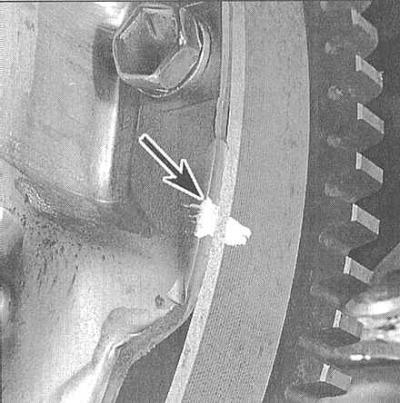
3. Carefully inspect the flywheel and clutch basket assembly surfaces for markings (usually in the form of letters X or O painted in white). If you cannot find the marking, apply it yourself, clearly marking the position of the basket relative to the flywheel.
4. Acting in a diagonal order, in several steps (half a turn per approach) evenly loosen the bolts securing the clutch basket to the flywheel, completely unloading the diaphragm spring; before loosening the bolts, the flywheel can be locked using a special device.
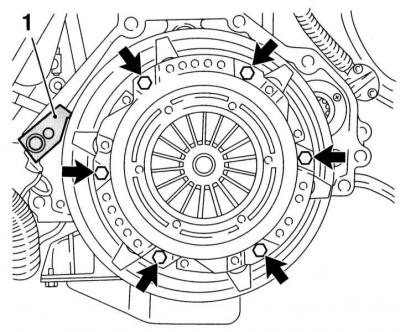
5. While supporting the clutch assembly securely, remove the bolts completely, then separate the clutch basket from the flywheel and remove the entire assembly from the vehicle.
6. Remove the friction disc - try to remember which side it is installed on the flywheel.
Examination
Assembling the slave disk
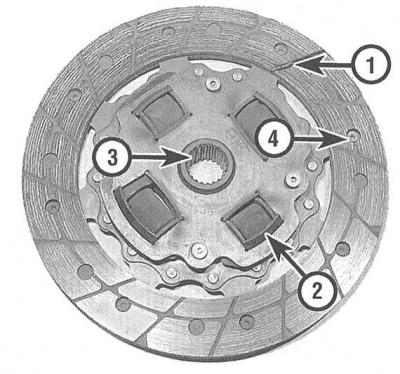
1 — Friction linings in the picture are worn below the permissible limit
2 — Torsion springs or dampers must be checked for cracks and signs of deformation
3 — Splined hub must slide freely on the splines of the gearbox input shaft, the splines must not be excessively worn
4 — Rivets are used to secure friction linings and when the latter become excessively worn, they begin to leave grooves on the working surface of the flywheel
Examples of diaphragm spring wear
Most often, the malfunction of the clutch is associated with wear of the friction linings of the driven disk. However, it is necessary to carefully examine the condition of all other components of the assembly.
1. Examine the flywheel working surface for cracks, traces of overheating, grooves and other damage. Minor defects can be eliminated by turning in a car service workshop (it is recommended to perform turning regardless of the surface condition). A description of the flywheel removal and installation procedures is given in the corresponding section of the Chapter Engine.
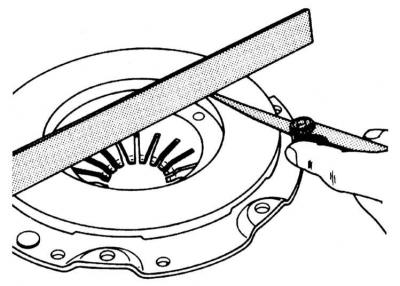
2. Also check the condition and evaluate the flatness of the mating surface of the clutch pressure plate.
3. Assess the degree of wear of the friction linings of the driven clutch disc. The surface of the linings should rise above the rivet heads by at least 1.6 mm. Make sure that all rivets are tightly seated, check the torsion springs/dampers for cracks, signs of deformation and other mechanical damage (see illustration Assembling the slave disk). Oiling of friction linings most often occurs due to failure of the crankshaft oil seal, damage to the integrity of the oil pan gasket, the sealing element of the actuator cylinder assembly or the oil seal of the primary shaft of the manual transmission - replace the damaged components (see the relevant Chapters). As mentioned above, it is reasonable to replace clutch components every time the assembly is dismantled, so pay attention to the slightest errors.
4. The release bearing is always replaced together with the driven disk. If the driven disk is OK, check the condition of the release bearing - the bearing should rotate smoothly, without signs of jamming. The mating surfaces should be absolutely smooth and undamaged, without cracks, burrs or dents. If you are not sure of the bearing condition, replace the slave cylinder assembly (see Removal and installation the clutch slave cylinder assembly with release bearing).
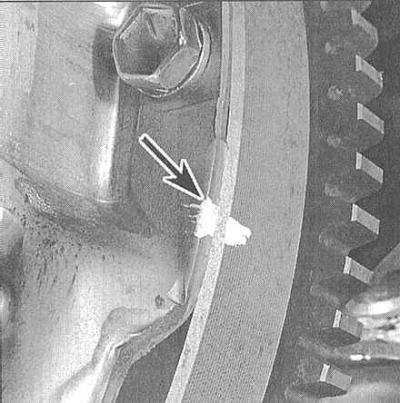
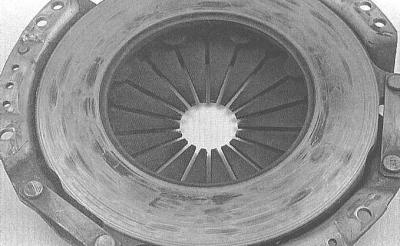
5. Assess the condition of the machined surfaces and petals of the diaphragm spring of the pressure plate (see illustration Examples of diaphragm spring wear). If defects are detected, replace the basket assembly. Light polishing marks can be removed with fine-grained sandpaper. A reconditioned clutch assembly can always be purchased on an exchange basis through Opel service stations.
Installation
1. Make sure that the mating surfaces of the flywheel and clutch discs are absolutely clean and dry; if necessary, wipe the working surfaces with solvent.
2. Install the friction disc with the protruding part of the hub away from the flywheel. Usually the disc is marked at the factory indicating which side it should be installed towards the flywheel ("Flywheel side" or "Getriebeseite").
3. Install the clutch basket - if you are installing an old basket, make sure that the alignment marks applied during dismantling are correct. Screw in the basket mounting bolts and tighten them only by hand for now to ensure that the driven disk can be centered without any obstacles.
4. Now it is necessary to center the friction disc so that when installing the transmission, its input shaft passes through the splines in the disc and enters the guide sleeve in the crankshaft journal.
5. The friction disk can be centered using a screwdriver inserted through its central hole and into the crankshaft guide bushing. The task can be made much easier by using a special mandrel (like device #2174) in the form of a primary transmission shaft journal. Good results can also be achieved using a thin rod with electrical tape wound around it to the required diameter.
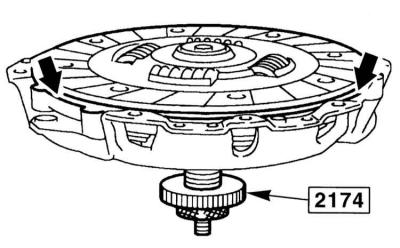
6. After finishing centering the driven disk, tighten the basket mounting bolts evenly in several steps in a diagonal order with the required force. Remove the centering device.
7. Install the gearbox in place (see Chapter Manual gearbox).
Visitor comments