
OpelBook.ru
Cars AvtoVAZ Cars Mitsubishi Cars BMW Cars Mercedes Cars Nissan Cars Toyota Cars Chevrolet
English Русский
Български
Беларускі
Український
Српски
Hrvatski
Română
Polski
Slovenský
Magyar
 |  Sitemap  |  Contacts  |    


Main Astra Corsa Insignia Kadett Omega Vectra Zafira Others Articles
Astra F (1991-1998, petrol) Astra G (1998-2004, petrol) Astra G (1998-2004) Astra H (2004-2009) Astra J (2009-2015, petrol)
  • Main
  • Astra
  • Astra G
  • Transmission
  • Clutch
  • Clutch — General information and component condition check

Clutch — General information and component condition check (Opel Astra G)

            0

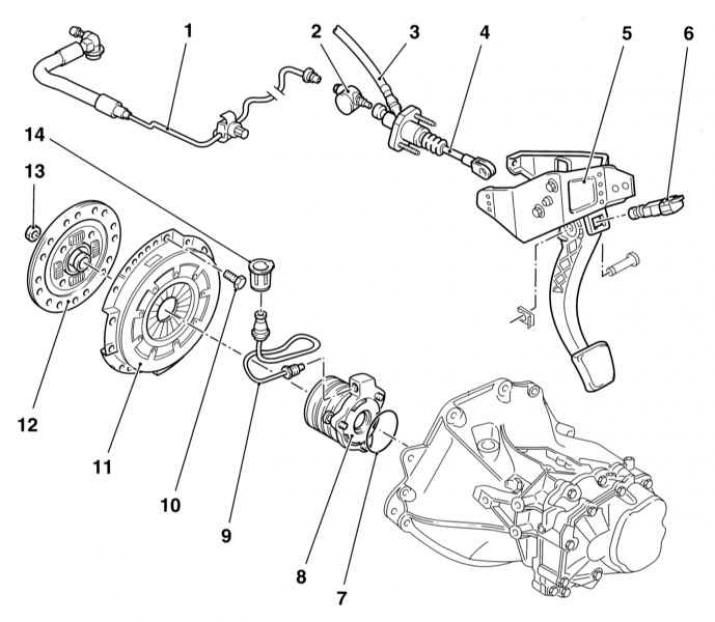
Design of the clutch and its drive components

1 — Clutch release drive hydraulic line

1 — Clutch release drive hydraulic line

2 - Damper

3 - Hose connecting the master cylinder to the reservoir

4 — Clutch master cylinder push rod

5 — Clutch pedal bracket

6 — Clutch pedal position sensor switch (models with tempostat)

7 — Sealing ring

8 — Assembling the clutch slave cylinder with the release bearing

9 - Hydraulic line

10 — Clutch basket mounting bolt

11 — Assembling the clutch basket with the pressure plate

12 — Slave (friction) clutch disc

13 — Guide bushing

14 — Union nut


All models equipped with a manual transmission use a single-plate dry clutch with a diaphragm spring. The hub of the friction (driven) disk is equipped with longitudinal splines that engage with the splines of the transmission primary shaft journal. The friction and pressure plates of the clutch are held in contact with each other by the force developed by the diaphragm spring of the pressure plate. The design of the clutch and its drive - see the illustration Design of the clutch and its drive components.

(Original posted on the website: opelbook.ru)

The clutch is released hydraulically. The release drive consists of a clutch pedal, a main hydraulic cylinder with a reservoir, connecting lines and a slave cylinder combined with a release bearing, mounted directly on the input shaft of the gearbox (see illustration Design of the clutch and its drive components).


When the pedal is depressed, the hydraulic pressure in the system tract increases, which is then applied to the release bearing mounted in the slave cylinder. The bearing, under the influence of hydraulic force, is pressed against the petals of the diaphragm spring of the pressure plate in the clutch basket. By bending, the spring interrupts the contact of the pressure and driven disks, releasing the latter.

When servicing a clutch, in addition to replacing components that are obviously damaged, it is necessary to perform some initial checks (it is assumed that the gearbox is in good condition):
  • First of all, you should check the fluid level in the clutch master cylinder (see Chapter Routine maintenance). If necessary, make adjustments by adding the required amount of hydraulic fluid and carefully inspect the system for signs of leaks. When emptying the master cylinder reservoir, it is necessary to remove air locks from the hydraulic circuit (see Bleeding air from the hydraulic circuit of the clutch release drive), then check the proper functioning of the clutch.
  • To estimate the clutch shift time, start the engine at normal idle speed. Make sure the transmission is in neutral and release the clutch pedal. Now depress the clutch pedal and wait a few seconds before engaging reverse gear. The shift should not produce any grinding or other abnormal noises, which would most likely indicate a faulty driven disc or clutch basket assembly.
  • To check that the clutch is fully disengaged, apply the parking brake and start the engine. Keeping the clutch pedal about 13 mm above the floor, shift the gearbox between first and reverse gears. If there is any interference when shifting the lever, this indicates a faulty clutch release mechanism component. Check the stroke of the clutch slave cylinder pusher. When the pedal is fully depressed, the pusher should extend noticeably; otherwise, check the hydraulic fluid level in the master cylinder.
  • Perform a visual inspection of the condition of the axle bushings at the top of the clutch pedal. Make sure there are no signs of jamming or excessive axle play.


This article is available at russian, bulgarian, belarusian, ukrainian, serbian, croatian, romanian, polish, slovak, hungarian
Checking the article: Pavlovsky Nikolay

Share information:

Previous articles
Opel Astra G: Clutch
Next articles

Clutch and Drive Shaft Specifications
General information about clutches and drive shafts
Removal and installation the clutch master cylinder
Removal and installation the clutch slave cylinder assembly with release bearing
Bleeding air from the hydraulic circuit of the clutch release drive
Removal and installation the clutch pedal
Removal, inspection and installation of clutch components


See similar ones from other Opel car manuals:
▶ Removal, condition check and installation of the camshaft… Opel Corsa B (1993-2000)
▶ Engine — technical condition check Opel Zafira A (1999-2005, petrol)
▶ Determining engine faults by the condition of spark plugs Opel Insignia A (2008-2017)
▶ Clutch Opel Kadett E (1984-1995)
▶ Check coolant level — every 400 km Opel Omega A (1986-1993)
Link to this page in different formats

Visitor comments


No comments yet


How much will 17 + 10 =


Astra J (2009-2015, petrol) 
  • General information
  • Vehicle device
  • User manual
  • Faults en route
  • Maintenance
  • Power unit
  • Engine repair
  • Cooling and lubrication system
  • Engine power system
  • Exhaust system
  • Transmission
  • Clutch
  • Car gearbox
  • Drive shafts
  • Chassis
  • Front suspension
  • Rear suspension
  • Steering
  • Brake system
  • Wheels and tires
  • Body
  • Exterior
  • Interior
  • Doors and windows
  • Body Care
  • Heating and air conditioning
  • Security systems
  • Electrical equipment
  • Equipment and devices
  • Lighting and signaling
  • Power devices
  • Electrical circuits
Astra H (2004-2009) 
  • General information
  • Introduction to the guide
  • Troubleshooting
  • User manual
  • Maintenance
  • Power unit
  • Engine repair
  • Cooling and heating
  • Power and exhaust system
  • Ignition system
  • Launch and charge system
  • Transmission
  • Mechanical gearbox
  • Automatic gearbox
  • Drive shafts
  • Chassis
  • Brake system
  • Car suspension
  • Steering
  • Body
  • Interior
  • Exterior
  • Electrical equipment
  • Equipment and devices
  • Electrical circuits
Astra G (1998-2004) 
  • General information
  • Introduction to manual
  • User manual
  • Maintenance
  • Power unit
  • SOHC gasoline engines
  • DOHC gasoline engines
  • Diesel engines 1.7 and 2.0
  • Engine repair
  • Cooling system
  • Supply system
  • Injection system (gasoline)
  • Injection system (diesel)
  • Exhaust system
  • Charge and launch system
  • Ignition system (gasoline)
  • Preheat system (diesel)
  • Transmission
  • Manual gearbox
  • Automatic gearbox
  • Clutch
  • Drive shafts
  • Chassis
  • Brake system
  • Wheel suspension
  • Steering
  • Body
  • Exterior
  • Interior
  • Doors and windows
  • Ventilation and heating
  • Electrical equipment
  • Equipment and devices
  • Electrical circuits
Astra G (1998-2004, petrol) 
  • General information
  • User manual
  • Car care
  • Maintenance
  • Power unit
  • Single shaft engines
  • Twin shaft engines
  • Engine repair
  • Cooling and heating
  • Fuel and exhaust systems
  • Starting and charging system
  • Ignition system
  • Transmission
  • Clutch
  • Mechanical gearbox
  • Automatic gearbox
  • Drive shafts
  • Chassis
  • Brake system
  • Car suspension
  • Steering
  • Body
  • Interior
  • Exterior
  • Electrical equipment
  • Equipment and devices
  • Wiring diagrams Opel Astra
  • Wiring diagrams Opel Zafira
Astra F (1991-1998, petrol) 
  • General information
  • Maintenance
  • Power unit
  • Engine in car
  • Engine removed
  • Cooling system
  • Heating and ventilation
  • Fuel supply (carburetor)
  • Fuel supply (injector)
  • Emission control
  • Ignition system
  • Transmission
  • Clutch
  • Mechanical gearbox
  • Automatic gearbox
  • Drive shafts
  • Chassis
  • Brake system
  • Car suspension
  • Steering
  • Body
  • Exterior
  • Interior
  • Electrical equipment
  • Equipment and devices
  • Electrical circuits
OpelBook.ru © 2017–2026 · Mobile version · · Sitemap: EN BG BY UA RS HR RO PL SK HU · Feedback · Site search
Astra F, petrol · Astra G, petrol · Astra G · Astra H · Astra J, petrol · Corsa B · Corsa C, petrol · Corsa C · Insignia A · Kadett D · Kadett E · Omega A · Omega B · Omega B2 · Vectra A, petrol · Vectra A · Vectra B, petrol · Vectra B · Vectra C · Zafira A, petrol · Frontera A, petrol · Frontera B · Ascona C · Vivaro A ·
We want your visit to be comfortable 🤝! We use cookies 🍪 to make that happen.