
OpelBook.ru
Cars AvtoVAZ Cars Mitsubishi Cars BMW Cars Mercedes Cars Nissan Cars Toyota Cars Chevrolet
English Русский
Български
Беларускі
Український
Српски
Hrvatski
Română
Polski
Slovenský
Magyar
 |  Sitemap  |  Contacts  |    


Main Astra Corsa Insignia Kadett Omega Vectra Zafira Others Articles
Astra F (1991-1998, petrol) Astra G (1998-2004, petrol) Astra G (1998-2004) Astra H (2004-2009) Astra J (2009-2015, petrol)
  • Main
  • Astra
  • Astra G
  • Transmission
  • Automatic gearbox
  • General information about automatic transmission

General information about automatic transmission (Opel Astra G)

            0

A detailed description of the operating principles and designs of automatic transmissions used in most modern cars is provided in Manual No.179 published by ARUS.


Location of the AT and its associated components in the engine compartment of the car (bottom view)
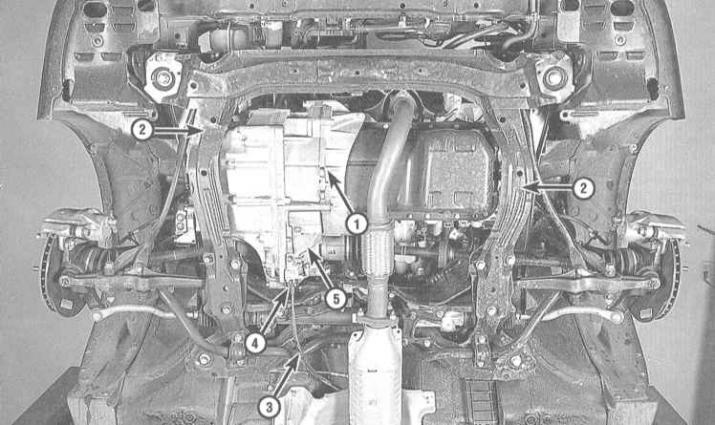
1 — Powertrain amplifier

1 — Powertrain amplifier

2 — Subframe

3 — Gear shift cable

4 — Shift cable holder

5 — Shift cable cover


4-speed automatic transmission (AT) consists of a torque converter (rotation converter), planetary assemblies and hydraulically controlled clutches and brake bands. The transmission is controlled by the ECM via electrically controlled valves. The AT has three driving modes: normal (economical), sports and winter.

Normal (economical) mode is designed for a normal driving style, when upshifting occurs at relatively low engine speeds, corresponding to the minimum fuel consumption mode. Shifting in sports mode is carried out using a button located on the selector lever and leads to a delay in the upshifts of the transmission, which leads to an increase in the dynamic characteristics of the car, but is accompanied by a slight increase in fuel consumption. The activation of the sports mode is indicated by the "SPORT" control lamp (see Chapter User manual). To enable winter mode the function is designed to be located on the central console to switch - the car starts moving from a standstill when this mode is activated from third gear, which significantly improves the quality of the treads' grip on slippery road surfaces.


Torque converter (rotation converter) provides the transmission of torque from the engine to the gearbox. Due to the fact that the transmission of rotation is carried out hydraulically (via transmission fluid - ATF), the car starts moving and gear shifting is very smooth. In addition, the torque converter provides dynamic adjustments to the torque value during acceleration.

The planetary mechanism of the AT provides the ability to select four forward and one reverse gear. The gear ratio of the planetary gear is determined by which of its elements are locked and which rotate freely. Locking and releasing of the elements of the planetary assemblies in the AT is carried out using clutches and brake bands activated by commands coming from the control module. The hydraulic pump placed inside the transmission housing supplies the working fluid pressure necessary to activate the clutches and brake bands.

The driver controls the AT via a selector lever mounted on the car floor and having seven positions. Position "D" (Drive) provides the ability to shift the transmission to any of the four forward gears, while the kickdown function provides automatic downshifting when the gas pedal is pressed all the way down (in order to increase the gear ratio, providing the car with increased dynamic characteristics, necessary, for example, when overtaking). IN position "1" the forward gearshifts are completely locked and the car can only move in first gear. Select positions "2" and "3" provides transmission shifting between the first two/three gears, providing the ability to perform engine braking in difficult road conditions (for example, when driving in mountainous areas). It should be remembered that the automatic transmission can only switch to a lower gear after an adequate reduction in engine speed. Position "R" (Reverse) corresponds to the selection of reverse gear, position "N" (Neutral) - neutral and position "P" - parking.


By including a special sensor-switch in the starting circuit (start enable switch sensor) the engine can only be started in the "P" and "N" positions of the selector lever; the same sensor switch ensures that the reverse lights are activated when the lever is moved to the "R" position.


Due to the complexity of the AT design, the lack of commercially available replacement internal components, and the need to use special equipment, the authors of this Manual do not recommend that vehicle owners perform major transmission repairs on their own. This Chapter only covers procedures for diagnosing common transmission failures, routine maintenance, adjustments, removal, and installation.

Sometimes, in case of a serious breakdown, it is wiser and easier to replace the transmission than to spend time and money on restoring the failed assembly. Regardless of the chosen method of putting the failed AT into operation, performing its removal and installation yourself will help to significantly reduce costs (first make sure that the transmission really needs a rebuild).


This article is available at russian, bulgarian, belarusian, ukrainian, serbian, croatian, romanian, polish, slovak, hungarian
Checking the article: Pavlovsky Nikolay

Share information:

Previous articles
Opel Astra G: Automatic gearbox
Next articles

Automatic transmission specifications
Adjusting the gear selection mechanism
Removal and installation the gear selection cable
Removal and installation the AT selector lever assembly
Replacing oil seals
ATF Cooler — General Information


See similar ones from other Opel car manuals:
▶ Automatic Transmission Fluid Replacement (ATF) Opel Corsa B (1993-2000)
▶ Automatic transmission Opel Kadett E (1984-1995)
▶ Automatic transmission Opel Omega A (1986-1993)
▶ Automatic transmission Opel Vectra A (1988-1995, petrol)
▶ Automatic transmission mode selector Opel Zafira A (1999-2005, petrol)
Link to this page in different formats

Visitor comments


No comments yet


How much will 11 + 12 =


Astra J (2009-2015, petrol) 
  • General information
  • Vehicle device
  • User manual
  • Faults en route
  • Maintenance
  • Power unit
  • Engine repair
  • Cooling and lubrication system
  • Engine power system
  • Exhaust system
  • Transmission
  • Clutch
  • Car gearbox
  • Drive shafts
  • Chassis
  • Front suspension
  • Rear suspension
  • Steering
  • Brake system
  • Wheels and tires
  • Body
  • Exterior
  • Interior
  • Doors and windows
  • Body Care
  • Heating and air conditioning
  • Security systems
  • Electrical equipment
  • Equipment and devices
  • Lighting and signaling
  • Power devices
  • Electrical circuits
Astra H (2004-2009) 
  • General information
  • Introduction to the guide
  • Troubleshooting
  • User manual
  • Maintenance
  • Power unit
  • Engine repair
  • Cooling and heating
  • Power and exhaust system
  • Ignition system
  • Launch and charge system
  • Transmission
  • Mechanical gearbox
  • Automatic gearbox
  • Drive shafts
  • Chassis
  • Brake system
  • Car suspension
  • Steering
  • Body
  • Interior
  • Exterior
  • Electrical equipment
  • Equipment and devices
  • Electrical circuits
Astra G (1998-2004) 
  • General information
  • Introduction to manual
  • User manual
  • Maintenance
  • Power unit
  • SOHC gasoline engines
  • DOHC gasoline engines
  • Diesel engines 1.7 and 2.0
  • Engine repair
  • Cooling system
  • Supply system
  • Injection system (gasoline)
  • Injection system (diesel)
  • Exhaust system
  • Charge and launch system
  • Ignition system (gasoline)
  • Preheat system (diesel)
  • Transmission
  • Manual gearbox
  • Automatic gearbox
  • Clutch
  • Drive shafts
  • Chassis
  • Brake system
  • Wheel suspension
  • Steering
  • Body
  • Exterior
  • Interior
  • Doors and windows
  • Ventilation and heating
  • Electrical equipment
  • Equipment and devices
  • Electrical circuits
Astra G (1998-2004, petrol) 
  • General information
  • User manual
  • Car care
  • Maintenance
  • Power unit
  • Single shaft engines
  • Twin shaft engines
  • Engine repair
  • Cooling and heating
  • Fuel and exhaust systems
  • Starting and charging system
  • Ignition system
  • Transmission
  • Clutch
  • Mechanical gearbox
  • Automatic gearbox
  • Drive shafts
  • Chassis
  • Brake system
  • Car suspension
  • Steering
  • Body
  • Interior
  • Exterior
  • Electrical equipment
  • Equipment and devices
  • Wiring diagrams Opel Astra
  • Wiring diagrams Opel Zafira
Astra F (1991-1998, petrol) 
  • General information
  • Maintenance
  • Power unit
  • Engine in car
  • Engine removed
  • Cooling system
  • Heating and ventilation
  • Fuel supply (carburetor)
  • Fuel supply (injector)
  • Emission control
  • Ignition system
  • Transmission
  • Clutch
  • Mechanical gearbox
  • Automatic gearbox
  • Drive shafts
  • Chassis
  • Brake system
  • Car suspension
  • Steering
  • Body
  • Exterior
  • Interior
  • Electrical equipment
  • Equipment and devices
  • Electrical circuits
OpelBook.ru © 2017–2026 · Mobile version · · Sitemap: EN BG BY UA RS HR RO PL SK HU · Feedback · Site search
Astra F, petrol · Astra G, petrol · Astra G · Astra H · Astra J, petrol · Corsa B · Corsa C, petrol · Corsa C · Insignia A · Kadett D · Kadett E · Omega A · Omega B · Omega B2 · Vectra A, petrol · Vectra A · Vectra B, petrol · Vectra B · Vectra C · Zafira A, petrol · Frontera A, petrol · Frontera B · Ascona C · Vivaro A ·
We want your visit to be comfortable 🤝! We use cookies 🍪 to make that happen.