
OpelBook.ru
Cars AvtoVAZ Cars Mitsubishi Cars BMW Cars Mercedes Cars Nissan Cars Toyota Cars Chevrolet
English Русский
Български
Беларускі
Український
Српски
Hrvatski
Română
Polski
Slovenský
Magyar
 |  Sitemap  |  Contacts  |    


Main Astra Corsa Insignia Kadett Omega Vectra Zafira Others Articles
Vectra A (1988-1995, petrol) Vectra A (1988-1995) Vectra B (1995-2002, petrol) Vectra B (1995-2002) Vectra C (2002-2008)
  • Main
  • Vectra
  • Vectra B
  • Power unit
  • SOHC gasoline engine
  • Checking the compression pressure

Checking the compression pressure (Opel Vectra B)

            0

The engine condition can be checked by measuring the compression pressure in the cylinders. If this check is carried out regularly, it is possible to know in advance the beginning of engine wear, without waiting for the moment when wear manifests itself in low engine efficiency.

1. Warm up the engine to operating temperature, with the battery fully charged. Unscrew the spark plugs.

2. Remove the connectors from the fuel injectors of the fuel injection system.
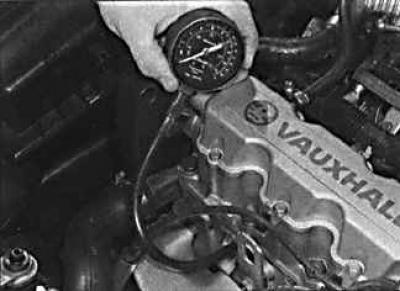
2. Remove the connectors from the fuel injectors of the fuel injection system.


3. Install a compression gauge into the spark plug hole of the first cylinder.

4. The assistant should press the accelerator pedal all the way down and turn the engine over with the starter. After turning the crankshaft one or two revolutions, the compression pressure should increase to the maximum and then stabilize. Record the maximum result obtained.

5. Check the remaining cylinders in the same way.

The compression pressure in all cylinders should not differ by more than two units. Note that the compression value should increase quickly on a healthy engine; low compression pressure on the first revolution of the crankshaft, followed by a gradual increase in pressure on subsequent revolutions of the crankshaft, indicates wear of the piston rings. Low pressure on the first revolution of the crankshaft, which increases slightly thereafter, indicates a loose valve fit, a broken cylinder head gasket, or a crack in the cylinder head. Wear on the ends of the valve stems can also lead to low compression pressure.


Opel does not define the exact compression pressure, but if the compression pressure in the cylinders is less than 10, this indicates engine wear.

If the pressure in one cylinder is low, then perform the following test. Pour some engine oil into the cylinder through the spark plug hole and check the compression pressure.

If pouring oil into the cylinder increases the compression pressure, this indicates that the cylinder or piston rings are worn.

Low pressure in two adjacent cylinders indicates a burnt-out gasket between the cylinders.

If the pressure in one cylinder is 20% less than in the others and the engine runs rough at idle, this indicates a worn camshaft cam.

If the compression pressure is too high, this indicates that the combustion chamber is covered with a thick layer of carbon deposits.

After this check, screw in the spark plugs and connect the high-voltage wires to them.


This article is available at russian, bulgarian, belarusian, ukrainian, serbian, croatian, romanian, polish, slovak, hungarian
Checking the article: Pavlovsky Nikolay

Share information:

Previous articles
Opel Vectra B: SOHC gasoline engine
Next articles

Technical specifications
General information about SOHC engine repair
Top dead center (TDC) of the piston of the first cylinder
Cylinder head cover — removal and installation
Crankshaft pulley — removal and installation
Timing Belt Covers — Removal and Installation
Timing belt — removal and installation
Timing Belt Tensioner and Pulleys


See similar ones from other Opel car manuals:
▶ Checking the compression pressure in the cylinders Opel Astra H (2004-2009)
▶ Checking the compression pressure in the cylinders and… Opel Corsa B (1993-2000)
▶ Checking the compression pressure Opel Omega B (1993-1999)
▶ Checking the compression in the cylinders Opel Insignia A (2008-2017)
▶ Checking oil pressure Opel Kadett E (1984-1995)
Link to this page in different formats

Visitor comments


No comments yet


How much will 21 + 22 =


Vectra C (2002-2008) 
  • General information
  • User manual
  • Vehicle device
  • Maintenance
  • Troubleshooting
  • Power unit
  • Engine repair
  • Cooling system
  • Power and control system
  • Engine electrics
  • Transmission
  • Clutch
  • Car gearbox
  • Drive shafts
  • Chassis
  • Car suspension
  • Steering
  • Brake system
  • Body
  • Exterior
  • Interior
  • Doors, locks and windows
  • Heating and ventilation
  • Electrical equipment
  • Equipment and devices
  • Headlights and lighting
  • Electrical circuits
Vectra B (1995-2002) 
  • General information
  • User manual
  • Weekly checks
  • Maintenance (gasoline)
  • Maintenance (diesel)
  • Troubleshooting
  • Power unit
  • SOHC gasoline engine
  • DOHC petrol engine
  • Diesel engine 1.7 liter
  • Diesel engine 2.0 liters
  • Engine repair
  • Cooling system
  • Fuel system (gasoline)
  • Fuel system (diesel)
  • Charging system
  • Launch system
  • Ignition and preheat
  • Transmission
  • Clutch
  • Mechanical gearbox
  • Automatic gearbox
  • Drive shafts
  • Chassis
  • Brake system
  • Wheel suspension
  • Steering
  • Body
  • Exterior
  • Interior
  • Doors and windows
  • Heating and ventilation
  • Electrical equipment
  • Equipment and devices
  • Electrical circuits
Vectra B (1995-2002, petrol) 
  • General information
  • Maintenance
  • Help with malfunctions
  • Power unit
  • Engine repair
  • Exhaust system
  • Cooling system
  • Fuel system
  • Multec injection system
  • Four point injection
  • Transmission
  • Clutch
  • Gearbox and drive
  • Chassis
  • Wheel suspension
  • Steering
  • Brake system
  • Wheels and tires
  • Body
  • Exterior
  • Interior
  • Electrical equipment
  • Fuses and electronics
  • Power devices
  • Ignition system
  • Lighting and signaling
  • Equipment and devices
  • Heating and ventilation
  • Electrical circuits
Vectra A (1988-1995) 
  • Power unit
  • Engine repair
  • Ignition system
  • Lubrication system
  • Cooling system
  • Injection system
  • Fuel system (carburetor)
  • Fuel system (diesel)
  • Exhaust system
  • Transmission
  • Clutch
  • Car gearbox
  • Chassis
  • Front suspension
  • Rear suspension
  • Steering
  • Brake system
  • Wheels and tires
  • Body
  • Exterior
  • Interior
  • Electrical equipment
  • Electrical circuits
Vectra A (1988-1995, petrol) 
  • General information
  • User manual
  • Maintenance
  • Power unit
  • SOHC engine
  • DOHC engine
  • Cooling and ventilation
  • Fuel system (carburetor)
  • Fuel system (injector)
  • Exhaust converter
  • Transmission
  • Clutch
  • Mechanical gearbox
  • Automatic gearbox
  • Drive shafts
  • Chassis
  • Brake system
  • Car suspension
  • Steering
  • Body
  • Body elements
  • Electrical equipment
  • Power devices
  • Equipment and devices
  • Electrical circuits
OpelBook.ru © 2017–2026 · Mobile version · · Sitemap: EN BG BY UA RS HR RO PL SK HU · Feedback · Site search
Astra F, petrol · Astra G, petrol · Astra G · Astra H · Astra J, petrol · Corsa B · Corsa C, petrol · Corsa C · Insignia A · Kadett D · Kadett E · Omega A · Omega B · Omega B2 · Vectra A, petrol · Vectra A · Vectra B, petrol · Vectra B · Vectra C · Zafira A, petrol · Frontera A, petrol · Frontera B · Ascona C · Vivaro A ·
We want your visit to be comfortable 🤝! We use cookies 🍪 to make that happen.