
OpelBook.ru
Cars AvtoVAZ Cars Mitsubishi Cars BMW Cars Mercedes Cars Nissan Cars Toyota Cars Chevrolet
English Русский
Български
Беларускі
Український
Српски
Hrvatski
Română
Polski
Slovenský
Magyar
 |  Sitemap  |  Contacts  |    


Main Astra Corsa Insignia Kadett Omega Vectra Zafira Others Articles
Kadett D (1979-1984) Kadett E (1984-1995)
  • Main
  • Kadett
  • Kadett E
  • Transmission
  • Automatic gearbox
  • Frictions

Frictions (Opel Kadett E)

            0

The multi-disc clutch consists of discs with friction linings and steel discs, a hub, a drum or a gearbox housing, depending on whether the rotating element engages with a stationary or rotating element. The clutch is driven by a hydraulic drive using a piston.

Depending on the direction of torque supply to the friction, the disks can be driven or leading.

Some of the disks are fixed on the splines of the clutch hub, other disks are installed on the splined surfaces of the drum or gearbox housing. When the hydraulic drive piston moves away from the clutch, its hub together with the disks rotates freely relative to the drum or gearbox housing. When pressure is applied to the rear surface of the piston, the piston presses the driven and driving disks against each other, as a result of which the hub begins to rotate together with the clutch drum or remains in contact with the gearbox housing. The clutch is disengaged when the oil pressure on the rear surface of the piston drops. Under the action of the return springs, the piston returns to its original position, releasing the driven and driving disks.

The forward clutch consists of a housing welded to the input shaft, steel disks and disks with friction linings. sliding along the internal input gear. The hydraulic drive piston presses the disks against each other. The clutch is disengaged when the oil pressure behind the hydraulic drive piston drops. Under the action of the return springs, the piston returns to its original position, releasing the driven and driving disks. When oil pressure appears on the rear surface of the piston, the clutch is engaged and the internal input gear is connected to the input planetary gear. This clutch remains engaged in all forward gears.


When the automatic transmission selector lever is in neutral position "N", the forward clutch is in the disengaged position.

The direct transmission clutch consists of a piston placed in the housing, a ring with pressure and release springs, steel disks and disks with friction linings. This clutch is used to engage the 2nd gear and reverse gear.

The 1st gear and reverse clutch is used to engage one of these gears. It consists of a piston, expansion spring, steel discs and discs with friction linings.
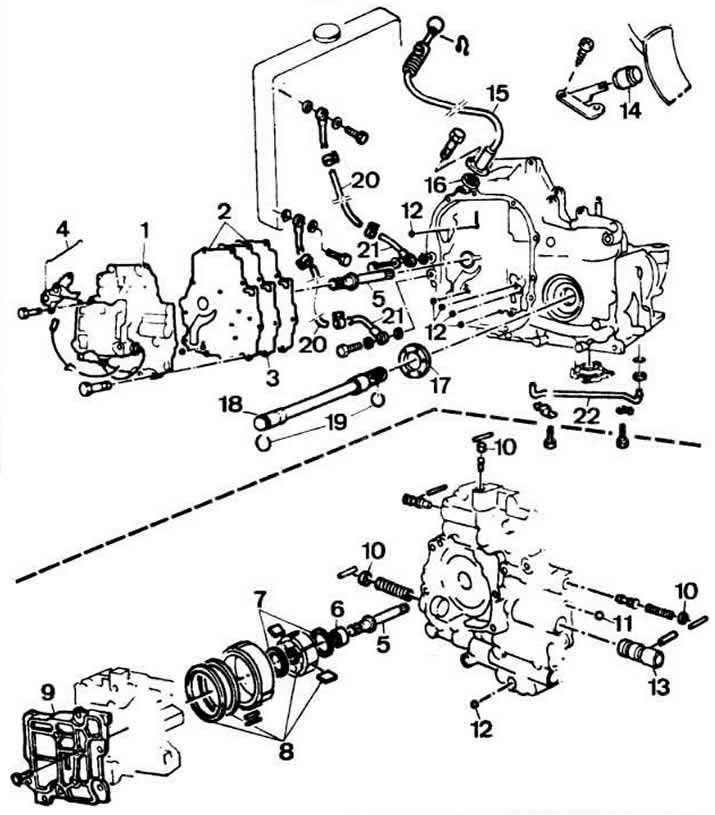
Valve box, oil pump and forced-reverse switching mechanism parts:

Valve box, oil pump and forced-reverse switching mechanism parts:
1 — valve box-oil pump assembly housing;
2 - gaskets;
3 — shield;
4 - forced reverse switching mechanism;
5 — oil pump drive shaft;
6 — bearing;
7 - sealing rings;
8 - oil pump parts;
9 — oil pump cover;
10 - cork;
11 - ball diameter 9.5 mm;
12 - balls with a diameter of 6.3 mm;
13 — bushing;
14 — forced reverse switching stop;
15 — forced reverse shift cable;
16 — oil seal;
17 — sealing ring;
18 — output shaft;
19 - retaining rings;
20 — oil supply and drainage pipeline to the cooler;
21 — oil line fittings;
22 - drain pipe.


This article is available at russian, bulgarian, belarusian, ukrainian, serbian, croatian, romanian, polish, slovak, hungarian
Checking the article: Shapovalov Yaroslav

Share information:

Previous articles
Opel Kadett E: Automatic gearbox
Next articles

Planetary gear
Torque converter torque converter
Design features and operating principle
Tightening torques of main threaded connections, kgf.m
Technical characteristics of transmission oil
Gearbox specifications
Band brake
Freewheel clutch
Output planetary gear
Removal the hydromechanical gearbox
Checking oil pressure
Adjusting the forced reverse shift cable


Link to this page in different formats

Visitor comments


No comments yet


How much will 40 + 44 =


Kadett E (1984-1995) 
  • General information
  • Vehicle description
  • Operation and maintenance
  • OHV power unit
  • Engine design
  • Check and repair
  • Engine work
  • OHC power unit
  • Engine design
  • Engine repair
  • Ignition system
  • Cooling and lubrication
  • Supply system
  • Fuel injection «LE-Jetronic»
  • Fuel injection «LE3-Jetronic»
  • Motronic ML4.1 system
  • Motronic M1.5 system
  • Motronic M2.5 system
  • Transmission
  • Clutch
  • Gearbox F10 and F13
  • Gearbox F16 and F20
  • Automatic gearbox
  • Drive shafts
  • Chassis
  • Front suspension
  • Rear suspension
  • Steering
  • Brake system
  • Electrical equipment
  • Equipment and devices
  • Electrical circuits
Kadett D (1979-1984) 
  • General information
  • Car care
  • Maintenance
  • Power unit
  • Gasoline engines
  • Lubrication system
  • Cooling system
  • Power system (gasoline)
  • Carburetor Solex 35 PDSI
  • Carburetor Varajet II
  • Carburetor 1B1
  • Fuel injection (gasoline)
  • Diesel engines
  • Fuel system (diesel)
  • Transmission
  • Clutch
  • Manual gearbox
  • Chassis
  • Front suspension
  • Rear suspension
  • Steering
  • Brake system
  • Wheels and tires
  • Body
  • Body elements
  • Doors and windows
  • Electrical equipment
  • Equipment and devices
  • Lighting system
  • Power devices
  • Ignition system
  • Electrical circuits
OpelBook.ru © 2017–2026 · Mobile version · · Sitemap: EN BG BY UA RS HR RO PL SK HU · Feedback · Site search
Astra F, petrol · Astra G, petrol · Astra G · Astra H · Astra J, petrol · Corsa B · Corsa C, petrol · Corsa C · Insignia A · Kadett D · Kadett E · Omega A · Omega B · Omega B2 · Vectra A, petrol · Vectra A · Vectra B, petrol · Vectra B · Vectra C · Zafira A, petrol · Frontera A, petrol · Frontera B · Ascona C · Vivaro A ·
We want your visit to be comfortable 🤝! We use cookies 🍪 to make that happen.