


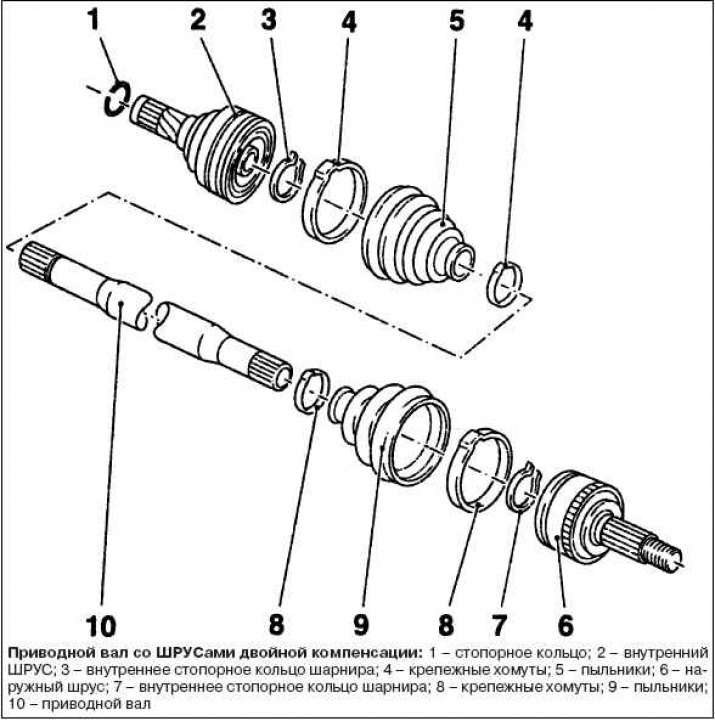
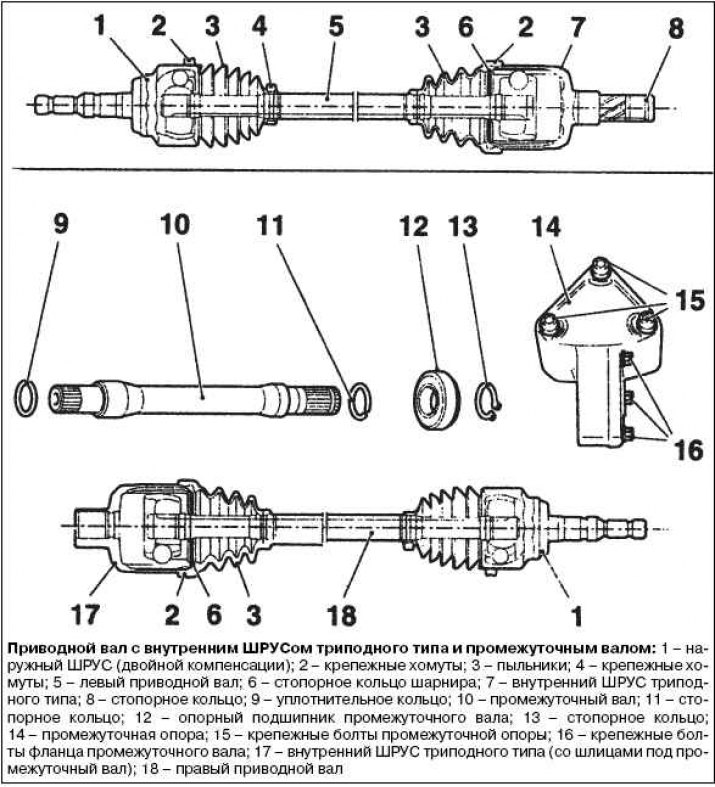
The drive shafts transmit torque from the engine, gearbox and differential to the front wheels. In the gearbox housing, the drive shafts are secured with splined connections to the differential axle gears. The splined end of the inner joint of the drive shaft is fixed in the axle gear by means of a spring retaining ring. During installation, the retaining ring is compressed, entering the groove of the shaft. After the shaft is completely installed in the axle gear of the differential, the retaining ring is released and fixes the splined end from axial movement. The outer joints of the drive shafts are attached to the hubs of the front wheels, mounted on bearings. The shaft is secured to the hub with a nut.
A tripod-type constant velocity joint (CV joint) is installed on the drive shaft on the differential side, ensuring a low vibration level.
Constant velocity joints (CV joints) are protected by rubber boots, which are secured with clamps and protect against water and dirt.
The covers should be inspected periodically for signs of damage, lubricant leaks or cuts. Damaged CV joint covers should be replaced immediately with new ones, otherwise the CV joints may be damaged. Replacement of the cover involves removing the drive shafts. Signs of wear or damage to the CV joint, in addition to lubricant leaks, are clicking when driving and turning, humming when accelerating after coasting or vibration at high speeds on the highway.
Visitor comments