


Contents: Three-point seat belts ⬇ Instructions for using seat belts ⬇ Seat belt stoppers ⬇ Seat belt stopper indicator ⬇ Fastening seat belts ⬇ Adjusting the height of the upper…⬇ Removal the belt ⬇ Three-point seat belt for the middle…⬇ Checking the belts ⬇
Seat belts help reduce the likelihood of serious injury in road accidents and emergency braking of the vehicle. All seats are equipped with diagonal-lap seat belts. These belts are equipped with an inertia reel, onto which the unused seat belt is pulled. Inertia reels provide comfort for the driver and passenger under normal driving conditions. In the event of a vehicle collision, the inertia reels block the belt from being released and keep the driver and passenger from dangerous movements. The rear seat is equipped with diagonal-lap seat belts with inertia reels.
Three-point seat belts
The car is equipped with three-point seat belts with an automatic winding and locking mechanism, which provide complete freedom of movement, while constantly pressing the spring-loaded belts tightly to the body. About the correct position of the seat.
When the car accelerates strongly or brakes sharply, the belts instantly lock.
Instructions for using seat belts
Seat belts should be placed on the parts of the body where strong bones are located. The belt should go over the pelvis, chest, and shoulder, not over the stomach.
It is necessary to adjust the seat belt so that it fits as tightly as possible to the body, while maintaining the comfort of the seat. Only in this case the seat belt will be able to effectively perform its protective function, for which it is installed on the car. A sagging seat belt significantly reduces the effectiveness of passive protection of the passenger.
Make sure that the seat belt straps are free of polish, oil, and other chemicals, especially the electrolyte used in the battery. Use neutral soap and water to clean your seat belts. Replace the seat belt if the strap is worn, dirty, or shows signs of damage.
It is essential to replace the entire seat belt assembly if it has been used by the driver or passenger in a severe vehicle collision, even if there is no visible evidence of damage to the seat belt.
Do not use a seat belt if the strap is twisted.
Each seat belt should only be used by one passenger at a time. It is dangerous to use the same seat belt for a passenger and a child sitting on his/her lap.
Any modifications to the seat belt design that interfere with the normal operation of the automatic slack adjuster or make it difficult to adjust the belt to eliminate slack are prohibited.
Retracting the belt onto the reel can be difficult if the webbing and intermediate guide bracket are dirty. Therefore, make sure that the webbing and guide bracket are clean.
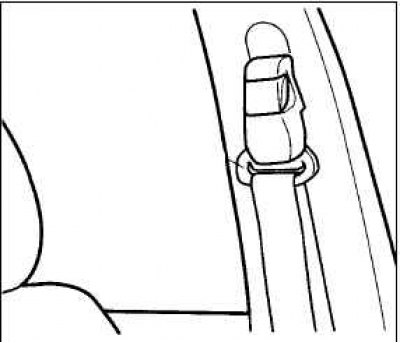
If the seat belt is pulled onto the reel, it will operate in the emergency locking mode. In this mode, the seat belt does not interfere with the passenger's comfort. In the event of a vehicle collision, the inertia reel blocks the release of the seat belt, which holds the passenger in place. If the seat belt is completely pulled out of the reel, it will switch to the automatic belt locking mode. If the belt feels too tight or hinders the passenger's movement in a stationary vehicle or while driving, the possible cause is that the inertia reel has switched to the automatic locking mode after the belt has been pulled out too far from the reel. To return the inertia reel to the more convenient emergency locking mode, stop the vehicle in a safe place on a level surface and completely release the belt onto the inertia reel. This will switch the reel to the emergency belt locking mode. Then pull the seat belt out again to the required length to fasten the seat belt.
Seat belt stoppers
The front seat belt system is equipped with seat belt locks. In frontal and rear collisions, starting from a certain level of accident severity, the seat belt buckles are pulled downwards, thereby tightening the belts.
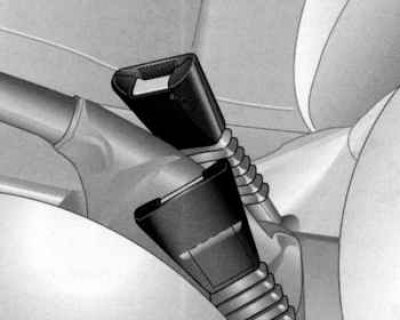
The seat belt locks that have been activated are indicated by a lit indicator.
If the seat belt stoppers have been activated, they must be replaced.
Note: If the seat belts are not damaged, they will remain functional even if the seat belt stoppers are activated.
Seat belt stopper indicator
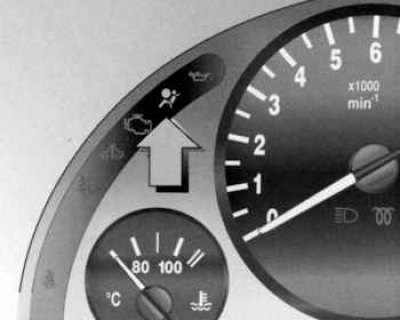
The seat belt buckle stoppers and air bag systems are controlled electronically and their operation is indicated by an indicator on the instrument panel. When the ignition is turned on, the indicator lights up for approximately 4 seconds. If it does not light up, does not go out after 4 seconds, or lights up while driving, there is a malfunction in the seat belt buckle stoppers or air bag systems. The seat belt buckle stoppers or air bags may not deploy in an accident.
Fastening seat belts
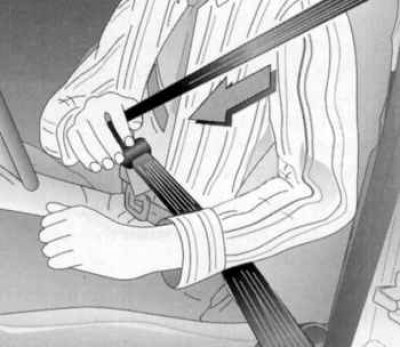
Pull the belt evenly from the reel and, without twisting it, pull it over the body.
Snap the buckle tongue into the lock.
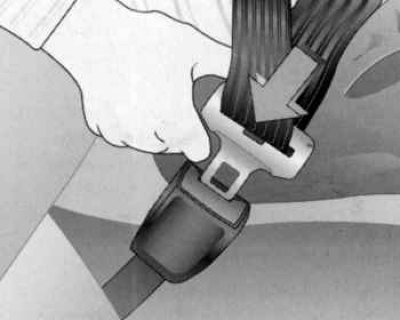
The back of the front seat should not be tilted too far back, as this will negatively affect the effectiveness of the seat belts. The recommended tilt angle is about 25°. The lap belt should fit snugly against the body without twisting. During the trip, it should be tightened from time to time by pulling the shoulder belt.
Waist belt (especially when buckling pregnant women) should run as low as possible on the hips to avoid pressure on the lower abdomen.
A thick layer of outer clothing will disrupt the tightness of the belt. The belt should not be placed on hard or fragile objects in clothing pockets (for example, keys, pens or glasses), as this may cause injury. There should be no objects between the belt and the body, such as handbags or mobile phones.
Adjusting the height of the upper guide element of the front and rear belts
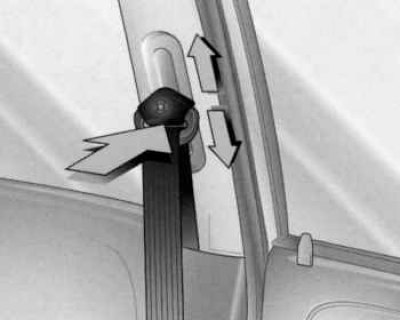
Pull the belt slightly.
Press down the button on the sliding controller.
Move the slide control up or down.
Lock the sliding regulator until you hear a noticeable click.
Caution: Do not adjust the belt height while driving.
Caution! Adjust the height of the strap so that it passes over the shoulder and fits snugly against it. Under no circumstances should the strap pass across the neck or upper arm.
Removal the belt
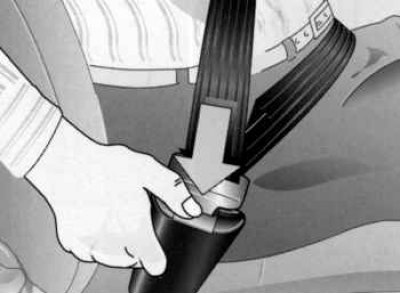
To remove the belt, press the red button on the lock, the belt will automatically wind onto the roller.
Three-point seat belt for the middle rear seat
The belt is pulled out of the tensioner only if the rear seat back is fixed in the vertical position in its holders.
Checking the belts
All parts of the seat belt system should be checked periodically for damage and functionality. Damaged parts, belts stretched in an accident, and buckle stoppers that have been triggered should be replaced.
[Text copied from an online resource: opelbook.ru]
Warning! Do not change anything in the seat belts, their fastenings, automatic retractors or belt buckles.
Caution: Do not allow the seat belts to be damaged by sharp objects or pinched.
Visitor comments