
OpelBook.ru
Cars AvtoVAZ Cars Mitsubishi Cars BMW Cars Mercedes Cars Nissan Cars Toyota Cars Chevrolet
English Русский
Български
Беларускі
Український
Српски
Hrvatski
Română
Polski
Slovenský
Magyar
 |  Sitemap  |  Contacts  |    


Main Astra Corsa Insignia Kadett Omega Vectra Zafira Others Articles
Corsa B (1993-2000) Corsa C (2000-2006, petrol) Corsa C (2000-2006)
  • Main
  • Corsa
  • Corsa C
  • User manual
  • Heating and air conditioning
  • Air Conditioning Control

Air Conditioning Control (Opel Corsa C)

            0

Contents: Cooling ⬇ Air circulation system ⬇ Air distributor ⬇ Middle and side 1 blowing nozzles ⬇ Glass blower nozzles 2 ⬇

Cooling
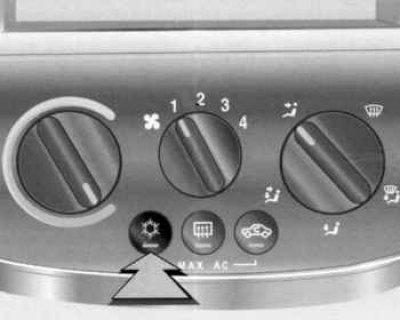


Cooling


The cooling mode is only possible when the engine is running and the blower is on. The mode is switched on and off using the button located on the air conditioning control panel.

The power control indicator is built into the switch.

With cooling on (air conditioning compressor) the air is cooled and dehumidified. If cooling or dehumidification is not required, turn off the cooling to save fuel.

At low outside temperatures, cooling is automatically switched off.

Air circulation system
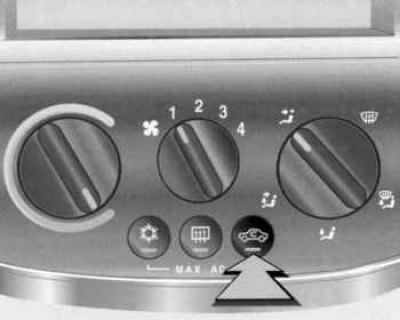


Air circulation system


The air circulation switch switches the air conditioner to circulation mode (power-on indicator).


If smoke or odor comes in from outside: Turn on the air circulation system for a short time.

The air circulation system turned on reduces air exchange. Air humidity increases, and fogging of the windows is possible. The quality of the air inside the cabin deteriorates over time, which can lead to fatigue in passengers.

Air distributor


The air circulation system is automatically switched off to speed up the removal of moisture from the glass.

Middle and side 1 blowing nozzles
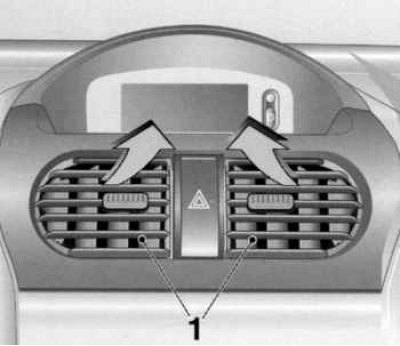


Middle and side 1 blowing nozzles


By changing the position of the temperature regulators, comfortable ventilation of the upper space of the passenger compartment is achieved. If the temperature regulator is in the middle range: cooler air comes from the middle air vents than from the side air vents.

Set the direction of air flow by moving the slats vertically and horizontally.
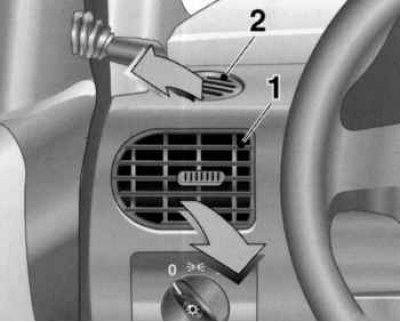
Set the direction of air flow by moving the slats vertically and horizontally.


To close the nozzles, move the valve to the middle of the car.


To increase the air flow, switch the blower to a higher level.

Glass blower nozzles 2


Through the distributor, air is directed to the windshield and side windows.

Additional nozzles are located under the windshield and side windows, as well as in the front in the lower space.


This article is available at russian, bulgarian, belarusian, ukrainian, serbian, croatian, romanian, polish, slovak, hungarian
Checking the article: Kornev Georgy

Share information:

Previous articles
Opel Corsa C: Heating and air conditioning
Next articles

General description of climate control
Heating and ventilation system with additional air conditioning
Heated seats
Power-on indicators in keys
Climate control management
Air intake openings


See similar ones from other Opel car manuals:
▶ Removal and installation the heating/ ventilation/ air… Opel Astra H (2004-2009)
▶ Air conditioning control Opel Insignia A (2008-2017)
▶ Air Conditioning Control Opel Omega A (1986-1993)
▶ Air Conditioning Control Opel Vectra B (1995-2002)
▶ Air conditioning control unit Opel Zafira A (1999-2005, petrol)
Link to this page in different formats

Visitor comments


No comments yet


How much will 33 + 21 =


Corsa C (2000-2006) 
  • General information
  • Introduction to guide
  • Troubleshooting
  • Vehicle device
  • User manual
  • Maintenance
  • Power unit
  • Engine repair
  • Cooling system
  • Power and exhaust system
  • Control system
  • Engine electrical equipment
  • Transmission
  • Clutch
  • Mechanical gearbox
  • Automatic gearbox
  • Drive shafts
  • Chassis
  • Brake system
  • Wheel suspension
  • Steering
  • Body
  • Exterior
  • Interior
  • Doors and windows
  • Heating and air conditioning
  • Electrical equipment
  • Equipment and devices
  • Lamps and lighting
  • Electrical circuits
Corsa C (2000-2006, petrol) 
  • User manual
  • Car access
  • Governing bodies
  • Seat control
  • Heating and air conditioning
  • Driving and maintenance
  • Engines 1.0 and 1.2 l
  • Engine repair
  • Cooling and lubrication system
  • Injection system
  • Engines 1.4, 1.6 and 1.8 l
  • Engine repair
  • Cooling and lubrication system
  • Injection system
  • Transmission
  • Clutch
  • Mechanical gearbox
  • Automatic gearbox
  • Drive shafts
  • Chassis
  • Wheels and tires
  • Wheel suspension
  • Steering
  • Brake system
  • Body
  • Exterior
  • Doors and windows
  • Electrical equipment
  • Equipment and devices
  • Lighting system
  • Electrical circuits
Corsa B (1993-2000) 
  • General information
  • Introduction to guide
  • User manual
  • Maintenance
  • Power unit
  • SOHC gasoline engines
  • DOHC gasoline engines
  • Diesel engines
  • Engine repair
  • Cooling system
  • Supply system
  • Injection system (gasoline)
  • Injection system (diesel)
  • Exhaust systems
  • Control system (gasoline)
  • Preheat system (diesel)
  • Charge and launch system
  • Transmission
  • Mechanical gearbox
  • Automatic gearbox
  • Clutch and drive shafts
  • Chassis
  • Brake system
  • Front suspension
  • Rear suspension
  • Steering
  • Body
  • Ventilation and heating
  • Exterior
  • Interior
  • Doors and windows
  • Electrical equipment
  • Equipment and devices
  • Lamps and lighting
  • Electrical circuits
OpelBook.ru © 2017–2026 · Mobile version · · Sitemap: EN BG BY UA RS HR RO PL SK HU · Feedback · Site search
Astra F, petrol · Astra G, petrol · Astra G · Astra H · Astra J, petrol · Corsa B · Corsa C, petrol · Corsa C · Insignia A · Kadett D · Kadett E · Omega A · Omega B · Omega B2 · Vectra A, petrol · Vectra A · Vectra B, petrol · Vectra B · Vectra C · Zafira A, petrol · Frontera A, petrol · Frontera B · Ascona C · Vivaro A ·
We want your visit to be comfortable 🤝! We use cookies 🍪 to make that happen.