


Contents: Adjustment ⬇ The headlights are adjusted using…⬇ Height adjustment ⬇ Direction adjustment ⬇
Adjustment
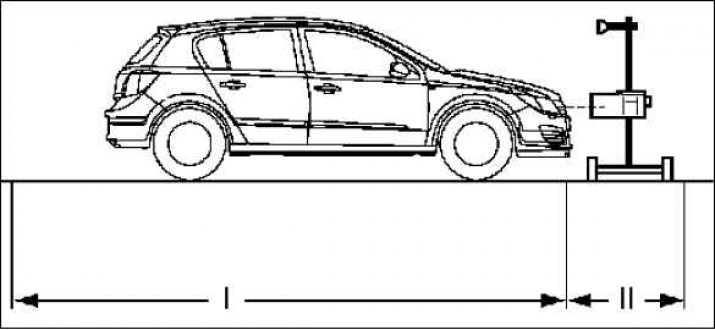
The adjustment lines 76/756 EWG or ECE-R48 include checking and adjusting the vehicle's headlights. Correct adjustment of the vehicle's headlights must ensure the best possible illumination of the road with low beams while minimizing glare to oncoming traffic. The inclination of the headlight beams to a flat surface and their direction to the vertical longitudinal central plane of the vehicle must correspond to the conditions specified in the adjustment line.
Blindness (low beam) is considered eliminated if the intensity of illumination at a distance of 25 m from each individual headlamp on a plane vertical to the road surface and at the height of the headlamps and above does not exceed 1 lux. This requirement is met if the headlamps are adjusted in accordance with the adjustment instructions.
On the housing of the front (main) headlight or on the mount there is a low beam adjustment, along the adjustment line 76/756 EWG or ECE-R48, indication: 1.0%.
The indication of 1.0% corresponds to the installation size of the headlight relative to the inclination of the light beam. Thus, the inclination at a distance of 10 m from the car headlights is 10 cm (L0017601 and L0017602). The indicator of the low beam headlight tilt is considered to be the light-dark boundary.
Note: The adjustment instructions are illustrated with pictures.
The abbreviations used mean:
- A - horizontal distance between the centers of the headlights;
- B - center mark;
- C - test surface;
- D - occupied area;
- E - transition point;
- e - installation size in cm;
- e = H - h = (installation dimension, headlights 1.0%, e = 10 cm, fog lights 2%, e = 20 cm).
- H - height of the center of the headlight above the occupied area;
- H - the height of the light-darkness boundary of the low-beam headlight above the surface on which the vehicle is standing.
The headlights are adjusted using the adjustment device in accordance with the instructions as shown in the figures.
The supporting surface of the measuring device and the vehicle must form a flat surface. The surface unevenness may be a maximum of ±0.5 mm/m.
I = ±1.0 mm/m.
II = ±0.5 mm/m.
The vehicle tires must have the air pressure specified in the instructions. Defective glass and headlight reflectors, as well as soot-covered incandescent lamps must be replaced before adjustment.
The adjustment is made with the vehicle's tare weight with one person or a load of 75 kg on the driver's seat. (Tare weight of the vehicle = the mass of the vehicle ready for operation with a full fuel tank and the mass of all equipment parts involved in the operation of the vehicle, such as spare wheel, tools, jack, first aid kit, warning triangle, etc.).
In vehicles with manual ride height adjustment, the specified base pressure must be set (0.8 bar at the vehicle's own weight).
When manually adjusting the ground clearance, turn on the ignition and set the light switch unit regulator to "0".
The intersection point of the horizontal and ascending parts of the light-dark boundary (transition point) must be on a perpendicular line that passes through the center mark.
To make it easier to calculate the mentioned intersection point, you can alternately close and then open half of the headlight several times.
The headlamp adjustment devices used must match the existing adjustment lines and the manufacturer's operating instructions must be followed.
Regular inspection of the headlight adjustment device should be initiated by the manufacturer's service department.
The headlight leveling device is adjusted according to the manufacturer's instructions and is set at a tilt of 1.0% for low beam or 2% tilt for front fog lights.
According to Directive 76/756 EWG, there is no 15° line for low beam on the measurement screen (the drawing shows the installation for right-hand traffic). The direction of adjustment can also be carried out using the headlight adjustment instruments, which display a 15° line on the measuring screen.
The center of the high beam light beam must be located inside the limiting corners at the central mark (figure) for headlights with the ability to install low and high beam.
Headlights:
- 1 - height adjustment;
- 2 - direction adjustment.
The headlights must be installed on a headlight alignment screen that complies with the instructions or using a headlight alignment tool.
(Original posted on the website: www.opelbook.ru)
Height adjustment
The light-dark boundary on the left should run horizontally from the adjustment crosshair along the adjustment line.
Direction adjustment
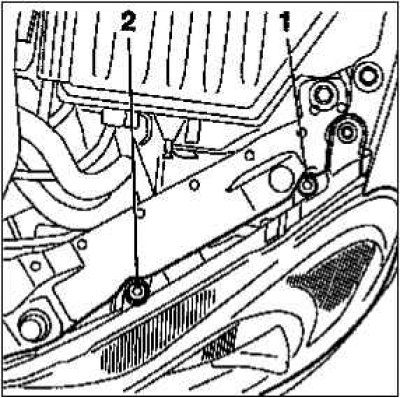
The light-dark boundary should run horizontally from the left side to the adjustment crosshair and from there at an angle of approximately 15° to the right and upwards. The beam tilt is 1.0% at 10 m.
First, you need to adjust the height, then adjust the direction. After adjusting the direction, you need to check the height adjustment again.
Visitor comments