


For the Russian market, Opel Astra J cars are equipped with a range of petrol engines with a working volume of 1.4 and 1.6 liters: 1.4 ECOTEC A14 XER (100 hp); 1.6 ECOTEC A16 XER (115 hp); 1.4 Turbo ECOTEC A14 NET (140 hp); 1.6 Turbo ECOTEC A16 LET (180 hp).
The car is produced with a five-door hatchback, three-door hatchback (GTC), sedan, and station wagon body.
The car is equipped with a five-speed manual or six-speed automatic transmission (except for vehicles with A14 XER engines) gearbox.
In Russia, the car is offered in three basic trim levels: Essentia, Active (Enjoy) and Cosmo.
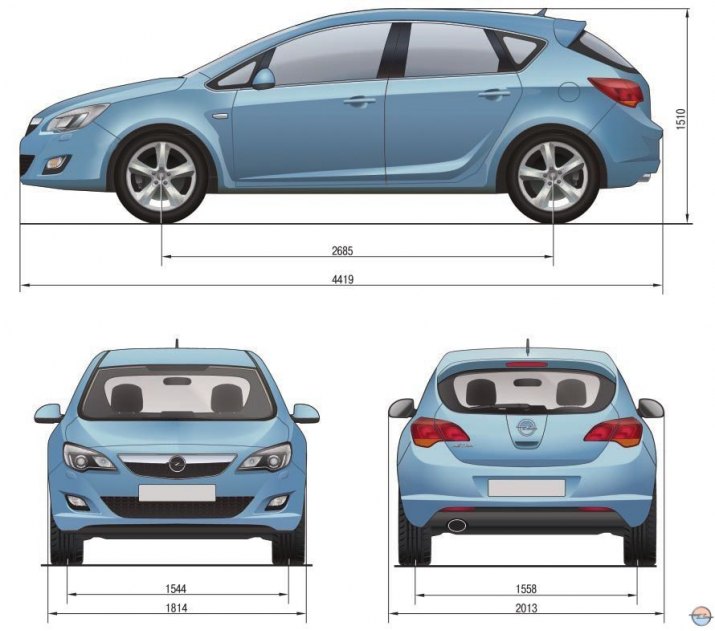
Fig. 1. Overall dimensions of the car
The complete sets include the following sets of options:
- Essentia. Fabric upholstery of the interior and doors, remote control of the central lock, driver's seat with height adjustment, rear seat folding in proportion 40:60, ISOFIX mounts on the rear seats, side mirrors with electric drive and electric heating, electric windows of the front doors, engine underbody protection, electric power steering, steering column adjustment for height and reach, three-spoke steering wheel, ABS and ESP systems, front and side airbags, side curtain airbags, immobilizer, anti-theft alarm, halogen headlights, headlight range control with manual control, steel wheels measuring 6.5Jx16 with decorative caps, small 16-inch spare wheel, CD300 car radio with MP33 file reading function (four speakers), vanity mirror in passenger sun visor, light tinting of all windows;
- Active (Enjoy). Listed above for the Essentia package and additionally: air conditioning, interior rearview mirror with automatic dimming function, audio system control on the steering wheel, trip computer, cruise control, fog lights, steel wheels, structural 7.0x17, automatic headlight corrector, CD400 car radio (7 speakers, CD player with MP3 function), illuminated vanity mirrors in both sun visors;
- Cosmo. The above for the Active (Enjoy) package and additionally: dual-zone climate control, rain sensor, electrochromic rear-view mirror, electrically folding outside mirrors, automatic headlight control, heated front seats, three-spoke leather-trimmed steering wheel with electrical heating, front floor console with sliding armrest, rear electric windows, two-tone horn, leatherette door trim, glasses case, 7.0x17 alloy wheels, parking sensor, chrome trim on side doors, door sills.
Additionally, for a separate fee, twenty option packages can be ordered for some trim levels, including various sets of comfort and safety systems provided for more expensive trim levels.
The body of the Opel Astra J is a load-bearing, all-metal, welded structure with hinged front fenders, doors, hood and tailgate. The windshield and tailgate glass are glued in. The driver's seat is adjustable in the longitudinal direction, by the tilt of the backrest, lumbar support (not on all trim levels) and height, the front passenger seat - in the longitudinal direction and by the backrest angle. The front and rear seats are equipped with height-adjustable headrests. The backrest of the rear seat can be folded forward in parts in a ratio of 40:60.
The transmission is made according to the front-wheel drive scheme with front wheel drives equipped with constant velocity joints.
Front suspension is MacPherson type, independent, spring, with anti-roll bar, with hydraulic shock absorber struts.
The rear suspension is semi-independent, spring, with anti-roll bar, Watt mechanism, with hydraulic shock absorbers.
Front wheel brakes are disc, ventilated, with a floating caliper; rear wheels - disc, non-ventilated with a floating caliper. The braking system is equipped with a vacuum booster.
The steering is trauma-safe, with a rack-and-pinion steering mechanism, with an electric booster. The steering column is adjustable for reach and tilt. The steering wheel hub contains a front airbag.
All vehicles are equipped with inertia-reel diagonal seat belts for the driver, front passenger and all rear seat passengers. Front airbags are provided for the driver and front passenger, and side airbags and curtain airbags are provided for all passengers and the driver.
The overall dimensions of the vehicle are shown in Fig. 1. The technical characteristics of the vehicle are given in Table 1. The elements of the vehicle with the 1.6 ECOTEC A16 XER engine, located in the underhood space, and the main units are shown in Fig. 2–4. The arrangement of the elements in the underhood space of vehicles with other engines is practically identical.
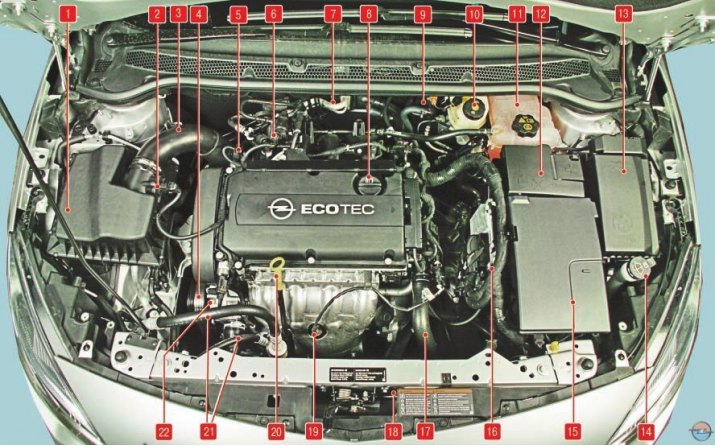
Fig. 2. Underhood space of a car with a 1.6 l A16 XER engine (top view): 1 – air filter; 2 – mass flow and incoming air temperature sensor; 3 – air supply hose; 4 – auxiliary drive belt; 5 – throttle assembly; 6 – purge valve of the adsorber; 7 – air conditioning system pipelines; 8 – oil filler neck; 9 – brake booster; 10 – brake and clutch hydraulic fluid reservoir; 11 – expansion tank of the engine cooling system; 12 – power fuse block (covered with a lid); 13 – fuse and relay mounting block; 14 – Windshield washer reservoir filler neck; 15 – battery (closed with a lid); 16 – electronic engine control unit; 17 – engine cooling system hose; 18 – engine cooling system radiator; 19 – oxygen concentration control sensor; 20 – oil level indicator (dipstick); 21 – Air conditioning system hoses; 22 – water pump
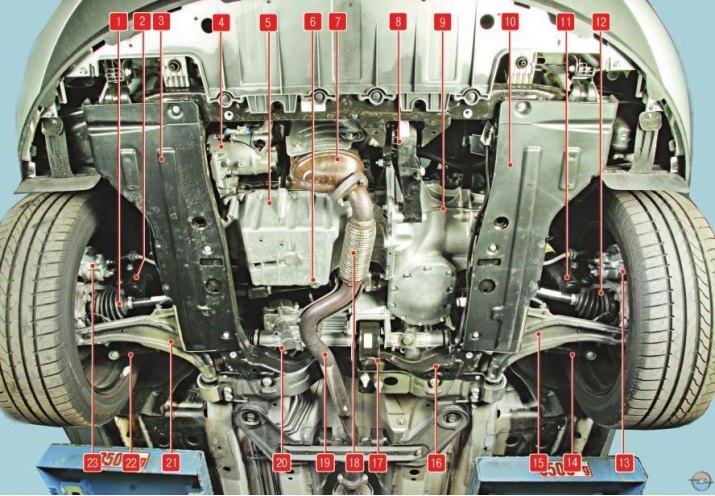
Fig. 3. Underhood space of a car with a 1.6 l A16 XER engine and the main units of the car (view from below, engine crankcase protection removed): 1, 12 – front wheel drives; 2, 11 – front suspension shock absorbers; 3, 10 – engine mudguards; 4 – air conditioning compressor; 5 – engine; 6 – plug for draining engine oil; 7 – cat collector (exhaust manifold integrated neutralizer); 8 – front support of the power unit suspension; 9 – gearbox; 13, 23 – front wheel brake mechanisms; 14, 22 – steering rods; 15, 21 – front suspension arms; 16 – front suspension subframe; 17 – rear support of the power unit suspension; 18 – bellows; 19 - intake pipe of the exhaust gas system; 20 – steering mechanism
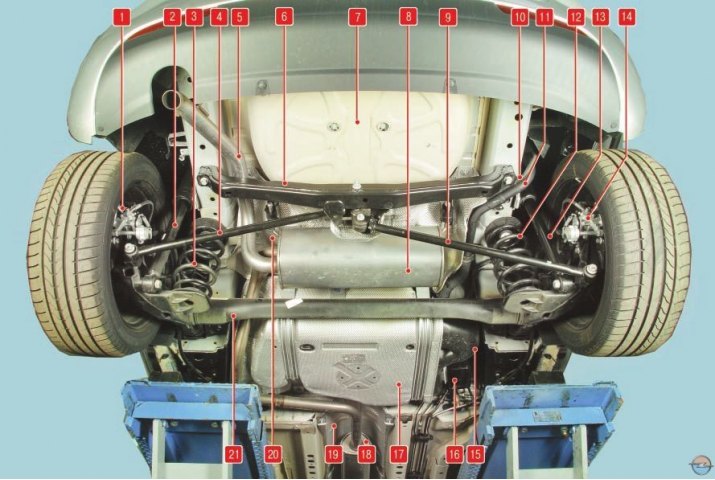
Fig. 4. Main units of the car (bottom view from behind): 1, 14 – rear wheel brake mechanisms; 2, 13 – rear suspension shock absorbers; 3, 12 – rear suspension springs; 4, 9 – Watt mechanism rods; 5 – exhaust pipe; 6 – crossbar of Watt mechanism; 7 – niche for spare wheel; 8 – main muffler; 10 – Fuel tank ventilation pipe; 11 – fuel tank filler pipe; 15 – fuel tank; 16 – fuel vapor recovery system adsorber; 17 – fuel tank heat shield; 18 – additional muffler; 19 – additional muffler heat shield; 20 – thermal shield of the main muffler; 21 – rear suspension beam
Table 1. Technical characteristics of cars
| Parameter | Cars with engines | |||
| A14 XER | A16 XER | A14 NET | A16 LET | |
| General information | ||||
| Number of seats, including driver's seat | 5 | |||
| Curb weight, kg (1) | 1373/1388 | 1393/1408 | 1433/1448 | –/1490 |
| Gross weight, kg (1) | 1870/1885 | 1890/1905 | 1830/1945 | –/1987 |
| Overall dimensions, mm | See Fig. 1 | |||
| Wheelbase, mm | Same | |||
| Wheel track, mm | >> | |||
| Ground clearance, mm | 160 | |||
| Minimum turning radius, m | 5,75 | |||
| Maximum speed, km/h (2) | 178/– | 188/182 | 205/201 | 221/210 |
| Acceleration time of a car from standstill to 100 km/h, s (2) | 14,2/– | 11,7/13,3 | 9,7/9,8 | 8,5/9,0 |
| Fuel consumption, l/100 km (2): | – | – | – | – |
| in the urban cycle | 7,2/– | 8,3/9,8 | 7,8/9,7 | 8,8/10,3 |
| in the suburban cycle | 4,5/– | 5,1/5,6 | 4,8/5,5 | 5,6/5,9 |
| in a mixed cycle | 5,5/– | 6,3/7,1 | 5,9/7,0 | 6,8/7,5 |
| Octane number of gasoline | Not less than 95 | |||
| Engine | ||||
| Cylinder firing order | 1–3–4–2 | |||
| Cylinder diameter, mm | 73,4 | 79 | 72,5 | 79 |
| Piston stroke, mm | 82,6 | 81,5 | 82,6 | 81,5 |
| Working volume, cm³ | 1398 | 1598 | 1364 | 1598 |
| Compression ratio | 10,5 | 10,8 | 9,5 | 8,8 |
| Maximum power, kW (hp) | 74 (100)/6000 min⁻¹ | 85 (115) | 103 (140) | 132 (180) |
| Maximum torque, Nm | 130/4000 min⁻¹ | 155/4000 min⁻¹ | 200/1850–4900 min⁻¹ | 230/2200–5400 min⁻¹ |
| Transmission | ||||
| Clutch (3) | Single-disc, dry, with diaphragm pressure spring and torsional vibration damper, permanently closed type | |||
| Clutch release drive (3) | Hydraulic | |||
| Transmission: | – | – | – | – |
| mechanical | Five-speed with synchronizers on all forward gears | |||
| automatic | – | Six-speed, hydromechanical, adaptive, planetary with locking torque converter | ||
| Main gear | Single, cylindrical, helical | |||
| Differential | Conical, two-satellite | |||
| Wheel drive | Open, constant velocity joint shafts | |||
| Chassis | ||||
| Front suspension | Independent, spring, MacPherson type, with hydraulic shock absorber struts, triangular lower arms and torsion-type anti-roll bar | |||
| Rear suspension | Semi-independent, with Watt mechanism, with coil springs, hydraulic shock absorbers, torsion-type anti-roll bar | |||
| Wheels | Stamped steel or alloy wheels | |||
| Wheel size | 6.5Jx16 or 7.0Jx17; 4Tx16 or 4Tx17 for spare tire | |||
| Tires | Radial, tubeless | |||
| Tire size | 205/60 R16, 215/60 R16, 215/50 R17, 225/45 R18, 235/40 R19 and T115/70 R16, T125/70 R17 for spare wheel (4) | |||
| Steering | ||||
| Steering | Trauma-safe, with electric power steering, with steering column adjustment for reach and tilt angle | |||
| Steering gear | Rack and pinion | |||
| Brakes | ||||
| Service brakes: | – | – | – | – |
| front | Disc, ventilated, with floating bracket | |||
| rear | Disc, non-ventilated, with floating bracket | |||
| Service brake drive | Hydraulic, dual-circuit, separate, diagonal design, with vacuum booster, anti-lock braking system (ABS), electronic brake force distribution (EBD) and emergency brake assist (EBA) | |||
| Parking brake | With mechanical cable drive to the brake pads of the rear wheel brake mechanisms from the floor lever, with an activation signal (5) | |||
| Electrical equipment | ||||
| Electrical wiring diagram | Single-wire, the negative pole is connected to the "ground" | |||
| Nominal voltage, V | 12 | |||
| Battery | Starter, low maintenance, 60 Ah capacity | |||
| Generator | Alternating current, three-phase, with built-in rectifier and electronic voltage regulator | |||
| Starter | With mixed excitation, remote control with electromagnetic switching, freewheel clutch and gearbox | |||
| Body | ||||
| Type | All-metal, load-bearing | |||
(1) For vehicles with air conditioning.
(2) For vehicles with automatic transmission.
(3) For vehicles with manual transmission.
(4) Depending on the vehicle configuration.
(5) An electromechanical parking brake drive can be installed on request.
Visitor comments