


The vehicle identification number (VIN), manufacturer name, year of manufacture, certification information and weight specifications are provided on the identification plate...
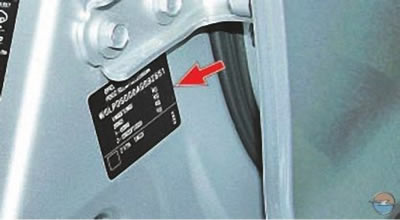
...glued to the left B-pillar of the car.
Fig. 1 shows all the information about the vehicle provided on the identification plate.
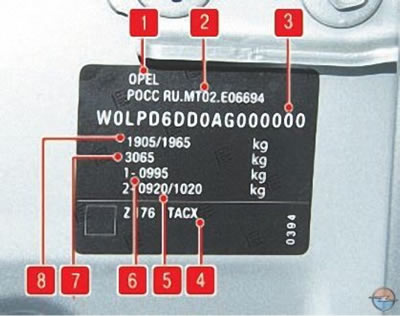
Fig. 1. Identification plate: 1 – manufacturer; 2 – license permit number; 3 – vehicle identification number; 4 – individual or country-specific data; 5 – permissible load on the rear axle of the vehicle; 6 – permissible load on the front axle of the vehicle; 7 – permissible total trailer weight; 8 – permissible gross vehicle weight
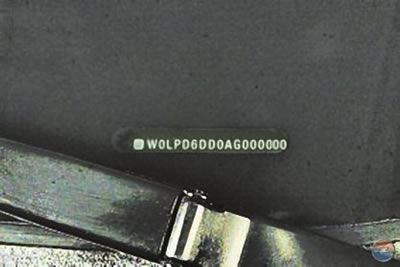
In addition, the vehicle identification number is located in the lower left corner of the windshield opening...
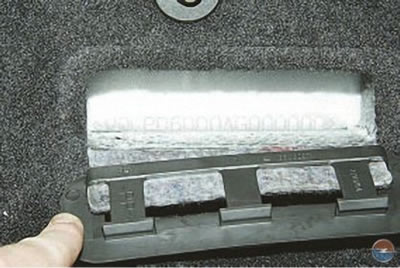
...and on the floor of the car (under sound insulation) from the front passenger side.
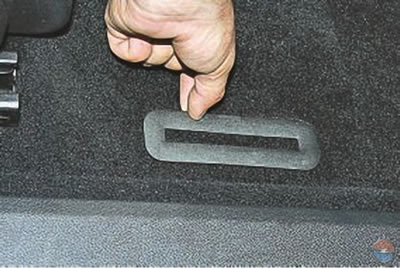
To see the number, lift the edge of the trim of the cut out part of the floor mat...
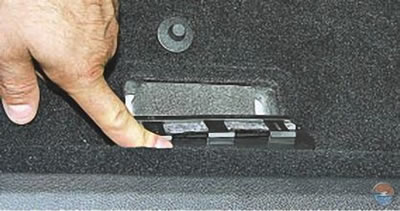
...fold back the cut out part of the rug...
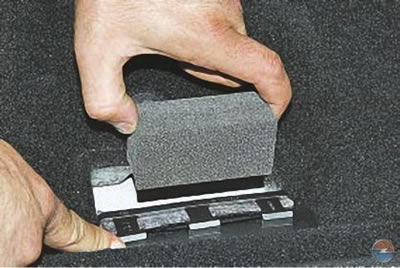
...and remove the leveling shim.
Decoding the identification number, for example, WOLPD6DD0AG000000:
- WOL – manufacturer code (WOL – Adam Opel AG);
- P - specialized execution;
- D – GM code (D – Astra J);
- 6 – model range (6 – Astra J);
- D – GM vehicle configuration code;
- D0 – body type (D0 – five-door hatchback);
- A – year of model production (A – 2010, B – 2011, etc.);
- G – manufacturer's code (G Gliwice);
- 000000 - serial number.
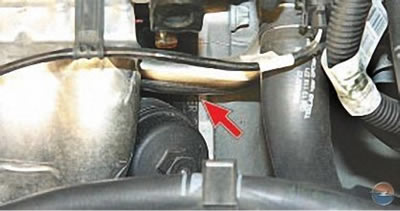
Designation (model and main characteristics) engine is stamped on the cylinder block lug next to the oil filter.
Note: The manufacturer does not apply a serial number to the Opel Astra engines.
Decoding the engine designation, for example, A16 XER:
- A – exhaust toxicity standard (A – compliance with Euro5 requirements);
- 16 – engine displacement (16 – 1.6 l, 18 – 1.8 l, etc.);
- X – compression ratio (L – 8.5–9.0; N – 9,0–9,5; S – 9,5–10,0; X – 10,0–11,5; Y – more than 11.5);
- E – type of fuel used (E – gasoline, D – diesel fuel);
- R – modification features (R/H – high-boost, L – low-boost, P – Twinport system, T – turbocharging).
Visitor comments