
OpelBook.ru
Cars AvtoVAZ Cars Mitsubishi Cars BMW Cars Mercedes Cars Nissan Cars Toyota Cars Chevrolet
English Русский
Български
Беларускі
Український
Српски
Hrvatski
Română
Polski
Slovenský
Magyar
 |  Sitemap  |  Contacts  |    


Main Astra Corsa Insignia Kadett Omega Vectra Zafira Others Articles
Astra F (1991-1998, petrol) Astra G (1998-2004, petrol) Astra G (1998-2004) Astra H (2004-2009) Astra J (2009-2015, petrol)
  • Main
  • Astra
  • Astra G
  • Power unit
  • SOHC gasoline engines
  • Bringing the piston of the first cylinder to the position of the top dead center of the compression stroke (TDC)

Bringing the piston of the first cylinder to the position of the top dead center of the compression stroke (TDC) (Opel Astra G)

            0

Contents: General information ⬇ Procedure execution order ⬇

General information


Top dead center (TDC) is the highest point of the piston stroke in its cylinder. Strictly speaking, in 4-stroke engines, during the rotation of the crankshaft, this position is reached by each of the pistons twice: once at the end of the compression stroke and the second time at the end of the exhaust stroke. When adjusting the valve timing and setting the ignition timing angle, in the vast majority of cases, the TDC position of the end of the piston compression stroke is used (usually the first cylinder).

The need to bring the piston to the TDC position arises when performing many procedures, in particular such as removing/installing camshafts, timing drive components and ignition distributor.

Some engines are designed in such a way that when the crankshaft or camshaft(s) is turned with the timing belt/chain removed, the valves may come into contact with the piston crowns, which carries the risk of damage to the corresponding internal components, including destruction of the cylinder head casting.

Do not allow the shaft position to change after removing the belt!


Procedure execution order


The arrangement of timing marks of the gear wheels of the camshaft (1) and crankshaft (2) in the TDC position of the end of the compression stroke of the piston of the first cylinder
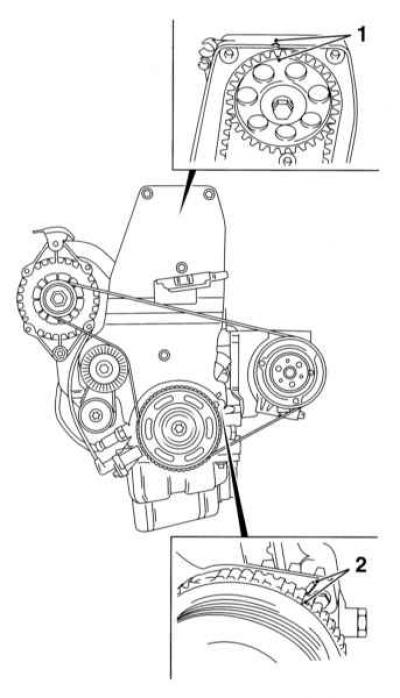
The arrangement of timing marks of the gear wheels of the camshaft (1) and crankshaft (2) in the…


Bringing any of the pistons to the TDC position is done by turning the engine crankshaft. If you look at the engine from the timing drive side, the normal direction of rotation of the crankshaft is clockwise. Remember that trying to turn the shaft counterclockwise can lead to a violation of the valve timing adjustments. The first is the cylinder, the outermost on the timing drive side.


1. Disconnect the negative battery cable. To make it easier to turn the engine, remove all spark plugs.

2. To gain access to the TDC mark on the camshaft gear, remove the timing belt cover (see Removal and installation the timing belt cover).

3. Using a wrench placed on the crankshaft pulley mounting bolt, turn the latter in the direction of normal rotation until the timing mark on the camshaft gear aligns with the corresponding mark on top of the rear timing belt cover. The mark on the rim of the crankshaft gear should align with the mark on the oil pump housing (see illustration The arrangement of timing marks of the gear wheels of the camshaft (1) and crankshaft (2) in the TDC position of the end of the compression stroke of the piston of the first cylinder).

When the listed conditions are met, the engine will be brought to the TDC position at the end of the compression stroke of the piston of the first cylinder.


This article is available at russian, bulgarian, belarusian, ukrainian, serbian, croatian, romanian, polish, slovak, hungarian
Checking the article: Pavlovsky Nikolay

Share information:

Previous articles
Opel Astra G: SOHC gasoline engines
Next articles

Engine condition diagnostics using a vacuum gauge
Checking the compression pressure in the cylinders
Specifications of all engines
General information about engines
Removal and installation the timing cover
Removal and installation the crankshaft pulley
Removal and installation the timing belt cover
Removal and installation the timing belt
Removal and installation the timing belt tensioner and timing drive gears
Replacing the camshaft seal


See similar ones from other Opel car manuals:
▶ Bringing the piston of the first cylinder to the position… Opel Corsa B (1993-2000)
▶ Bringing the piston of the first cylinder to the top dead… Opel Vectra C (2002-2008)
▶ Setting the piston of cylinder No. 1 to top dead center… Opel Omega B2 (1999-2003)
▶ Adjusting the position of the steering wheel Opel Insignia A (2008-2017)
▶ Cylinder head specifications Opel Kadett E (1984-1995)
Link to this page in different formats

Visitor comments


No comments yet


How much will 22 + 29 =


Astra J (2009-2015, petrol) 
  • General information
  • Vehicle device
  • User manual
  • Faults en route
  • Maintenance
  • Power unit
  • Engine repair
  • Cooling and lubrication system
  • Engine power system
  • Exhaust system
  • Transmission
  • Clutch
  • Car gearbox
  • Drive shafts
  • Chassis
  • Front suspension
  • Rear suspension
  • Steering
  • Brake system
  • Wheels and tires
  • Body
  • Exterior
  • Interior
  • Doors and windows
  • Body Care
  • Heating and air conditioning
  • Security systems
  • Electrical equipment
  • Equipment and devices
  • Lighting and signaling
  • Power devices
  • Electrical circuits
Astra H (2004-2009) 
  • General information
  • Introduction to the guide
  • Troubleshooting
  • User manual
  • Maintenance
  • Power unit
  • Engine repair
  • Cooling and heating
  • Power and exhaust system
  • Ignition system
  • Launch and charge system
  • Transmission
  • Mechanical gearbox
  • Automatic gearbox
  • Drive shafts
  • Chassis
  • Brake system
  • Car suspension
  • Steering
  • Body
  • Interior
  • Exterior
  • Electrical equipment
  • Equipment and devices
  • Electrical circuits
Astra G (1998-2004) 
  • General information
  • Introduction to manual
  • User manual
  • Maintenance
  • Power unit
  • SOHC gasoline engines
  • DOHC gasoline engines
  • Diesel engines 1.7 and 2.0
  • Engine repair
  • Cooling system
  • Supply system
  • Injection system (gasoline)
  • Injection system (diesel)
  • Exhaust system
  • Charge and launch system
  • Ignition system (gasoline)
  • Preheat system (diesel)
  • Transmission
  • Manual gearbox
  • Automatic gearbox
  • Clutch
  • Drive shafts
  • Chassis
  • Brake system
  • Wheel suspension
  • Steering
  • Body
  • Exterior
  • Interior
  • Doors and windows
  • Ventilation and heating
  • Electrical equipment
  • Equipment and devices
  • Electrical circuits
Astra G (1998-2004, petrol) 
  • General information
  • User manual
  • Car care
  • Maintenance
  • Power unit
  • Single shaft engines
  • Twin shaft engines
  • Engine repair
  • Cooling and heating
  • Fuel and exhaust systems
  • Starting and charging system
  • Ignition system
  • Transmission
  • Clutch
  • Mechanical gearbox
  • Automatic gearbox
  • Drive shafts
  • Chassis
  • Brake system
  • Car suspension
  • Steering
  • Body
  • Interior
  • Exterior
  • Electrical equipment
  • Equipment and devices
  • Wiring diagrams Opel Astra
  • Wiring diagrams Opel Zafira
Astra F (1991-1998, petrol) 
  • General information
  • Maintenance
  • Power unit
  • Engine in car
  • Engine removed
  • Cooling system
  • Heating and ventilation
  • Fuel supply (carburetor)
  • Fuel supply (injector)
  • Emission control
  • Ignition system
  • Transmission
  • Clutch
  • Mechanical gearbox
  • Automatic gearbox
  • Drive shafts
  • Chassis
  • Brake system
  • Car suspension
  • Steering
  • Body
  • Exterior
  • Interior
  • Electrical equipment
  • Equipment and devices
  • Electrical circuits
OpelBook.ru © 2017–2026 · Mobile version · · Sitemap: EN BG BY UA RS HR RO PL SK HU · Feedback · Site search
Astra F, petrol · Astra G, petrol · Astra G · Astra H · Astra J, petrol · Corsa B · Corsa C, petrol · Corsa C · Insignia A · Kadett D · Kadett E · Omega A · Omega B · Omega B2 · Vectra A, petrol · Vectra A · Vectra B, petrol · Vectra B · Vectra C · Zafira A, petrol · Frontera A, petrol · Frontera B · Ascona C · Vivaro A ·
We want your visit to be comfortable 🤝! We use cookies 🍪 to make that happen.