


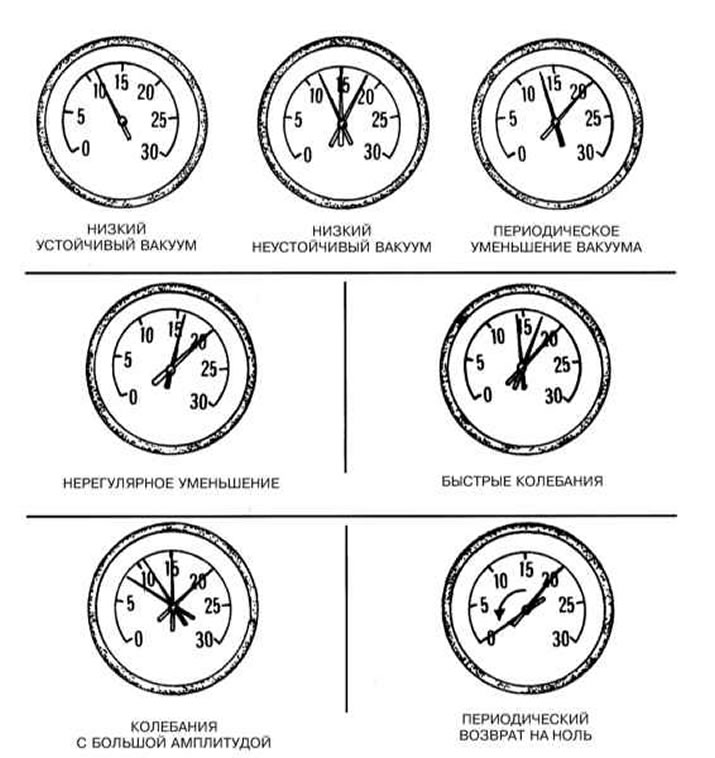
Using a vacuum gauge at a relatively low cost allows you to obtain fairly comprehensive information about the internal condition of the engine. Based on the results of the measurements, you can get an idea of the degree of wear of the piston rings and cylinder mirrors, identify signs of failure of the cylinder head gaskets and intake manifold, violations of carburetor adjustments and the patency of the exhaust system, jamming or burnout of valves, sagging valve springs, failure to set the ignition timing or valve timing, failures of the ignition system, etc., etc.
Unfortunately, the results of readings taken with a vacuum meter are easily misinterpreted, and therefore, they must be analyzed together with data obtained during other diagnostic checks.
When reading the vacuum gauge indicator, you should pay attention not only to the absolute value of the arrow's deflection, but also to the speed of its movement. Most imported gauges show the vacuum depth in inches of mercury. It should be taken into account that all regulatory requirements are given for the case of performing tests at zero altitude above sea level. The relief increase for every 300m after the 600m mark leads to an underestimation of the instrument readings by approximately 25 mm Hg.
1. Connect the vacuum gauge directly to the intake manifold - not to the throttle body. Make sure that all hoses remain connected during the test, otherwise the reading will not be reliable.
2. Before taking measurements, warm up the engine to normal operating temperature. Chock the wheels and apply the parking brake. Shift the transmission to position "P", start the engine and let it run at normal idle speed.
Before starting the engine, carefully check the fan blades for cracks and other damage. Try to keep your hands and the measuring device away from the impeller. Also, avoid taking a position directly in front of the car!
3. Read the vacuum gauge readings (see illustration Examples of possible vacuum gauge readings). On average, the vacuum depth in the intake manifold of a serviceable engine should be fairly stable (without jerking the arrows) and amount to about 430-560 mm Hg.
Scheme for interpreting the readings taken
Stable low readings may indicate leaks through the gasket between the intake manifold and the cylinder head, or between the manifold and the throttle body. It is also possible that the vacuum hose is leaking, or that the ignition timing is incorrect (towards lagging behind), or faulty valve timing. Check the ignition timing using a stroboscope, then eliminate all other possible causes one by one by performing the checks listed in this Chapter. Only then should you remove the timing belt cover to check that the timing marks are aligned correctly.
If the measurement result is on 80-200 mm Hg. below the norm and there are fluctuations, the cause of such a deviation may be a violation of the tightness of the intake manifold gasket in the area of the intake port, or a malfunction of the fuel injection injector.
Regular deviation of readings downwards from the stable value by 50-100 mm Hg. most likely indicates valve leaks. Check the compression pressure in the cylinders or perform a leak test.
Irregular deviations and resets of readings may be related to valve sticking or misfiring. Measure compression pressure, perform a leak test, check the condition of the spark plugs.
Frequent vibration of the meter needle with an oscillation amplitude of 100 mm Hg. at idle speed, accompanied by smoke emission from the exhaust pipe, indicates wear of the valve guide bushings. Conduct a leak test (see previous Section). If the needle starts to vibrate when the engine speed increases, check the intake manifold gasket and cylinder head for signs of leaks. Assess the degree of valve spring sag, check the valves for signs of burnout, and try to detect misfires.
Minor fluctuations within the range of 25 to 50 mmHg. may be considered as evidence of malfunction of the ignition system. Check the correctness of all normal settings, if necessary, resort to testing using an ignition parameter analyzer.
At deviations of meter readings over a wide range check the compression pressure or perform a leak test to identify a faulty cylinder or a leaky head gasket.
If the meter needle slowly "walks" over a wide range of the scale,. check the crankcase ventilation system (PCV) and the idling mixture composition, and make sure that there are no leaks through the carburetor/ throttle body gaskets and intake pipe.
Estimate the rate at which the vacuum gauge readings recover when the throttle valve closes after a full, rapid opening. The reading should first drop to almost zero, then rise above the value typical for normal idle speed by approximately by 130 mm Hg. and return to the idle speed reading again. If the vacuum depth is restored slowly and does not form a peak surge when the throttle valve is closed sharply, you should check whether the piston rings are worn. If the readings are returned for a long time, check the patency of the exhaust system (often the muffler or catalytic converter is blocked) — the easiest way is to simply disconnect the suspect section of the exhaust system and repeat the check.
Visitor comments