


Heating, ventilation and air conditioning systems
With proper use of the heating and ventilation systems in the car interior, comfortable conditions are ensured and fogging of the windows is prevented.
If the car was not equipped with an air conditioning system when purchased, it can be mounted and installed at any time convenient for the owner; you can install this system on your car at any time by contacting an Opel service station.
Control panel for the operation of the ventilation and heating systems of the passenger compartment (models without air conditioning)
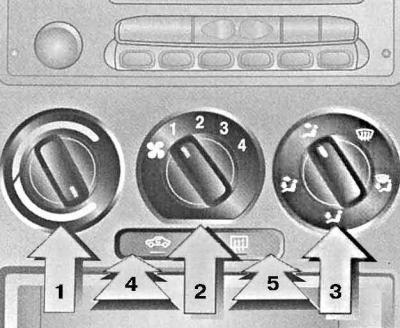
Control panel for the operation of heating and ventilation systems (models without K/V)
1 — Air temperature control handle
2 — Fan speed selection knob
3 — Air flow direction switching handle
4 — Closed air circulation mode switch
5 — Rear window heating switch
Air temperature control knob
Turning the handle clockwise increases the temperature of the air entering the vehicle interior.
Fan speed selection knob
Turning the handle clockwise increases the fan speed and, consequently, the intensity of air supply to the car interior. Moving the handle to the extreme left position
 causes the fan to turn off.
Closed circuit air circulation mode switch
This button is used to turn on the closed air circulation mode in the car. The button is equipped with a built-in control lamp. When the mode is turned on, the car's interior is isolated from the atmosphere and the flow of fresh air into it stops. The fan ensures air circulation in a closed circuit. When the button is pressed again, (the control lamp should go out), the supply of outside air to the cabin will resume.
When selecting the direction of air distribution for blowing the windshield (see below item Air distribution direction switching handle) the closed air circulation mode is switched off automatically in order to speed up the process of removing condensation from the glass.
Rear window defroster switch
The switch button is also equipped with a built-in control lamp that lights up when the heating is turned on. A timer is built into the circuit of the high-capacity heater to protect the battery from discharge, which automatically switches off the glass heating after 15 minutes of continuous operation.
Air distribution direction switching handle
General scheme of air flow distribution
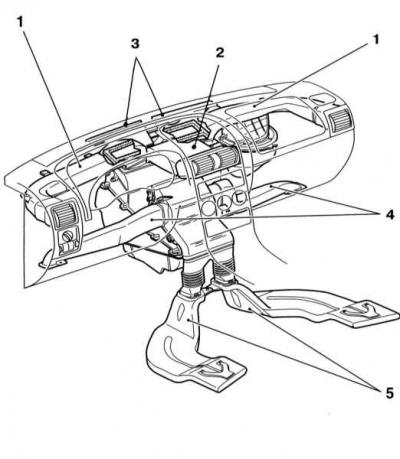
1 — Side air supply hoses to the front level/side window blowing
2 - Central air supply hose to the face level
3 — Nozzles for air supply hoses for blowing windshield
4 — Air supply hoses to the front footwells
5 — Air supply hoses to the rear footwells
Air distribution diagram
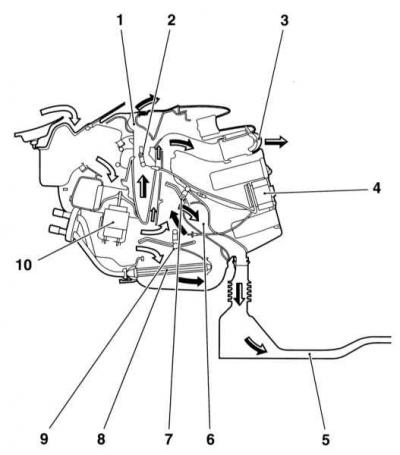
1 - On the windshield
2 — Distribution flap
3 - To the front level
4 — Control Panel
5 - Into the rear footwells
6 - Into the foot wells
7 — Distribution flap
8 — Heat exchanger
9 — Distribution flap
10 — Electric motor for heater fan drive
When supplying air to the front level, do not forget to open the deflectors.
The handle is designed to select the air distribution mode in the cabin.
Air is supplied through the side deflectors of the instrument panel in all modes. General air flow distribution diagram — see the illustrations General air flow distribution diagram and Air distribution diagram.
 Outside air is supplied to blow onto the windshield through nozzles mounted in the control panel at the top near the lower edge of the glass.
When selecting the air distribution direction for blowing the windshield (see above), the closed air circulation mode (if it was selected - see above item Closed air circulation mode switch) is switched off automatically in order to speed up the process of removing condensation from the glass.
 Outside air enters the passenger compartment simultaneously through the windshield defroster nozzles mounted in the control panel at the top near the lower edge of the glass, and through the lower ventilation openings of the footwells.
 Outside air is supplied only to the driver's and passenger's footwells.
 Outside air enters the cabin at the same time at the front level (through the central and side ventilation deflectors in the control panel), as well as through the lower ventilation openings, providing air supply to the driver and passenger footwells.
 Outside air enters the passenger compartment at the front level through the central and side instrument panel ventilation deflectors.
Control panel for the operation of the ventilation and heating systems of the passenger compartment (models with air conditioning system)
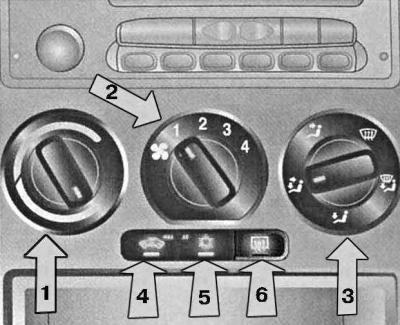
1 — Air temperature control handle
2 — Fan speed selection knob
3 — Air flow direction switching handle
4 — Closed air circulation mode switch
5 - Air conditioner switch
6 — Rear window heating switch
Air temperature control knob
See above Control panel for the operation of the ventilation and heating systems of the passenger compartment (models without air conditioning) — the relevant paragraph.
Fan speed selection knob
See above Control panel for the operation of the ventilation and heating systems of the passenger compartment (models without air conditioning) — the relevant paragraph.
Closed circuit air circulation mode switch
See above Control panel for the operation of the ventilation and heating systems of the passenger compartment (models without air conditioning) — the relevant paragraph.
Rear window defroster switch
See above Control panel for the operation of the ventilation and heating systems of the passenger compartment (models without air conditioning) — the relevant paragraph.
Air distribution direction switching handle
See above Control panel for the operation of the ventilation and heating systems of the passenger compartment (models without air conditioning) — the relevant paragraph.
Air conditioner switch
Using the button
 the K/V is switched on and off (selection of air cooling mode).In this case, the intensity of the blowing decreases, however, if desired, it can be increased. The button is equipped with a built-in control lamp.
Control of ventilation grille deflectors
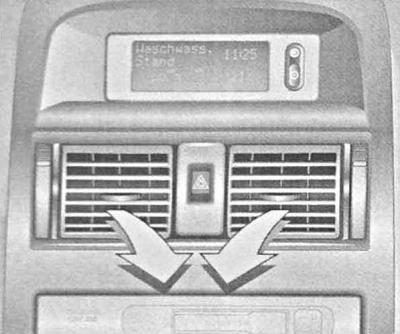
The deflectors of the central air ducts of the instrument panel nozzles are equipped with special louvered deflectors, allowing you to adjust the deviation of the supplied air flow in both horizontal and vertical planes. The deflectors are controlled using the ring handles located on the sides (0 = air supply is blocked) and levers built into the nozzle grille.
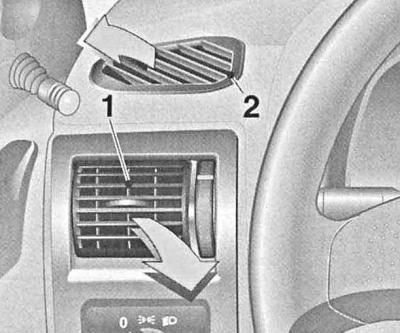
The deflectors of the side air duct nozzles of the instrument panel have a similar design (1), in addition, slightly higher are the non-adjustable nozzles for blowing the door windows (2).
Instructions for using ventilation, heating and air conditioning systems
Below are detailed instructions for operating heating, ventilation and air conditioning systems in various climatic conditions. The reader is provided with information on how to ensure effective ventilation, heating and cooling of the air in the car, as well as how to quickly remove condensation and frost from the glass.
All systems under consideration operate only when the engine is running. The engine coolant is used as the working fluid of the heater heat exchanger. If the engine is not warmed up to normal operating temperature, it will take several minutes before warm air starts to flow into the passenger compartment.
The operation of the air conditioning system is not dependent on the engine coolant temperature.
In the vast majority of cases, the best efficiency of systems providing a comfortable microclimate is achieved in the mode of supplying outside air to the passenger compartment. Long-term activation of the closed circulation mode, especially when the air conditioner is not working, leads to fogging of the windows and increased stuffiness of the air, so it is recommended to turn on this mode only if necessary and for a relatively short time, for example, when driving in an area with a smoky or polluted atmosphere. As soon as the need for insulation of the passenger compartment disappears, the supply of fresh air to the passenger compartment should be resumed.
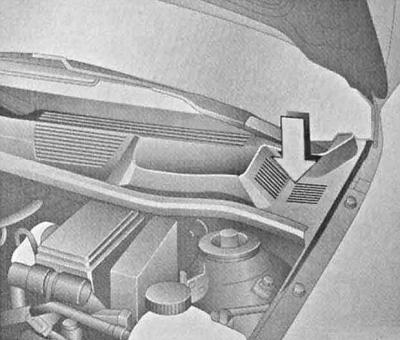
Outside air enters the heating and air conditioning systems through intake grilles located in front of the windshield and equipped with a fairing. Periodically clean the openings of the intake grille from leaves and other debris that impede the passage of air.
Car interior ventilation
The supply and exhaust ventilation system ensures a constant exchange of air in the car's interior. Fresh outside air, entering through the front intake grille, circulates through the interior and is then removed through the outlet openings located in the storage compartments of the luggage compartment.
1. Turn the air temperature control knob counterclockwise until it stops. Make sure the air conditioner is turned off.
2. Set the air flow direction selector handle to the position
 . The closed air circulation mode must be turned off.
3. Using the fan speed selection knob, set the required air flow rate into the vehicle interior.
Cooling the air in the car interior
The cooling mode can only be selected when the engine is running. At low outside temperatures, the cooling mode is automatically switched off.
The interior cooling is performed as follows:
1. Turn on the air conditioner by pressing the "A/C" button - the indicator light built into the switch should light up.
2. Check that the air temperature control knob is turned to the extreme left position.
3. Set the air flow direction selector handle to the position
 .
.
4. If the outside air humidity is high, turn on the closed circulation mode; if the humidity is low, turn on the fresh air intake mode.
5. Using the fan speed selection knob, set the required air flow rate into the passenger compartment.
If the car has been standing in the sun for a long time and the air inside the car has become very hot, quickly reduce the temperature inside the car as follows:
1. Start the engine.
2. Turn on the air conditioner (A/C button). Check that the air temperature control knob is turned to the extreme left position.
3. Using the fan speed selection knob, set the maximum intensity of air supply to the passenger compartment.
4. Partially open the windows and turn the air distribution direction switch handle to the position
 .
.
5. Turn on the closed circulation mode, after a while close the windows.
The operation of the air conditioning system increases the load on the vehicle's engine, so when driving with frequent stops and at low speeds in busy urban conditions, or when climbing long, steep hills, you should carefully monitor the coolant temperature gauge (see Instrument panel). When the pointer approaches the red range of the scale, temporarily turn off the air conditioner until the engine temperature returns to normal.
Heating the car interior
To raise the air temperature in the car, perform the following manipulations.
1. Start the engine.
2. Set the air distribution direction switching handle to the position
 . The closed air circulation mode must be turned off.
3. Using the fan speed selection knob, set the required intensity of air supply to the passenger compartment.
4. Turn the air temperature control knob in one direction or another to set the desired level of air heating.
Heating the interior while simultaneously dehumidifying the air using the air conditioner
When the air conditioning system is operating, the humidity in the car interior decreases, which allows the air in the car interior to be made warm and dry by turning on the heating and air conditioning systems simultaneously.
1. Turn on the fan.
2. Turn on the air conditioner.
3. Set the air distribution direction switching handle to the position
 . The air recirculation mode must be turned off.
4. Turn the air temperature control knob in one direction or another to set the desired degree of heating of the air entering the passenger compartment. In this mode, the cold air from the air conditioner mixes with the warm air from the heater.
The combined activation of the heating and air conditioning systems can be used in all driving conditions when the ambient temperature is above 0°C.
Removal condensation and frost from glass
You can clean the inner surfaces of the glass from condensed moisture as follows:
1. Turn on the fan.
2. If your vehicle is equipped with the appropriate equipment, turn on the air conditioner.
3. Set the air distribution direction switching handle to the position
 . The closed air circulation mode must be switched off. Some versions of the vehicle provide the ability to automatically switch on the fresh air supply mode and its conditioning by setting the air distribution direction switch handle to the position .
4. Turn the air temperature control knob to a position where warm air is supplied through the windshield defroster vents.
5. Turn on the rear window defroster to remove condensed moisture from the rear window surface more quickly. On some vehicle versions, if the air distribution direction selector handle is in any position other than
 , the air conditioner remains on. To turn off the air conditioner, press the A/C button.
To remove frost or ice from the outer surface of the windshield and side windows that has formed after parking the car outside in frosty weather, perform the following steps:
1. Turn on the ignition by turning the key in the lock to the "ON" (II) position.
2. Set the air distribution direction switching handle to the position
 . The closed air circulation mode must be switched off. Some versions of the vehicle provide the ability to automatically switch on the fresh air supply mode and air conditioning by setting the control handle for switching the distribution direction modes to the position .
3. Turn the air temperature control knob to the extreme right position (maximum air heating) and turn the fan to maximum speed.
4. Start the car engine.
To clear the windshield of frost or ice more quickly in very cold weather, it is recommended to first turn on the closed air circulation mode. Once the windshield is free of ice, resume the supply of fresh air to prevent fogging of the glass.
In the windshield blowing mode, all air supplied to the passenger compartment enters through the slot nozzles located on top of the instrument panel at the base of the windshield, as well as through the side ventilation deflectors of the instrument panel. The temperature of the air blowing on the glass and the speed of cleaning the glass increase as the engine warms up. To speed up the process of removing condensation, frost or ice from the windshield, you can close the side ventilation deflectors (position 0, — see above p. Control of ventilation grille deflectors). In this case, all the air will go exclusively to blowing the windshield.
For safety reasons, do not drive until all vehicle windows are clear of condensation and the driver has adequate visibility.
Turning off heating and ventilation systems
To temporarily turn off the heating and ventilation systems, turn the fan speed and air temperature control knobs to their extreme left positions.
The need to turn off the systems arises in the first few minutes after starting the engine in cold weather, as this ensures faster warming up of the engine to a temperature sufficient for the effective operation of the heater. In all other cases, to avoid stagnation of air in the cabin, keep the fan constantly on.
Climate control system
The climate control system may be included in the standard equipment of some models and performs the functions of automatic ventilation control, heating and air conditioning in the cabin. The heater and air conditioner ensure the maintenance of the set air temperature. In addition, the climate control system automatically selects the required fan speed mode and distributes air depending on the set temperature.
The direction of the air flow entering the passenger compartment from the central and side ventilation nozzles can be adjusted manually using the movable deflector grilles (see above p. Control of ventilation grille deflectors).
System operation in automatic mode
The design of the K/V control system allows for activation of the automatic mode when the engine is not running (during a forced long stop, for example, before a railway crossing). You should turn on the ignition and press the "AUTO" button - the set temperature level will appear on the display screen (adjustment can be made using the appropriate regulator). The duration of the climate control system operation with the engine off is limited. To forcefully disable the mode, press the "AUTO" button again.
Control panel for the operation of heating, ventilation and air conditioning systems on models equipped with climate control
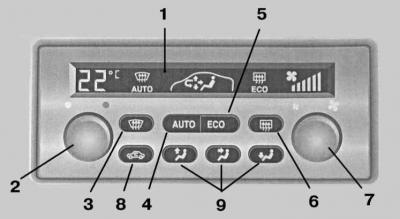
1 - LCD screen
2 — Air temperature control handle
3 — Button for turning on the condensate removal mode
4 — Automatic climate control system operation button
5 — Fuel economy mode activation button
6 — Button for turning on the heated rear window and outside rearview mirrors
7 — Fan/A/C switch control handle
8 — Closed air circulation mode selection switch
9 — Switches for selecting air distribution directions
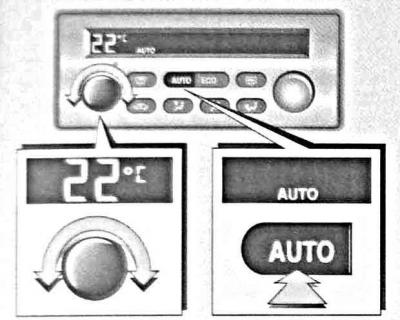
Switching the climate control system to automatic operation mode by pressing the "AUTO" button on the instrument panel. Turning the left control knob, set the desired air temperature. The display screen of the system should show the inscription "AUTO".
Text copied from an internet website: OPELBOOK.ru
The system automatically creates an optimal combination of air flows coming through the air conditioner and/or heater heat exchanger, ensuring the fastest possible heating or cooling of the air in the cabin to a set temperature; the operation of automatically launched control elements is accompanied by the display of corresponding symbolic images on the display screen.
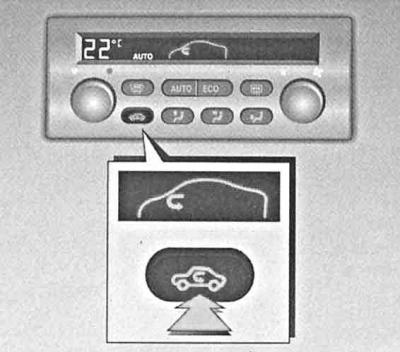
To quickly warm up or cool the air in the cabin, turn on the closed air circulation mode and turn the temperature control knob to one of the extreme positions (left or right) positions, — in this case the upper (32°C) or lower (18°C) limit of the regulated temperature is set. If the air temperature regulator is turned to one of the extreme positions, the system will operate in constant mode, without switching off, and heating/cooling the air with the maximum possible efficiency. In this case, the system does not control the current air temperature in the car. If the regulator handle is set to one of the intermediate positions, the system will automatically maintain the set air temperature in the car.
In cold weather, the fan turns on automatically only after the engine has been running for some time and the heater is ready to heat the air.
The climate control system is switched off by turning the fan control knob to the extreme left position - the display screen indication should go out.
The system should not be left switched off for any length of time. To avoid stagnant air in the cabin and the appearance of unpleasant odors, it is recommended to keep the fan on at all times.
Operation of the system in semi-automatic mode
It is possible to manually switch on any of the climate control system functions when the latter operates in automatic mode. At the same time, automatic control of all other system functions is maintained. Pressing any of the control buttons switches the system to semi-automatic mode - the control lamp built into the "AUTO" button and the corresponding inscription on the display should go out.
In order to minimize fuel consumption, it is possible to force the cooling/drying modes to be switched off by pressing the "ECO" button - the display screen will show the corresponding message. Returning to the air conditioning mode is done by pressing the button again (the corresponding indicator should go out).
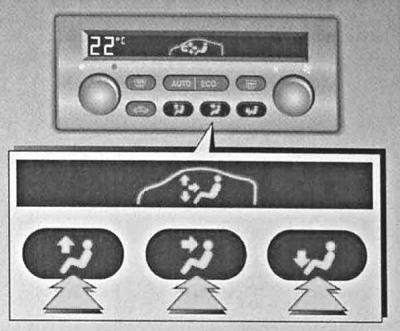
The activation of the condensation/ice removal modes from the glass and the selection of the air distribution direction are performed using the corresponding buttons on the control panel of the system (see illustration Control panel for the operation of heating, ventilation and air conditioning systems on models equipped with climate control). Symbolic images of the corresponding content will be displayed on the display screen.
The selection of the required air flow directions is carried out by using three control buttons in combination.
The left rotary knob on the instrument panel is used to set the required temperature mode, the right knob allows you to select the speed mode of the heater fan, as well as turn off the air conditioning system.
Features of the climate control system operation with the convertible top open on Convertible models
Opening the convertible top automatically switches off the air conditioning system, making it impossible to use the following modes:
1. Automatic climate control;
2. Closed air circulation;
3. Removing condensation and ice from glass;
4. Rear window heating.
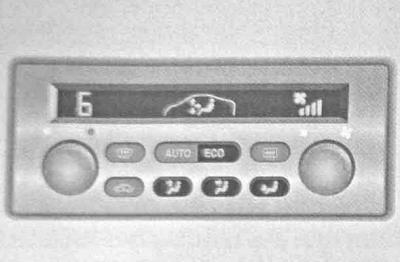
All other controls will continue to function, and the temperature will be adjusted in steps from zero to tenth level.
Solar radiation and air temperature sensors
The climate control system includes two information sensors: a solar radiation sensor installed on top of the instrument panel, between the slotted windshield blower nozzles, and an air temperature sensor located next to the steering wheel. Try not to place any objects on top of the sensors and do not allow any liquids to come into contact with them.
Visitor comments