


Contents: Adjusting the position of the…⬇ Seat adjustment ⬇ Luggage compartment ⬇ Cigarette lighter/on-board power…⬇ Main storage compartment ⬇ Sun visors ⬇ Interior rear view mirror ⬇
Adjusting the position of the steering column
Adjustment of the steering column position should only be carried out when the vehicle is stationary!
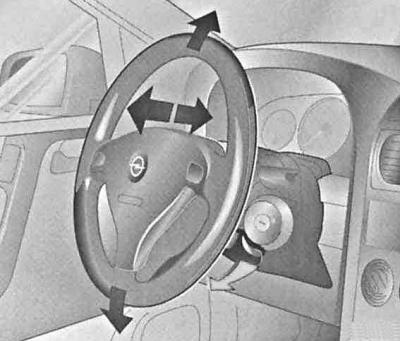
The steering column position lock release lever is located on the bottom side of the latter's casing.
1. Insert the key into the ignition switch and release the steering column lock.
2. Pull the lock release lever down, move the steering wheel to a comfortable position, then lock the column again by returning the lever to the upper position.
Seat adjustment
Front seats
Adjustment of the seat position should only be carried out when the vehicle is stationary!
1. In the section Elements of vehicle safety systems provides important information on safety issues and the correct adjustment of the seats, their backs and headrests - adjust the seat position accordingly before starting to drive.
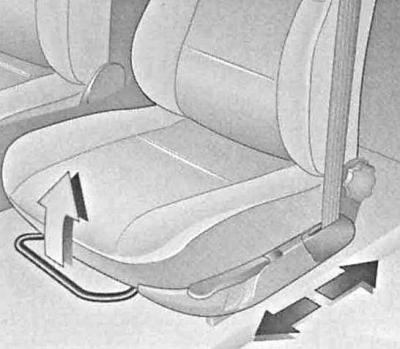
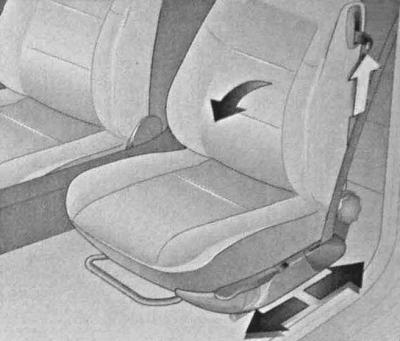
2. To adjust the seat position in the longitudinal direction, pull up the locking bracket located under the front edge of the cushion. While holding the bracket in the raised position, slide the seat assembly forward or backward to a comfortable position, then release the locking bracket. To check that the seat is securely locked, try moving it forward and backward.
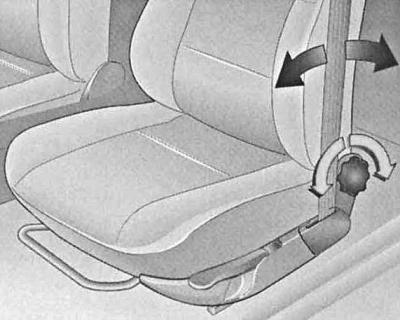
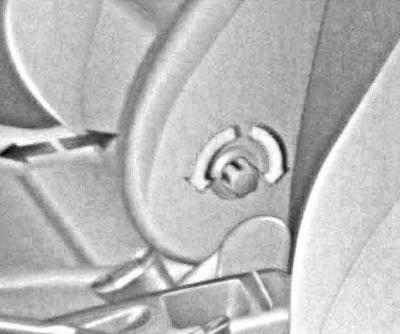
3. The seat back angle is adjusted using the rotary handle located on the outer side surface of the back.
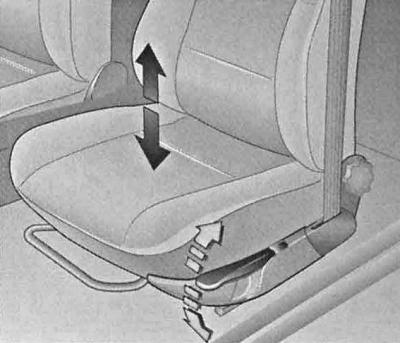
4. The seat cushion height adjustment lever is located on the outer front corner of the cushion. Pulling the lever up raises the cushion, pushing it down lowers it.
5. On some models, the design of the driver's seat back also allows for adjustment of the lumbar portion. The adjustment is carried out using a rotating handle located on the side surface of the seat back, with the inner (coupe, Convertible and 3-door Hatchback models), or from the outside (sedan, 5-door Hatchback and Station Wagon models) his side.
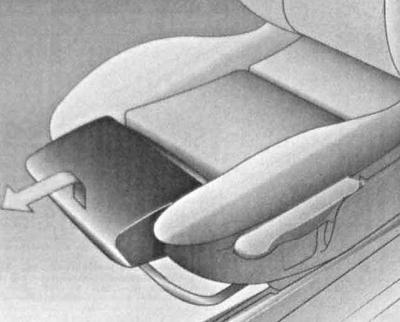
6. Some models are equipped with seats with the ability to adjust the position of the thigh support - lift the front section of the cushion and move it forward.
7. The backrest lock release lever, which allows the backrest to be folded, is located at the top of the outer wall of the backrest. To fold the backrest, pull the lever up.
Headrests
Head restraints help prevent neck and head injuries in a rear-end collision. In order for head restraints to effectively perform their protective functions, they must be adjusted properly. Adjust the height of the head restraints so that the top of the head restraint cushion is level with the top of the ear. If tall passengers cannot achieve this, the head restraint should be set to the highest position.
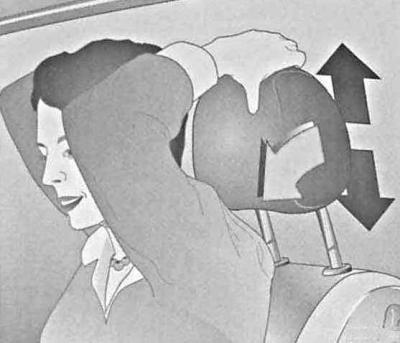
Some vehicle models have the option of adjusting the height of the head restraints. The head restraint position must be adjusted with both hands at the same time, so do not attempt to adjust the head restraint while the vehicle is moving. To raise the head restraint, tilt it forward to release the lock, then pull it up/down.
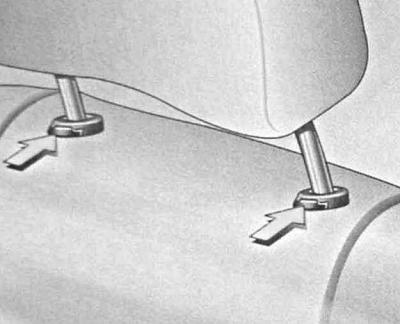
To remove the headrest for cleaning or replacement, do the following: lift the headrest up to the stop, then press the locking buttons and release the fastening rods from the seat back.
Back seat
Rear seat center armrest
On some models, the rear seat is equipped with a central armrest. The armrest is located in the central part of the seat and is folded out by removing it from the niche in the backrest and lowering it to a horizontal position.
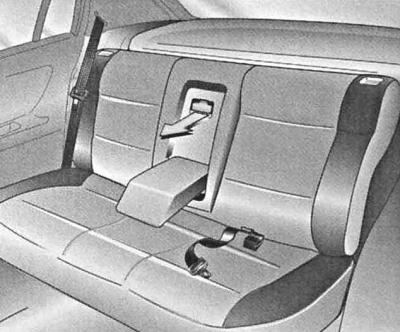
On the Hatchback, Sedan and Coupe models, a cover equipped with a locking handle is located under the armrest, which, when lowered, allows small, long items to be transported in the luggage compartment (for example, skis).
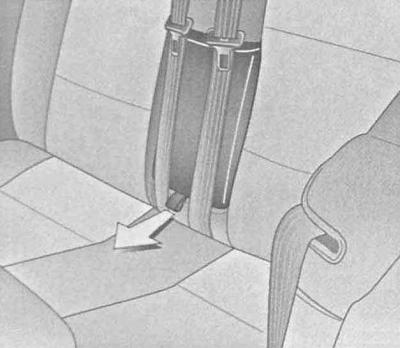
The technology for expanding the luggage compartment volume for transporting small, long items on Convertible models is somewhat different from that described above. Here, the armrest is attached to the seat back by means of a belt equipped with a holder. The armrest is moved to a horizontal position by pulling it out using a specially provided loop.
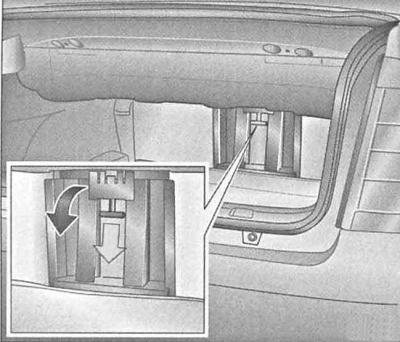
To completely remove the armrest, release the retaining strap holder, then pull the latch handle down from inside the luggage compartment and lower the lid. When closing the lid, lift it up and snap the latch into place.
Folding the rear seat backs
The rear seat back is a split design and consists of two parts that can be folded forward, providing direct access to the luggage compartment and allowing the transportation of large, long items.
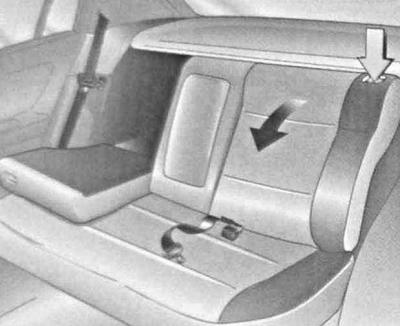
Each of the two sections of the rear seat back can be folded forward independently of the other. The release buttons for the seat backs are located on the outer sides of their upper edges.
1. To fix the seat back in the vertical position, press it firmly against the rear storage shelf until the locks click into place - do not forget to release the seat belts from under the back first. Make sure that the back is securely fixed in the vertical position by pulling it towards you by the upper edge.
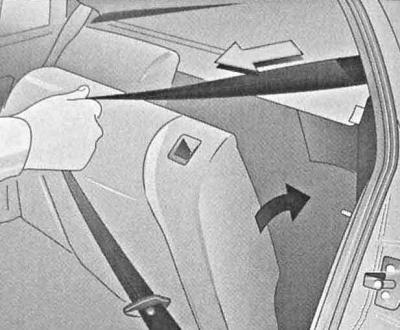
2. Make sure that the rear seat belts are in their normal positions when the seatbacks are raised.
3. Make sure that all items located in the luggage compartment and protruding into the passenger compartment are securely fastened. Remember that sudden braking may cause unsafely fastened cargo to shift.
4. Avoid operating the vehicle with the rear seatbacks folded down and the trunk lid open to prevent toxic carbon monoxide (CO) exhaust gases from entering the vehicle interior.
Headrests
On Convertible models, it is not possible to adjust or remove the rear seat head restraints.
The rear seat is equipped with three head restraints, the left and right of which are of standard design (see above p. Seat adjustment — Headrests). The middle headrest is compact in design and has two fixed working positions.
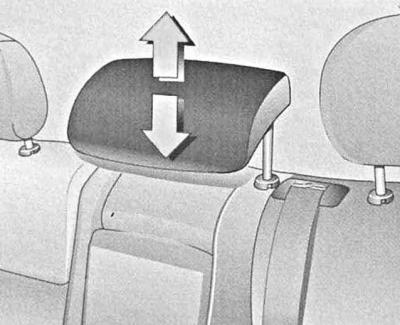
When folding the seats (see below), or to expand the rear view (with the center rear seat unoccupied) the central headrest should be lowered to its lowest position, after first releasing the spring clamps of its rods.
Folding the seat
The rear seat is folded to maximize the expansion of the vehicle's luggage compartment when transporting large or multi-seat cargo.
1. Remove the side head restraints, lower the center head restraint to its lowest position.
2. Raise the armrest.
2. Pull the special loops to fold the rear seat cushions into a vertical position; if equipped, secure the seat belt buckles in the special fasteners on the seat backs, then release the upper fasteners and lower the seat backs.
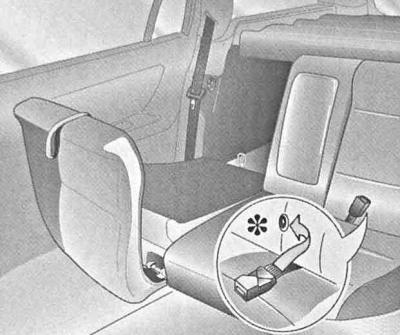
3. When assembling the seat, do not forget to release the seat belt straps from under the raised backrests.
Luggage compartment
Removable rear shelf/folding cover (hatchback and Station Wagon models)
Removable rear shelves (folding luggage compartment covers) on Hatchback and Station Wagon models are not designed for transporting heavy objects.
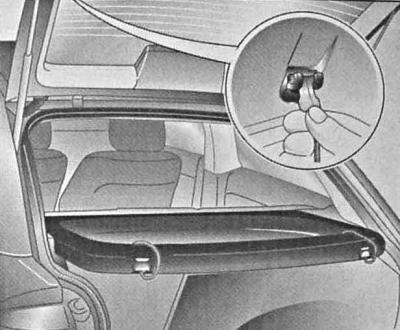
To remove the removable rear shelf on Hatchback models, remove the drive straps from the hooks on the tailgate, then release the shelf from the guides and remove it. Installation is done in the reverse order.
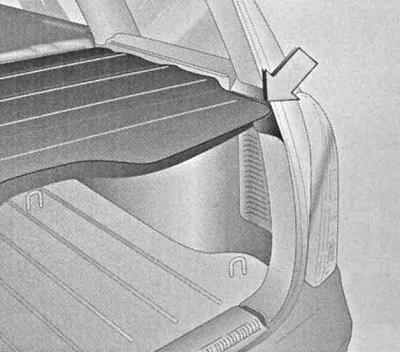
On station wagon models, the luggage compartment is covered at the top by a folding cover that is secured with two corner holders.
1. To provide access to the luggage compartment, the cover is released from the clamps and moved forward (to the back of the rear seat).
2. To remove the casing, fold it, then, while folded, pull it back in the guide grooves and, overcoming the resistance of the springs, release it from the holders.
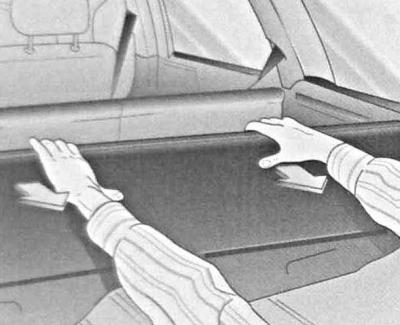
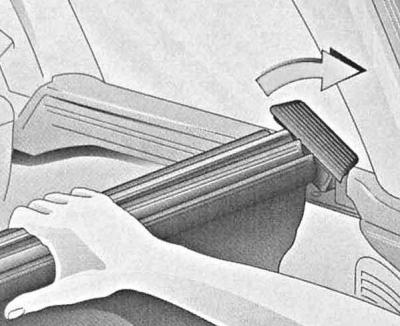
3. The curtain is installed in the reverse order.
Storage boxes
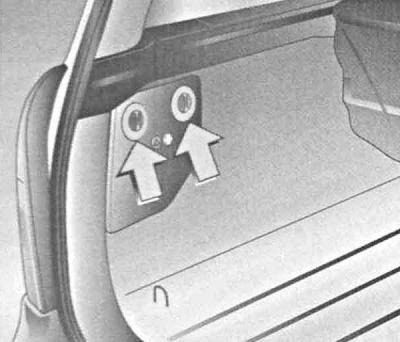
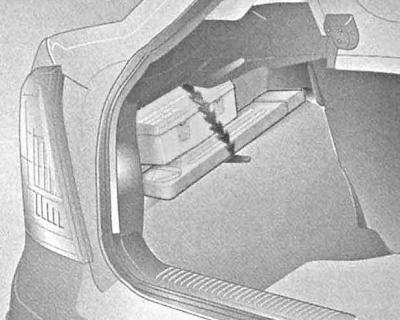
The upholstery of the left wall of the luggage compartment has a cover equipped with rotary fasteners, after removal of which access is opened to the glove compartment, designed for storing such mandatory elements of any car as a first aid kit and an emergency stop sign.
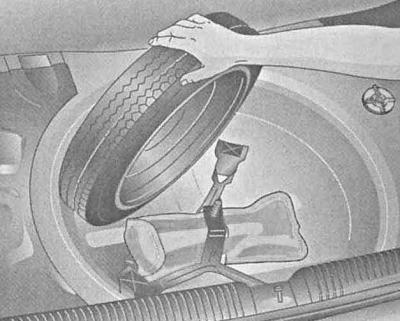
Under the luggage compartment floor covering there is a well for storing a spare wheel, wheel brace and jack.
Eyelets for attaching a safety net
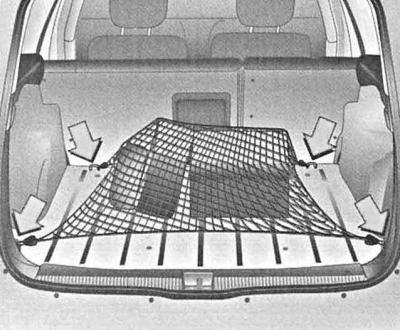
The corners of the luggage compartment floor panel are equipped with metal eyelets that allow the attachment of a safety net designed to secure the cargo being transported.
The same eyes on the Universal models are also used to secure the protective grille (see below).
Protective grille (models Universal)
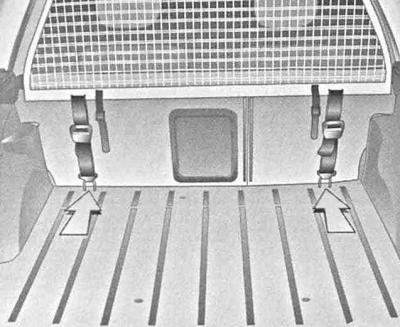
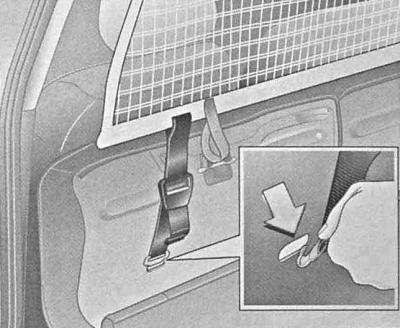
The protective grille can be mounted behind the back of the rear seat, or (with the rear seat folded down), - behind the backs of the front seat.
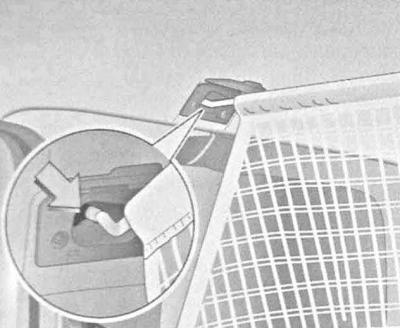
The roof frame also has two pairs of mounting holes into which the lattice anchor rods are inserted.
Cigarette lighter/on-board power socket
Cigarette lighter
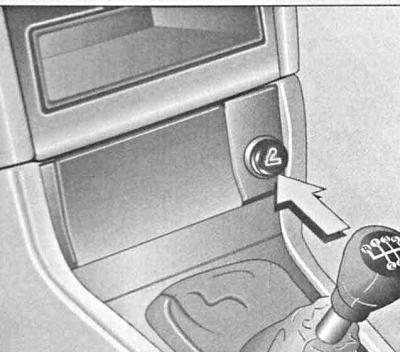
The cigarette lighter is located in the front section of the central console of the car and functions only in two positions of the key in the ignition switch: "ACC" (I) or "ON" (II), i.e., when the ignition or power supply of auxiliary power consumers is on. To turn on the cigarette lighter, press its button until it clicks. After the coil is heated, the button will automatically return to its original position with a click.
To avoid damage to the cigarette lighter, do not hold its button while the coil is heating!
The socket for installing a cigarette lighter also functions as an on-board power outlet, into which any auxiliary car accessories can be connected (compressor, vacuum cleaner, mobile phone charger, etc.). To gain access to the socket, remove the cigarette lighter from the socket.
The power consumption of devices connected to the on-board power supply must not exceed 50 W at a supply voltage of 12 V.
Ashtrays
Use ashtrays only for their intended purpose! To avoid fire, do not put scraps of paper, candy wrappers or other flammable materials in ashtrays. Ignition of debris in ashtrays may cause damage to your car.
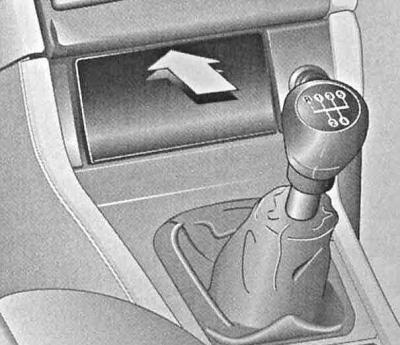
The front ashtray is integrated into a single assembly with the cigarette lighter. To open the ashtray, press the top edge of its lid.
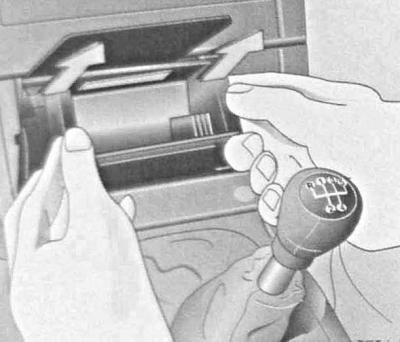
To empty the ashtray of cigarette butts, open the ashtray lid and, pulling it upward, remove the receiving container from its seat by pulling it towards you.
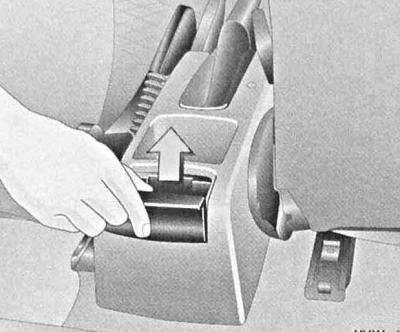
The rear ashtray is built into the rear of the center console. To open the ashtray, flip up its lid. To empty the ashtray of cigarette butts, open it, then pull up and remove the container from its slot in the console.
Main storage compartment
The glove compartment is located on the right side of the car's dashboard and is equipped with a hinged lid. Opening the compartment with the ignition on automatically activates its backlight.
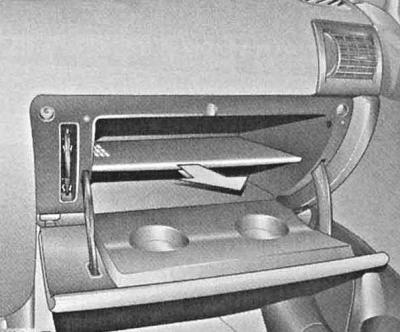
Inside the drawer there is a removable intermediate shelf, placed on the guide strips and secured by means of clamps installed on the back wall of the drawer. On the left under the hinged lid of the drawer there is a panel with a clamp for attaching a pen (see ibid).
On the inside of the glove compartment lid, which can be folded horizontally, there are two recesses for fixing glasses.
Sun visors
Two sun visors are mounted on the left and right above the windshield in the car's interior. The visors can be lowered and turned sideways, providing protection for the driver's and front passenger's eyes from direct sunlight, both frontally and laterally.
Interior rear view mirror
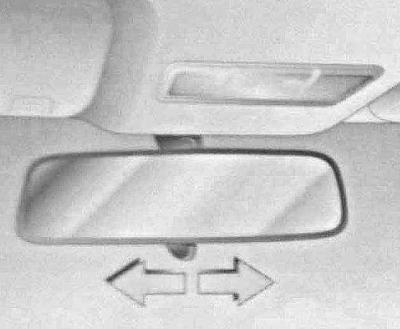
The base of the internal rearview mirror is glued to the inner surface of the windshield, from above in its central part. In the lower part of the mirror assembly there is a lever that allows switching the reflective surface to night mode, which provides protection for the driver's eyes from being blinded by the light of vehicles moving behind in the same direction.
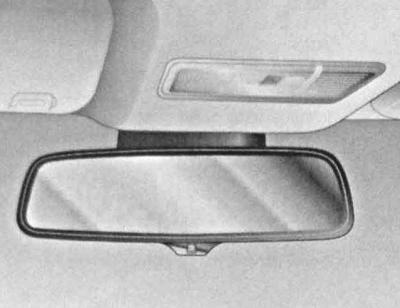
Some models are equipped with a mirror with an automatic night mode switch. The mirror dimming is deactivated when the ignition is turned off, reverse gear is engaged and the interior lighting is on.
Heated front seats
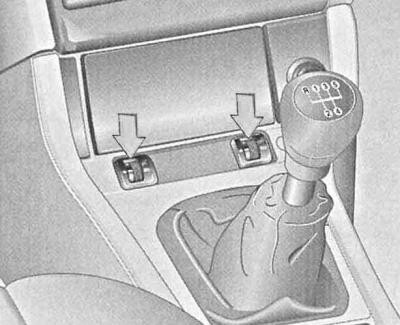
The controls for switching on and operating the front seat heating are located in the front part of the centre console under the ashtray assembly and are marked with a pictogram
 . Next to the controls there are control lamps that notify the operator about the activation of the heating mode of the corresponding seat.
The heating is switched off by moving the regulator to the position "–".
Visitor comments