


Contents: Replacing the air filter element ⬇ Replacing the fuel filter ⬇ Checking the oil level in the manual…⬇ Checking the oil level in the…⬇ Checking the front suspension and…⬇ Checking the shock absorber ⬇ Checking the drive shaft protective…⬇
Replacing the air filter element
The air filter is located in the front right corner of the engine compartment.
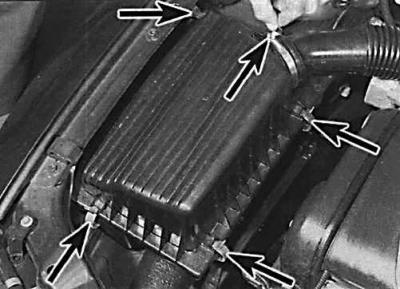
1. Detach the mounting brackets (indicated by arrows) and lift the air filter cover enough to remove the filter element.
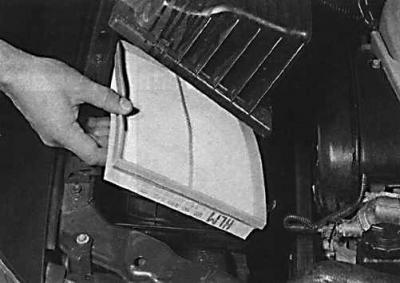
2. Remove the filter element.
3. Wipe the inside of the air cleaner housing and cover. Install the new filter so that the rubber seal on the filter element is on top.
Replacing the fuel filter
1. The fuel filter is located under the rear of the vehicle and is secured to the fuel tank with a special strap.
2. Depressurize the fuel system.
3. Raise the rear of the vehicle and support it on stands.
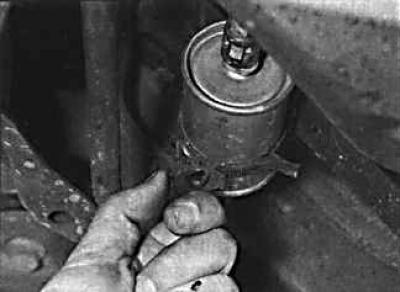
4. Release the retaining clip holding the filter. Before removing the filter, pay attention to the arrow on the filter housing indicating the direction of fuel flow.
5. Place a suitable container under the fuel filter to catch any spilled fuel.
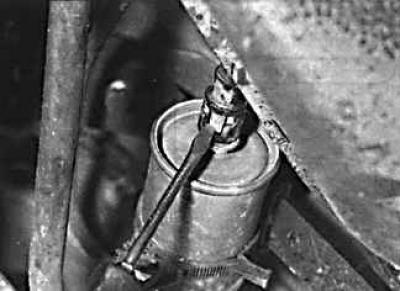
6. Loosen the hose clamps.
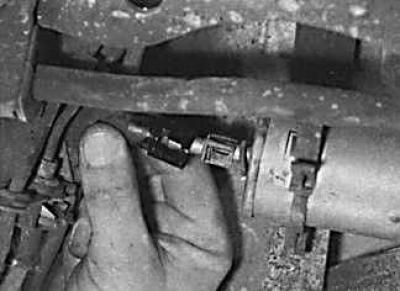
7. Remove the fuel hoses from the fuel filter.
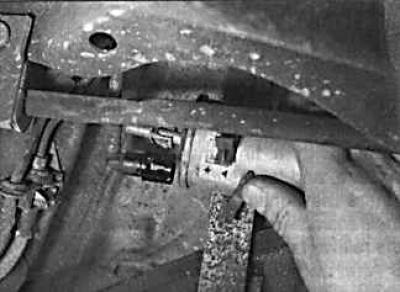
8. Remove the fuel filter from under the vehicle.
9. The fuel filter is installed in the reverse order of removal, taking into account the following points:
- check that the arrow on the fuel filter points correctly to the direction of fuel flow;
- check that the fuel hoses are properly connected to the fuel filter;
- start the engine and check the fuel system for leaks.
Checking the oil level in the manual transmission
1. Place the car horizontally over the inspection pit. Check the oil level no earlier than 5 minutes after stopping the engine.
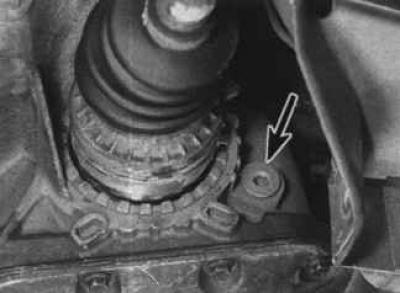
2. Clean the area around the transmission oil level plug. On 1.6L models, the oil level plug is located on the left side of the transmission behind the drive shaft (indicated by the arrow)On 1.8L and 2.0L models, the level plug is located on the right front side of the transmission behind the drive shaft. Unscrew the plug and clean it.
3. The oil level should reach the lower edge of the oil level plug hole.
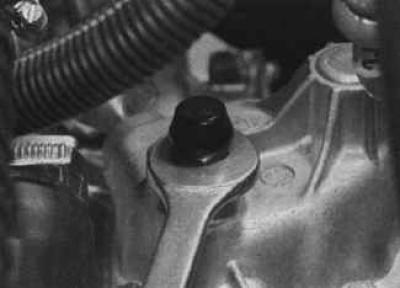
4. If it is necessary to add oil to the gearbox, unscrew the breather from the top of the gearbox housing.
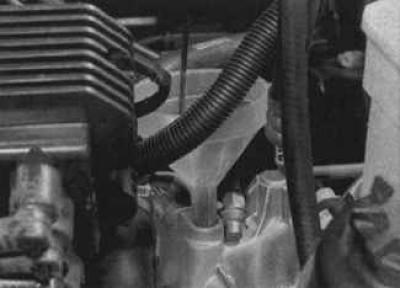
5. Add the required oil through the breather hole until oil begins to flow out of the oil level plug hole.
6. Tighten the gearbox oil level check plug to the specified torque.
7. Install the breather on the top of the transmission.
Checking the oil level in the automatic transmission
Location of oil level marks depending on engine temperature
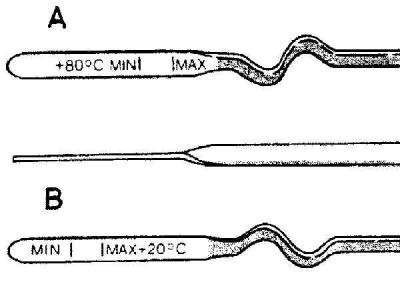
A - hot gearbox marks
B – cold gearbox marks
1. Place the car on a level surface and apply the handbrake. The oil level is checked using the dipstick, which is located on the top of the gearbox and is visible between the battery and the engine.
2. Run the engine at idle speed for two minutes with the selector lever in position P.
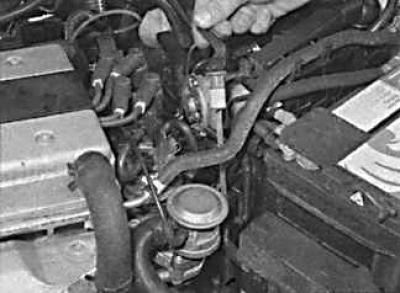
3. With the engine idling, remove the transmission oil dipstick, wipe it clean and reinstall it, then remove it again.
4. The oil level on the end of the dipstick should be between the max and min marks. If the gearbox oil is cold, use the side of the dipstick marked 20°C. If the gearbox oil is hot, use the side of the dipstick marked +80°C (see Fig. Location of oil level marks depending on engine temperature).
5. If the oil level is low, add oil through the dipstick hole.
6. Take a test drive and check the transmission fluid level again.
7. Always keep the oil level between the two marks on the dipstick. Insufficient oil can cause serious damage to the gearbox.
8. If there is a need to frequently top up the oil, then there is a leak that needs to be found and fixed before it leads to serious consequences.
Checking the front suspension and steering
Raise the front of the vehicle and support it securely on stands.
Visually inspect the ball joint dust boots and rack and pinion steering gear boots for cracks, wear, and aging. Any wear on these boots will result in loss of lubricant and entry of water and dirt, resulting in rapid wear of the ball joints or steering gear.
Check the power steering hoses for wear or deterioration, and the pipes and hose connections for leaks. Also check the steering gear boots for signs of pressure leakage, which indicates damage to the steering seal.
Checking the hub bearing for wear
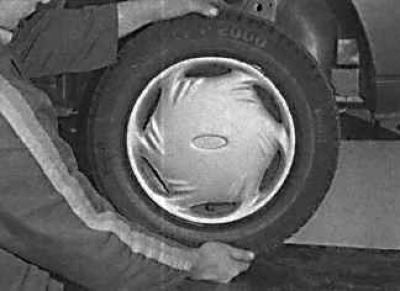
Raise the car with a jack, grab the wheel with your hands at the 6 and 12 o'clock positions and try to rock it in a vertical plane.
A very small amount of play in the wheel is acceptable, but if the play is significant, further inspection is necessary to determine the source. Continue pumping the wheel while an assistant applies the foot brake. If the play is eliminated or significantly reduced, the hub bearings are likely damaged. If play is still significant with the brake applied, there is wear in the linkage and suspension mount.
Now take the wheel at the 9 and 3 o'clock positions and try to rock it horizontally. The presence of play in the horizontal plane can be caused by wear of the hub bearing or the ball joints of the steering rod. If the outer or inner ball joint is worn, the play will be obvious.
Using a large screwdriver as a lever, check for wear in the suspension mount bushings between the suspension component and the point of attachment. Some movement should be visible since the mount bushings are made of rubber, but excessive wear should be evident. Also check the condition of any visible portions of the rubber bushings for cracks, wear, and deformation.
Checking the shock absorber
Check the shock absorber for any signs of fluid leaks. If a leak is found, the shock absorber is damaged and needs to be replaced.
Warning! Shock absorbers must be replaced in pairs on the same axle.
The effectiveness of the shock absorber is also checked by pressing on the corner of the body and releasing it sharply. The body should return to its original position after releasing it. If the body rises above the original position and continues to swing, then the shock absorber located on this side is probably out of order and must be replaced. Also check the shock absorber mount for wear.
Checking the drive shaft protective cover
Raise and secure the vehicle securely on stands. Turn the steering wheel all the way to the right or left and spin the wheel.
Checking the constant velocity joint protective boot
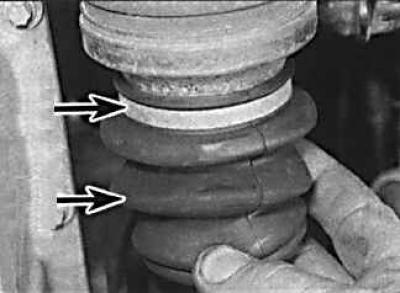
Inspect the rubber protective covers of equal angular velocity hinges, squeezing them to open the folds. Check them for cracks that can lead to grease leaks, as well as water and dirt getting inside.
Also check the condition of the fastening clamps, inspect the inner hinge covers and the covers on the other side. If any damage is found, the protective cover must be replaced immediately.
At the same time, check the general condition of the constant velocity joints by holding the shaft and trying to turn the wheel. Try again by holding the inner constant velocity joint and turning the shaft. Any noticeable play indicates wear in the joint, wear in the shaft grooves, or looseness of the shaft lock nut.
Visitor comments