


Contents: Oil and oil filter change ⬇ Checking and replacing the auxiliary…⬇ Checking the front brake pads and…⬇ Checking the rear brake pads and…⬇ Checking the tightness of the hoses…⬇ Replacing the pollen filter of the…⬇
Oil and oil filter change
Periodic oil and oil filter changes are the most important preventative maintenance procedures. As motor oil ages, it becomes thin and contaminated, leading to premature engine wear.
Before starting this procedure, gather all the necessary tools and materials together. It is necessary that the engine is warm so that the oil flows better along with the bulk of the contaminants.
1. Apply the handbrake and raise the front of the car.
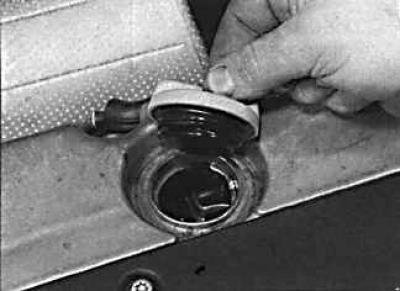
2. Remove the plug from the oil filler neck.
3. Loosen the drain plug about half a turn. Place a container to collect the oil under the drain plug and unscrew the plug completely. If necessary, apply pressure to the plug while unscrewing to prevent premature oil leakage. Remove the O-ring from the oil drain plug.
4. Once the oil has drained completely, wipe off any debris around the drain hole with a rag and screw the plug back on securely.
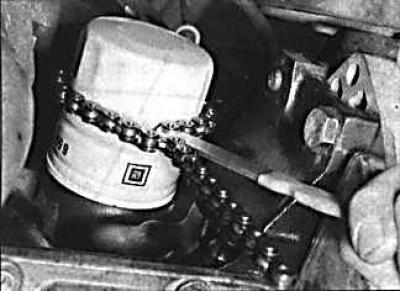
5. Use a special tool to loosen the filter, then unscrew it by hand.
6. Wipe away all traces of oil and dirt around the filter mounting area. Check to see if there is any rubber seal left on the cylinder block. If there is, remove it.
7. Apply a thin layer of engine oil to the rubber seal of the new oil filter and screw the filter on by hand without using any tools.
8. Fill the engine with oil using the correct grade of oil. Fill half the required amount of oil and wait a few minutes for the oil to drain into the pan. Then continue pouring oil in small portions until the oil level reaches the minimum level on the dipstick. Adding about another liter of oil will raise the oil level to the maximum on the dipstick. Close the filler cap.
9. Start the engine and let it run for a few minutes. Check for oil leaks around the filter and the drain plug on the pan. Note that the oil pressure warning light may stay on for a few seconds as the oil fills all the passages and oil reservoirs in the engine.
10. Turn off the engine and wait a few minutes for the oil to drain into the pan. Check the oil level and top up if necessary.
Checking and replacing the auxiliary drive belt
Examination
1. With the engine off, inspect the drive belt along its entire length. Check the accessory belt pulleys for nicks, cracks, deformation, and corrosion.
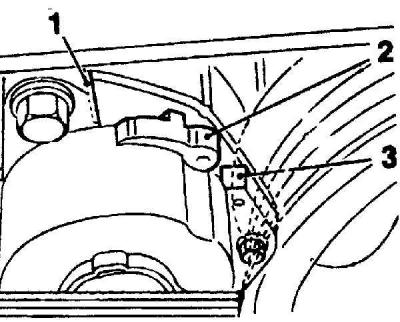
2 – drive belt tension mechanism lever indicator
2. Check the position of the drive belt tensioner assembly lever. The lever should be between the stops (1) and (3) on the support plate and move freely.
3. If the drive belt is worn or damaged or the tensioner lever is positioned against the stop, the drive belt must be replaced.
Replacement
1. Remove the air filter housing.
2. On models with air conditioning, remove the right front powertrain mount.
3. Before removing the drive belt, mark its position on the pulleys. If the belt is to be reinstalled, mark its direction of rotation.
4. Using a wrench, move the tensioner lever away from the drive belt to release the drive belt tension and remove the belt from the pulleys.
5. Install a new drive belt.
6. Check that the belt is correctly positioned on all pulleys and slowly release the belt tensioner.
7. On models with air conditioning, install the powertrain support.
8. On all models, install the air cleaner housing.
Checking the front brake pads and brake disc
1. Apply the handbrake, raise the front of the car and secure it on stands. Remove the front wheels.
2. Check the brake pad thickness through the inspection hole in the front of the caliper.
3. If the brake shoe lining is worn to the minimum thickness, all four brake shoes must be replaced as a set.
4. Install the wheels and lower the vehicle.
Checking the rear brake pads and brake disc
1. Raise the rear of the car and secure it on stands. Remove the rear wheels.
2. Inspection of the brake pads can be performed through the inspection hole in the rear caliper.
3. If the brake lining is worn down to the minimum thickness, all brake pads in the set must be replaced.
4. Install the wheels and lower the vehicle.
Checking the tightness of the hoses and fluid leakage
Cooling system leaks are usually detected by a white or rust-colored coating in the area adjacent to the leak.
Fuel leaks are difficult to pinpoint until the leak is significant and therefore easily visible. Fuel tends to evaporate quickly once it comes into contact with air, especially in a hot engine bay. Small droplets may disappear before you can pinpoint the leak. If you suspect a fuel leak in the engine bay area, then cool the engine and run it while it is cold with the hood open. Metal objects tend to shrink when cold, and rubber hoses tend to loosen, so any leaks will be more obvious as the engine warms up from starting and being cold.
If there are signs that there is a leak of some kind of fluid, but you cannot identify the type of fluid or the exact source, then you should leave the car for a long time and put a large piece of paper or rag under the car. This will help to find the place of the leak and also help to identify the leaking fluid by color. But keep in mind that some leaks may only appear when the engine is running.
A leak in the vacuum hose means that air is being sucked into the hose (but it doesn't come out of the hose), and this makes the leak very difficult to detect. The detection method is to use an old vacuum hose as a kind of stethoscope. Hold one end of the hose close to your ear (but not in the ear), and use the other end to probe the area around the suspected leak. When the end of the hose is directly over the leak, a hissing sound will be clearly audible through the hose. Avoid contact with hot or moving parts, as the engine must be running when checking.
Replacing the pollen filter of the ventilation system
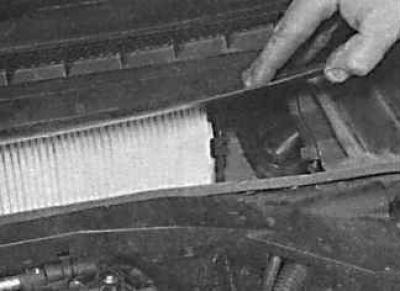
1. Open the hood and pull the rubber seal off the lug at the rear of the engine compartment.
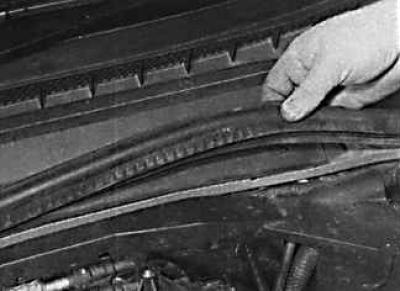
2. To access the pollen filter, remove the water deflector.
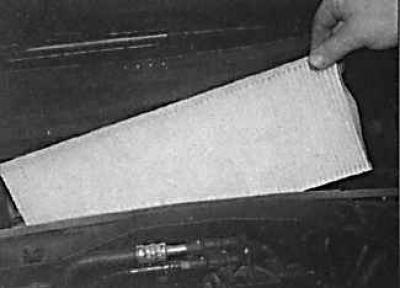
3. Release the bracket on both sides and lift up the pollen filter.
4. Install the new pollen filter in the reverse order of removal.
Visitor comments